III · THE WORK · ART HISTORY
Nok Terracotta Sculpture
▶ Listen · narrated
The Nok terracottas survived two thousand years underground. They did not survive being dug up by people who were looking for something else and had no reason to write down where things were.
At a glance
- Culture
- Nok
- Date
- c. 1500 BC–1 AD
- Material
- Terracotta
- Region
- Southern Kaduna State, Nigeria
Look closer
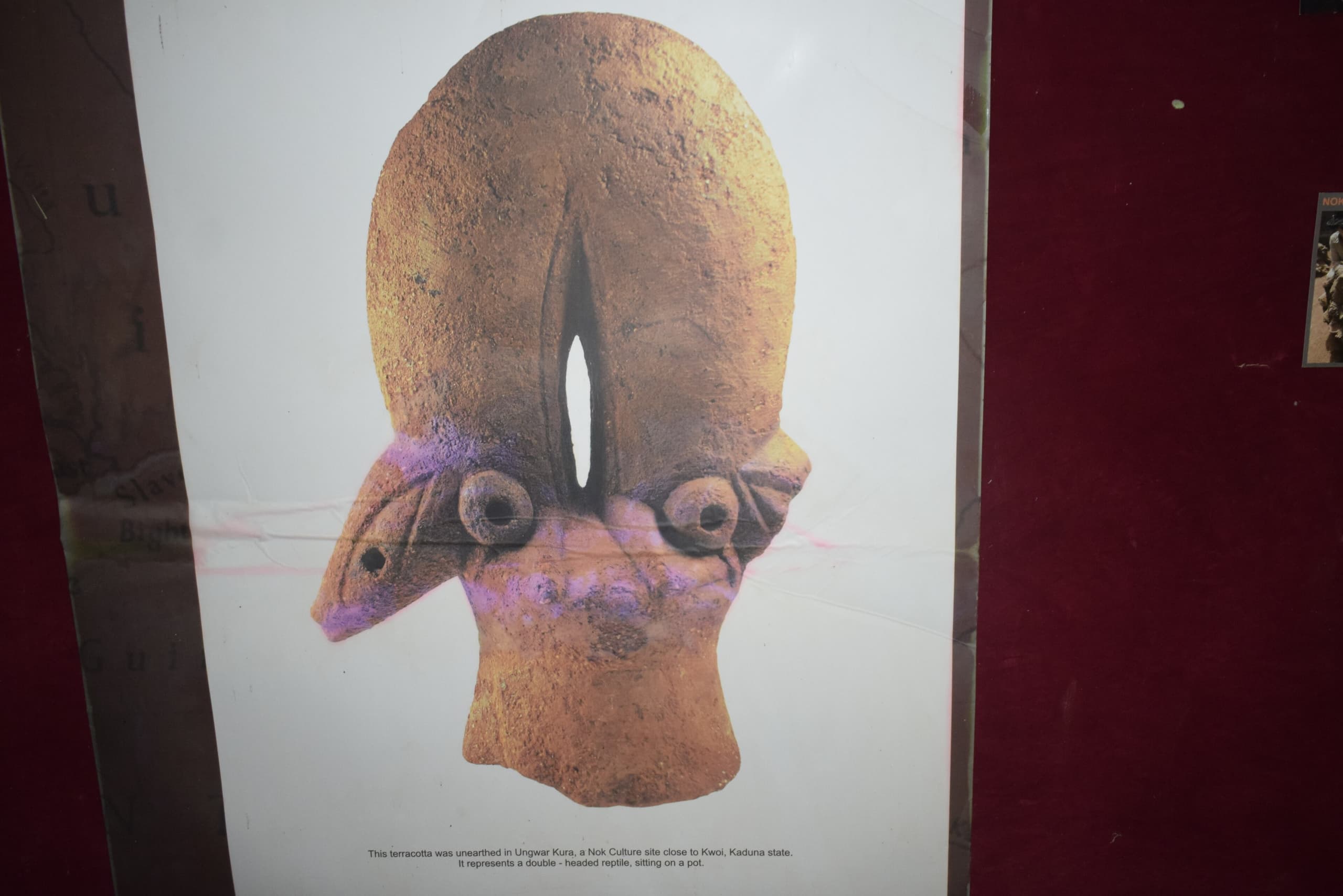
Triangular eyes with drilled pupils
The eyes are carved as triangles, sometimes equilateral, sometimes elongated. The pupils are circular holes drilled straight through the clay. This is not stylisation for its own sake: the piercing serves a structural purpose during firing, allowing moisture and heat to escape from the thick clay of the head. The triangle may have begun as a practical shape that could be cut cleanly and then became a convention, or it may have had a meaning we cannot now recover. Either way, it is the most consistent feature across the figures.
Elaborate coiffure carved in relief
Many of the heads carry detailed hairstyles: braids, buns, crests, rows of small spheres arranged in patterns. The hair is built up in relief or carved into the surface, and in some cases the elaboration suggests hours of work on a part of the figure that would be seen only from certain angles. The care taken over these details indicates that the figures were meant to be looked at closely, and that the hairstyles may have signified something — status, age, role — that mattered to the people who made and used them.
Perforated nostrils and ears, needed for firing
The nostrils are drilled through, as are the ears in many examples. Like the pupils, these perforations are functional: terracotta this thick, fired in an open pit rather than a kiln, will crack or explode if steam cannot escape from inside the clay. The holes are small and placed where they will not compromise the structure. The result is a figure that breathes, literally, and whose features are determined as much by the demands of the material as by the intentions of the sculptor.
The story
The Nok terracottas are named after a village in southern Kaduna State, in what is now Nigeria, where an example was found in 1928. That find was made by tin miners, and so were most of the others. The miners were working alluvial deposits — river sediment rich in cassiterite, the ore of tin — and they dug through the layers with no reason to care what else was in them. When a terracotta head or fragment came up in the spoil, it was sometimes kept, sometimes photographed, sometimes discarded. What was almost never recorded was where in the ground it had been, what else was near it, or which layer of sediment it came from. The archaeology was destroyed in the act of discovery.
This matters because context is how you date an object and understand what it was for. A head buried alone means one thing; a head buried with grave goods, or with evidence of a fire, or in a layer of midden waste, means another. The sediment itself can be dated, and so can organic material found alongside the terracotta — charcoal, seeds, bone — but only if you know which sediment, and only if you kept the charcoal. The miners kept almost nothing, and wrote down less. By the time archaeologists began systematic excavation in the region, decades later, the richest sites had been worked over and the stratigraphy — the layering of the ground that records sequence and association — was gone.
What survives is a collection of objects with thin provenances. Some have been dated by thermoluminescence, a technique that measures when the clay was last fired, and those dates cluster between 900 BC and 200 BC, with some earlier and some later. The culture itself may have begun around 1500 BC and persisted until the first century AD, but the uncertainty is wide and the evidence is not evenly distributed. Most of what we have are heads, which were either made more often than full figures or survived better. The figures that do exist show people holding bows, sitting in canoes, wearing jewellery, processing plants. One wears what may be a seashell on its head. These are records of activities, but without the context of the burial or the settlement, we do not know whether they are portraits, representations of roles, grave goods for specific people, or objects made for another purpose entirely.
The terracottas were made by coiling clay and then modelling the surface. The firing was done in open pits, not kilns, which means the temperature was lower and less controlled than in a kiln-fired ceramic. The perforations — in the eyes, nostrils, ears, and sometimes the mouth — are structural: they let steam out during firing and prevent the thick clay from cracking. The style is consistent enough across time and space to suggest a shared tradition, but the figures vary in scale, detail and skill. Some are life-sized; others are fragments of larger compositions. The tradition of making them seems to have been sustained over centuries, which implies both continuity of technique and continuity of purpose, whatever that purpose was.
The people who made these figures may have migrated into the region from the Central Sahara, possibly bringing pottery and pearl millet with them, or they may have come from the West African Sahel. The evidence for this is not conclusive. What is clearer is that they worked iron, and that iron-working in the region may have developed independently between 750 BC and 550 BC, though this too is debated. The terracottas themselves are not made of iron, but they were made by people who had access to it, and some of the figures carry tools or weapons that would have been iron in life. The relationship between the terracotta tradition and the development of metallurgy is another thing the missing archaeology might have clarified.
Why it mattered then
The terracottas were part of a funerary culture. They were made to be buried, or to accompany burials, and the effort invested in them — the modelling, the perforation, the firing, the decoration — suggests that the rituals around death were elaborate and that the figures played a role in them. Whether they represented the dead, accompanied the dead, or stood in for something else is not settled, but the care taken over details like hairstyles and ornaments indicates that these were not generic objects. They were made for particular purposes, perhaps for particular people, and they were made to last. The scale of production implies that this was not the work of a single sculptor or a single site. Terracotta figures have been found across a wide area of southern Kaduna State, and the consistency of style suggests a shared set of conventions and possibly a network of exchange or training. The figures may have been made by specialists, and if the depiction of a dugout canoe is reliable, those specialists may have been part of a regional trade network that moved goods along tributaries of the Niger River. The seashell on one figure's head, if that is what it is, suggests contact with the Atlantic coast, though how direct that contact was is not known. The terracottas were made by people who had time, skill and resources to invest in objects that would be seen briefly and then buried. That investment tells us something about how those people understood death and memory, even if we cannot reconstruct the specifics. The figures were meant to do something — to mark a grave, to honour a person, to placate or accompany a spirit — and whatever that something was, it mattered enough to sustain the tradition for centuries.
Why it matters now
The Nok terracottas are evidence of a complex society in West Africa at a time when the material record for the region is otherwise sparse. They show that people in this part of the continent were making large-scale figurative sculpture in clay by 900 BC, and that they were doing so with technical skill and stylistic consistency. The figures are not crude or experimental; they are the work of a mature tradition, which means the tradition itself must have begun earlier than the surviving examples. What we have is the middle of a story, not the beginning, and the beginning is lost. The destruction of the archaeology is a case study in what happens when economic extraction and cultural heritage meet without regulation. The tin miners were not vandals; they were doing their jobs, and they had no framework for understanding what they were digging through. By the time that framework existed, the damage was done. The terracottas that survive are in museums and private collections, and they are studied and admired, but they are also orphans: objects without context, beautiful and mute. Every head is a question we can no longer answer, because the ground that held the answer was sluiced away and sold as tin. The figures have also shaped how later West African sculpture is understood. The tradition of working clay into large figurative forms continued in the region for centuries, and the Nok terracottas are part of that continuum, though the exact nature of the influence is difficult to trace. What is clear is that the people who made these figures were not working in isolation, and that the tradition they belonged to was neither static nor simple. The terracottas are a reminder that the history of art in Africa does not begin with colonialism or with the objects that made it to European collections. It begins with people making things for their own reasons, in their own time, and leaving behind just enough evidence to make us wish we had more.
The surprising detail
The figures were fired in open pits, not kilns, which means the temperature never exceeded about 800 degrees Celsius — hot enough to harden the clay, but not hot enough to vitrify it. This makes the terracotta porous and relatively fragile, and it also means the firing process was visible and communal. An open pit fire large enough to harden a life-sized head would have burned for hours, and it would have been an event: something you could see from a distance, something that involved multiple people to build and tend. The firing was not a private or hidden act. It was part of the process, and it may have been part of the ritual.
What is disputed
The dating of the Nok culture is based on thermoluminescence testing of some terracottas and radiocarbon dating of associated organic material where context was preserved, but most figures were found by tin miners with no record of stratigraphic position. The span of 1500 BC to 1 AD is proposed but remains uncertain. Whether iron-working developed independently in the region, and whether the terracottas were made for funerary purposes specifically, are both debated. The interpretation of particular motifs — such as the seashell — as evidence of trade networks is plausible but not confirmed.
Remember this
The Nok terracottas survived two millennia underground. They did not survive being dug up by people looking for tin, who had no way to know what they were destroying.
Test yourself
Why does the loss of archaeological context matter more for the Nok terracottas than it would for, say, a collection of coins found in the same way?
Because coins carry information on their surfaces — inscriptions, dates, images of rulers, mint marks — that allow them to be dated, attributed and understood even when they are pulled out of the ground with no record of where they were or what was near them. The terracottas carry almost none of that. They have no inscriptions, no dates, no signatures. What they meant, when they were made, who they represented, and what rituals they were part of can only be inferred from where they were found, what they were found with, and how they were deposited. Strip that away and you are left with an object whose age can be estimated by thermoluminescence and whose style can be compared to other examples, but whose purpose and significance remain speculative. The context is not supplementary evidence; it is most of the evidence. Without it, each terracotta is a fragment of a sentence in a language we no longer speak.
Go deeper
Image: Friday musa, CC BY-SA 4.0. Licence: CC BY-SA 4.0. Source.