I · THE OBJECT · BRITISH MUSEUM
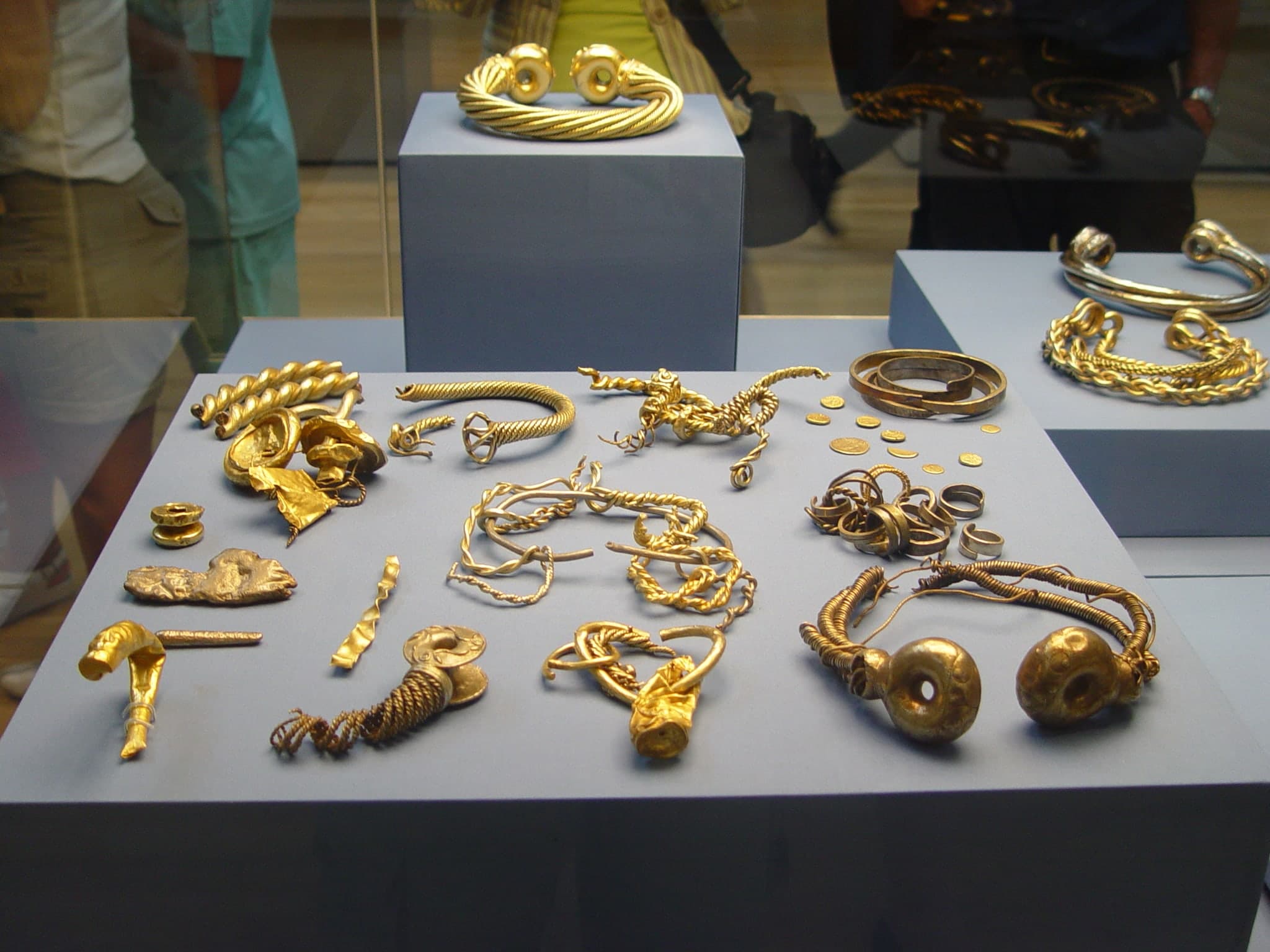
The Great Torc from Snettisham
▶ Listen · narrated
Someone twisted gold into rope, cast the terminals on, and buried it. Then someone else did it again. And again. What kind of society buries this much wealth?
At a glance
- Discovery
- Multiple finds between 1948 and 1992
- Location
- Snettisham, Norfolk
- Period
- Iron Age
- Type
- Hoard of precious metal objects
Look closer
Twisted, not cast
The rope effect is real rope-making. The goldsmith took eight separate strands of metal wire and twisted them together in pairs, then twisted the pairs again to make a thick cable. The technique is the same one used for plant fibre cordage, translated into metal. The terminals — the ring-and-clasp fittings at each end — were cast onto the twisted body afterwards, locking the strands in place and giving the torc its structural integrity.
Gold alloy, not pure gold
The metal is not pure gold but an alloy — gold mixed with silver and copper. The proportions vary between objects in the hoard, which suggests different sources of metal or different intentions about colour and hardness. Alloying changes the working properties: it makes the metal harder and less likely to deform under its own weight, which matters when you are making something this heavy that will be worn or handled.
Buried, not lost
The objects were not dropped or hidden in haste. They were placed in pits, sometimes in groups, sometimes wrapped or contained in organic materials that have since decayed. The care taken in deposition suggests intention: these were buried on purpose, not lost by accident. Whether that purpose was ritual, safekeeping, or something else is not recorded.
The story
The Snettisham discoveries are not a single find but a series of them, spread across decades. Objects appeared in 1948, then more in the decades that followed, with the final recorded find in 1992. Each time, precious metal objects — torcs, bracelets, coins, scrap metal — turned up in the same area of Norfolk farmland, sometimes during ploughing, sometimes during more systematic investigation.
The repetition is the puzzle. One burial might be chance or emergency. Multiple finds, across the same few fields over forty-four years, is a pattern. Someone chose this place, repeatedly, over what may have been generations, to put valuable objects into the ground and leave them there.
The torcs themselves are engineered. The body of a torc is made by twisting metal strands together under tension, the same principle as making rope from plant fibre. The goldsmith starts with eight wires, twists them in pairs, then twists the pairs together again to make a thick cable. The twist is tight enough that the strands grip each other and the whole structure holds its shape. Then come the terminals: the ring-and-clasp fittings at each end, cast separately and attached to the twisted body while the metal is still workable. Once the terminals are on, they lock the strands in place. The torc becomes a rigid object, not a flexible one.
The metal itself is an alloy. Gold, silver, and copper, mixed in proportions that vary from object to object. Alloying is not adulteration but technique: pure gold is soft and deforms easily, especially in an object this heavy. Adding silver and copper makes the metal harder, changes its colour, and alters how it responds to heat and hammering. Different alloys suggest different sources of raw material, or different choices about how the finished object should look and behave.
The weight is considerable. A torc of this type, if it matches others in the hoard, represents a kilogram or more of metal. That is not an ornament you forget you are wearing. It is a statement, and a heavy one.
What is not recorded is why any of this went into the ground. The objects were not lost: they were placed in pits, sometimes in groups, sometimes with care. But whether the burial was ritual offering, safekeeping during conflict, or something else entirely, the ground does not say. The repetition suggests the place mattered, but the reason it mattered is not preserved.
Why it mattered then
Gold in this quantity is not personal wealth in the way a coin purse is personal wealth. It is stored value on a scale that implies social structures capable of accumulating, working, and — this is the striking part — removing that value from circulation. Burying a kilogram of gold is not hoarding in the sense of hiding money under the mattress. It is taking resources out of the world of exchange and putting them somewhere else, for reasons the deposit itself does not explain. The Iceni, the people who lived in this part of Britain during the Iron Age, left no written accounts of what gold meant to them or what burying it accomplished. The objects themselves are the record. They show technical skill: the ability to draw wire, control twist, cast terminals, and alloy metals to specification. They show access to raw materials, either through trade or through control of sources. And they show a society that made these objects, used them for some purpose, and then put them in the ground and left them there. The repetition matters. One burial might be an emergency, a crisis deposit never retrieved. Multiple burials, over time, in the same place, suggest something else: a practice, a location that held significance, a reason to keep coming back. Whether that reason was religious, political, or economic, it was strong enough to override the obvious alternative, which was to keep the gold.
Why it matters now
The Snettisham deposits are evidence of a society we cannot interview. The people who made these objects and buried them left no written explanations, no labels, no accompanying texts. What we have is the physical record: the objects themselves, their location, the care taken in their deposit, and the fact that the practice continued over time. That makes the hoard a problem in interpretation. We can describe what is there — the alloy composition, the manufacturing technique, the weight, the burial context — but the why is inference. Different scholars have proposed different answers: ritual deposition, votive offering, wealth storage, boundary markers, status display removed from circulation. The evidence does not settle the question, which means the question stays open. What the hoard does settle is the technical question. These objects show what Iron Age metalworkers could do when they had access to materials and the time to work them. The twist is even, the terminals are precisely cast, the alloy is consistent within each object. That level of control does not happen by accident. It happens when someone knows what they are doing and has done it before. The broader question — what kind of society buries this much wealth, repeatedly, and leaves it there — remains unanswered. The ground holds the objects but not the reasons. That silence is part of the record too.
The surprising detail
The finds kept coming for forty-four years. Objects appeared in 1948, then more precious metal came out of the ground in the same area in 1992 and in the years between. Each time, torcs, bracelets, coins, and scrap turned up in roughly the same Norfolk fields. The repetition suggests either that the original deposits were much larger than any single find revealed, or that the place itself mattered enough that people kept coming back to bury things there over a long period. Either way, the pattern implies intention, not accident.
What is disputed
The dates of the original deposits are not known with precision. The objects are Iron Age, but the Iron Age in Britain spans several centuries, and the hoard contains objects that may not all be contemporary with each other. The finds came out of the ground over decades, often during agricultural work, which means the original archaeological context — how the objects were arranged, what else was with them, whether they were deposited at the same time or in separate events — is incomplete. Some finds were investigated systematically, others were not. That limits what can be said confidently about the sequence and purpose of the deposits.
Remember this
A kilogram of gold, twisted into rope, buried in a field — and then it happened again. The objects are evidence of skill. The repetition is evidence of purpose.
Test yourself
Why would alloying gold with silver and copper be a practical choice for an object like this, rather than a way to stretch limited gold supplies?
Pure gold is soft. An object weighing a kilogram or more, made of pure gold, would deform under its own weight and under the stresses of being worn or handled. Adding silver and copper makes the alloy harder and more resistant to deformation, which is a structural advantage, not a cost-saving measure. The alloy also changes colour and working properties — it can be drawn into finer wire, holds detail better in casting, and takes a different finish. For an object this heavy that needs to keep its shape, alloying is engineering, not economy.
Go deeper
Image: Portable Antiquities Scheme from London, England, CC BY 2.0. Licence: CC BY 2.0. Source.