III · THE WORK · ART HISTORY
Giotto's Scrovegni Chapel Frescoes
▶ Listen · narrated
In a small chapel completed around 1305, figures occupy space the way bodies do, and turn away from us the way people do. That matters because painting had not worked that way.
At a glance
- Artist
- Giotto
- Completed
- around 1305
- Medium
- Fresco cycle
- Location
- Padua, Italy
- Dimensions
- 18.5 metres high, 8.5 metres wide
Look closer
Mourners with their backs to us, anchoring the space
In the Lamentation scene, several figures kneel with their backs turned toward the viewer. Their shoulders curve, their heads bow, their robes gather and fold over bodies that occupy three-dimensional space. They are not labelled, not individualised, and they do not need to be: their postures communicate grief without requiring you to see a face. By turning them away, Giotto places you in the scene rather than outside it, as though you are standing in the room where this is happening.
Angels contorted with grief in the sky
Above the earthbound mourners, angels twist and writhe in the air. Their bodies bend, their arms fling outward, their faces contort. The grief is not serene or hieratic — it is physical, violent, uncontrolled. Each angel moves differently, and the variety itself registers as emotional chaos. The sky is not a flat gold background but a space these figures occupy and move through, and their anguish is legible in the shapes their bodies make.
Drapery describing a solid body beneath
The robes do not float or hang in decorative folds. They cling, they pull, they bunch where a knee presses forward or an arm bends. The fabric responds to the body underneath it, mapping its volume and movement. When a figure kneels, the cloth gathers at the knees. When an arm lifts, the sleeve pulls taut. This is not ornamental drapery; it is cloth behaving as cloth does when wrapped around a form that has weight and takes up space.
The story
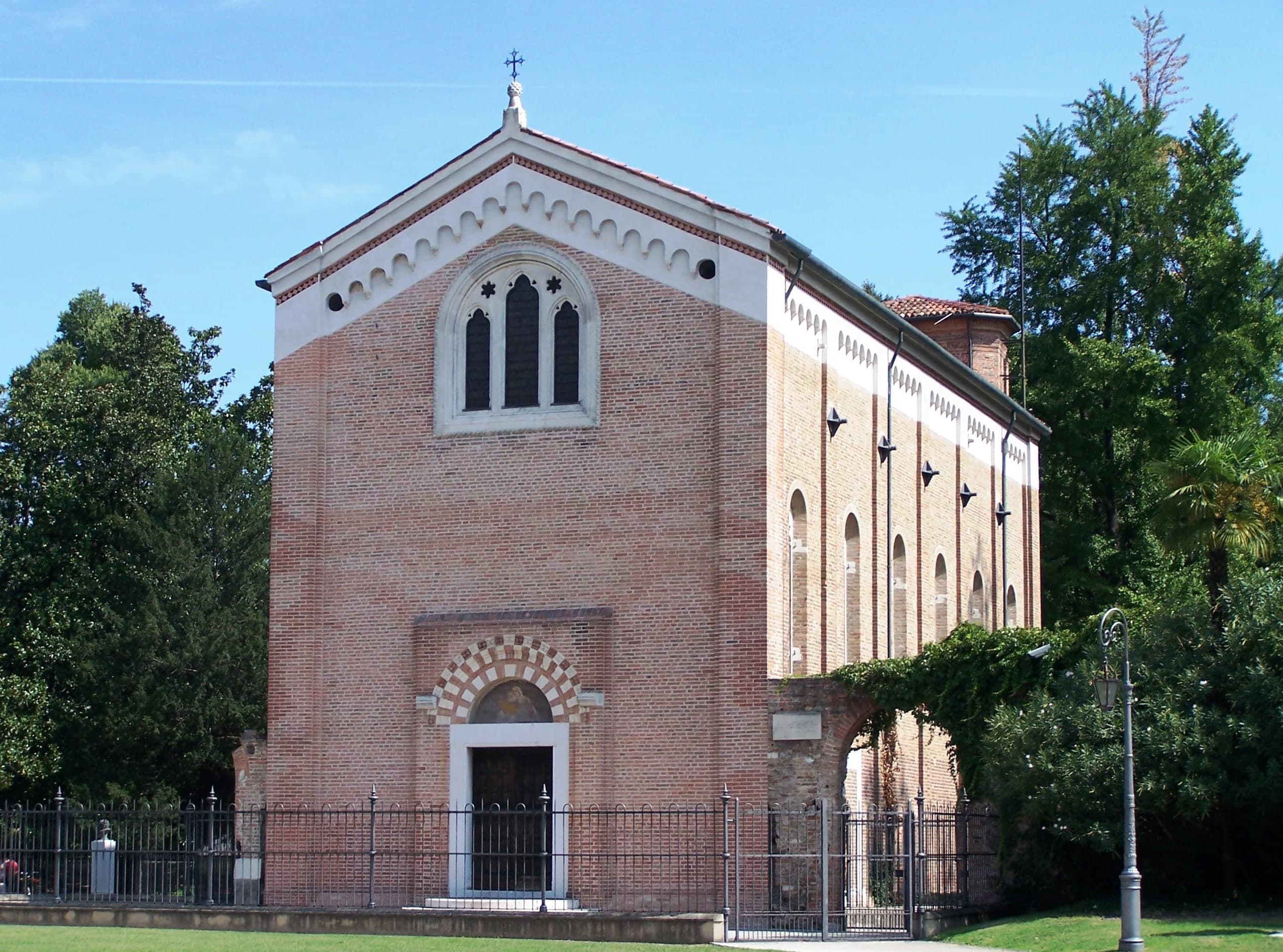
The Scrovegni Chapel is a small church in Padua, adjacent to the Augustinian monastery called the Monastero degli Eremitani. It is now part of the civic museum complex. The interior is covered with frescoes — paintings made by applying pigment to wet plaster — completed by Giotto around 1305. The cycle tells stories from the lives of the Virgin and Christ across the walls and ceiling.
What distinguishes these frescoes is not their subject matter, which was conventional, but the way the figures are painted. They have mass. They stand on ground that recedes into space. They turn, they kneel, they embrace, and when they do, their bodies move the way bodies move: shoulders shift, robes pull tight, weight transfers from one foot to another. This sounds unremarkable now because it became the standard method for painting people. It was not the standard method in 1305.
The Lamentation is the scene most often singled out, and the reason is visible in its construction. Christ's body lies on the ground in the foreground, surrounded by mourners. Several of those mourners have their backs to the viewer. You see their bent spines, their bowed heads, the way their robes gather and fold over their kneeling forms. They are placed between you and the central event, which means you are not looking at a picture of grief arranged for your inspection — you are standing in a space where grief is occurring, and some of the grieving figures are closer to you than the body they mourn.
This compositional choice does two things at once. It makes the space coherent: the figures are not floating on a gold background but standing and kneeling on a ground plane that extends from the front of the picture to the back. And it makes the emotion immediate: the grief is not symbolised by a gesture or a halo but performed by bodies in postures you recognise, because they are the postures grief produces in the people around you.
Above the earthbound mourners, angels twist and writhe in the sky. Their bodies contort, their arms fling wide, their faces distort with anguish. The grief is not contained or hieratic. It is physical, chaotic, uncontrolled. Each angel moves differently, and that variety itself registers as emotional turbulence. The sky is not a flat backdrop but a space these figures occupy, and their anguish is legible in the shapes their bodies make.
The drapery throughout the cycle behaves as cloth does when wrapped around a three-dimensional form. It clings where a body presses forward, gathers where a joint bends, pulls taut where an arm lifts. The folds are not decorative or arbitrary. They map the volume and movement of the body underneath. This is a small technical observation with large consequences: if the cloth describes the body, then the body must be conceived as a solid form occupying space, not as a flat shape decorated with lines.
The chapel is 18.5 metres high and 8.5 metres wide. The frescoes cover the walls and ceiling in a continuous cycle. You enter a room that is, in its entirety, a painted narrative, and the figures in that narrative are standing in the same kind of space you are standing in.
Why it mattered then
Around 1305, the dominant mode for painting religious figures was not naturalistic. Bodies were elongated, stylised, often placed against flat gold backgrounds. Space was indicated by hierarchy and symbol rather than by perspective or volume. Gestures were conventional — a raised hand meant blessing, a particular tilt of the head meant sorrow — and the meaning was carried by the gesture's recognisability, not by the body's physical plausibility. Giotto's frescoes in the Scrovegni Chapel did not abandon that symbolic language, but they embedded it in a different kind of picture. The figures still have halos, the scenes still follow scriptural narrative, the gestures still carry conventional meanings. But the figures also have weight, the space recedes, and the gestures are performed by bodies that bend and shift as bodies do. A viewer in 1305 would have recognised the subject matter immediately, but the method of depiction was not what they were accustomed to seeing on a church wall. The chapel was commissioned by a private patron and attached to a monastery. It was not a public building in the way a cathedral was, but it was accessible, and the frescoes were seen. What made them matter in their own moment was not that they were revolutionary in an abstract sense, but that they demonstrated a technique other painters could learn from and adapt. The figures' solidity, the spatial coherence, the way emotion was made legible through posture rather than symbol alone — these were methods that could be studied, copied, modified. The chapel became a reference point because the frescoes were there to be looked at, and because what they did was teachable.
Why it matters now
The Scrovegni Chapel is now part of Padua's civic museum complex, and it was declared part of a UNESCO World Heritage Site in 2021, grouped with other fresco cycles from the same period in the city. It is a destination, carefully managed: entry is timed, climate-controlled, limited. You book in advance, you wait in an acclimatisation chamber, you are admitted in small groups for a fixed interval. The frescoes are fragile, and the measures are preservation measures, but they also shape the experience. You are not wandering into a church. You are visiting a protected object. What still matters about the frescoes is the same thing that mattered in 1305: they show a way of painting people that makes emotional and spatial sense to a viewer who does not need to be trained to read it. The turned backs in the Lamentation put you in the room. The angels' contorted bodies communicate grief without requiring a symbolic key. The drapery describes a body you can imagine touching. These are not effects that have aged into quaintness or require historical imagination to appreciate. They are effects that still work, because they are built on observations about how bodies occupy space and how posture communicates feeling, and those observations remain true. The chapel is studied as a turning point, a beginning, the place where something changed. That framing is not wrong, but it can make the frescoes sound like a historical landmark rather than a set of pictures that still do what they were painted to do. They are both. You can visit them as evidence of a shift in technique, or you can visit them because the grief in the Lamentation is immediate and the space is coherent and the figures are standing in a room you feel you could walk into. Both reasons are defensible, and neither cancels the other.
The surprising detail
The chapel's preservation is now managed with environmental controls, timed entry, and visitor limits, but the frescoes have been on the walls, exposed to weather and human presence, since around 1305. They were not painted as museum objects. They were painted as the interior decoration of a functioning chapel, meant to be seen by people coming in and out for worship. The shift from working chapel to protected heritage object is recent, and it changes what the visit means. You are not encountering the frescoes in the context they were made for. You are encountering them as fragile survivors of that context, which is a different thing. The pictures are the same. The room's purpose is not.
Remember this
Giotto's mourners have their backs to you, which means you are standing in the room with them — and that is the method painting will use from now on.
Test yourself
Why does turning some of the mourners away from the viewer, so that you see their backs rather than their faces, change the way the picture works?
Because it converts the viewer's position from outside the scene to inside it. If all the figures face outward or are shown in profile, you are looking at a depiction arranged for your inspection. If some figures have their backs to you, you are standing in the space behind them, which means the picture is describing a room that extends forward to where you are, not a flat surface facing you. This makes the space coherent in a way that matters for everything that follows: if the viewer is inside the pictorial space, then that space must be constructed as a place a body could occupy, with a ground plane, with depth, with figures that have volume and cast shadows and move through air. The turned backs are not just a compositional choice. They are a claim about what kind of space the picture describes, and that claim requires a different method of painting.
Go deeper
Image: Andrea Piroddi, CC BY-SA 3.0. Licence: CC BY-SA 3.0. Source.