I · THE OBJECT · BRITISH MUSEUM
The Townley Discobolus
▶ Listen · narrated
The bronze original melted down centuries ago. What survives are Roman marble copies, and this one spent two hundred years with its head on backwards.
At a glance
- Original sculptor
- Myron
- Original date
- c. 450 BC
- Original material
- Bronze (lost)
- This copy
- Roman marble
- Height
- 156 cm
Look closer
The head faces the wrong way
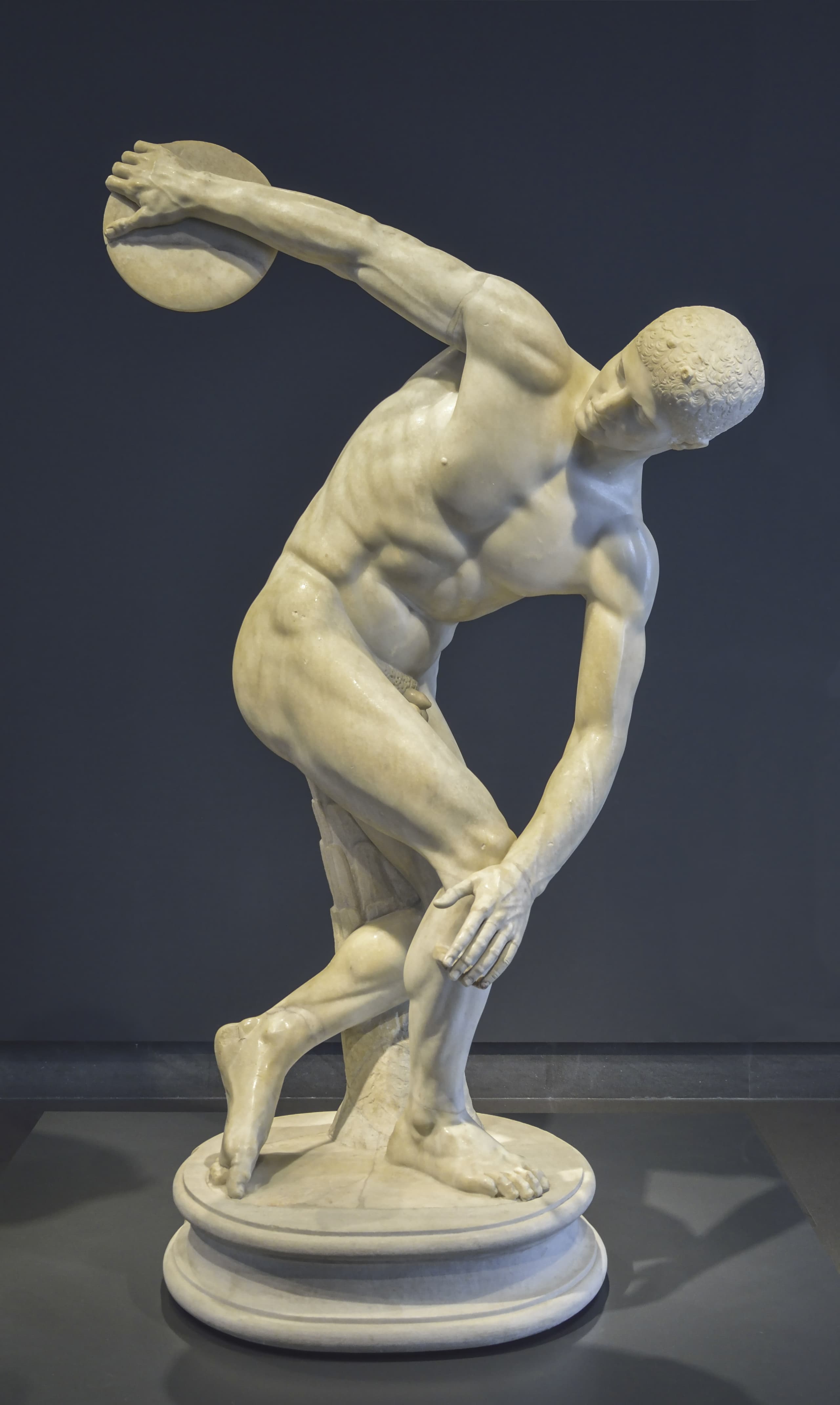
When this copy was excavated, it was in pieces. An eighteenth-century restorer reattached the head facing outward, toward the viewer, which seemed dignified and classical. Later discoveries of other Roman copies showed the head should turn inward, following the line of the throwing arm. The athlete looks along the trajectory of the discus, not away from it. The mistake was understandable — the restorer had no other complete version to check against — but it misreads the sculpture's logic. The figure is not posing for an audience; he is caught mid-motion, his gaze tracking the object he is about to release.
Marble copies of a bronze original
The original was cast in bronze around 450 BC. Bronze allowed finer detail and could support extended limbs without cracking, but it was valuable and often melted down for reuse. What survives are Roman copies carved in marble, made centuries after Myron worked. Marble is heavier and more brittle than bronze, so the copies needed added support: a tree trunk or a strut between the legs. The copies also lack the surface refinement bronze permitted. They are translations into a different material, with different structural constraints, and they show it.
A pose debated by athletes
The figure is twisted into a coil: weight on the right leg, torso rotated, arm swung back, discus held low. The position captures a moment of stored energy just before release. Whether anyone actually threw a discus this way is uncertain. Some who study ancient athletics argue the pose is too extreme to be functional, that it sacrifices mechanical efficiency for visual drama. Others suggest it represents a real technique now lost. The sculpture may record how discus was thrown in the fifth century BC, or it may show an idealised image of athletic effort, shaped more by aesthetic balance than by biomechanics.
The story
The bronze original is gone. What Myron cast in the fifth century BC was melted down, probably centuries ago, for the value of the metal. Bronze was expensive, and old statues were a ready source of it. What remains are Roman copies, carved in marble, made long after the original was created. This is the usual fate of Greek bronze sculpture: we know the works through later versions, not through the objects the sculptors themselves made.
Marble and bronze behave differently. Bronze is strong and can support its own weight even when limbs extend into space. Marble is brittle and heavy, and a marble arm held out from the body will crack under its own mass unless it is thickened or propped. Roman copyists added supports where the original had none: a tree stump, a strut, some piece of scaffolding worked into the composition. The copies are not identical to what Myron made. They are adaptations, constrained by the material.
The Townley Discobolus — named after an eighteenth-century collector — was excavated in fragments. When it was restored, the head was reattached facing outward. The restorer assumed a frontal orientation was correct, that the athlete's face should address the viewer. Later finds showed this was wrong. Other Roman copies, discovered with their heads still attached, revealed that the figure looks inward, along the line of the arm, following the discus. The Townley head was eventually repositioned, but for two centuries the sculpture was displayed with its gaze pointing the wrong way.
The error is instructive. Restoration is interpretation. When a sculpture is broken, decisions about how to reassemble it depend on assumptions about what the work is supposed to be doing. The restorer who turned the head outward was working within a tradition that valued frontal address and clear readability. A figure that looked away from the viewer seemed awkward. But the logic of the Discobolus is not frontal. It is about captured motion, about a body wound tight and about to release. The head follows the action, not the audience.
The question of what counts as the original is less straightforward than it appears. Myron's bronze is lost. The marble copies differ from one another in detail and in the supports they include. Some are full-scale, others reduced. Restorations have added parts, removed parts, repositioned parts. What we call the Discobolus is not a single object but a set of related versions, none of them identical to what Myron made, each shaped by the circumstances of its copying and its repair. The sculpture exists as an idea transmitted through multiple objects, and the transmission has altered it.
The pose itself is a problem. The figure is twisted, weight on one leg, torso rotated, discus held low and back. It is a moment of maximum tension, the instant before the throw. Whether this represents a real athletic technique is disputed. Some scholars of ancient sport argue that the position is biomechanically implausible, that no one would actually throw this way. Others suggest it may record a method that has since disappeared. The ambiguity is unresolved. The sculpture may be documentation, or it may be a constructed image of effort, shaped by aesthetic priorities rather than by how athletes moved.
What is clear is that the body is rendered with attention to proportion and to the distribution of mass. The limbs are extended but the torso shows no visible strain. The face is calm. The figure is not straining; he is poised. This is characteristic of Greek sculpture of the period: the depiction of physical exertion without the facial or muscular distortion that exertion produces. The body is idealised, brought into balance, even as it performs an action that in life would involve tension and effort.
Why it mattered then
The Discobolus was made during a period when Greek culture placed athletic competition at the centre of public life. The games were not merely sport; they were religious festivals, civic events, occasions for display and for the reinforcement of shared values. To compete was to demonstrate physical excellence, and physical excellence was understood as part of a broader ideal that linked the body to virtue. The sculpture embodies that ideal: the athlete is shown nude, his body proportioned and balanced, his effort contained within a poised and harmonious form. This was not realism in the sense of documenting how a person looked in a moment of exertion. It was an image of what a person should be: strong, controlled, beautiful in action.
Why it matters now
The Discobolus matters now because it raises questions about copies, originals, and what we mean when we say we are looking at a work of art. The object Myron made is gone. What survives are versions made by others, in a different material, for different patrons, centuries later. Some of those versions were broken and restored, and the restorations were based on guesses that turned out to be wrong. So what are we looking at? Not the original, but not a forgery either. A copy that is also an adaptation, a restoration that is also an interpretation. The sculpture asks us to think about how art is transmitted, how it is altered in transmission, and whether the idea of a single authentic version is coherent when the work exists only as a set of variants. It also asks whether a Roman marble copy of a Greek bronze is less valuable, less worth studying, than the lost original would have been. The answer is not obvious.
The surprising detail
The head was attached facing the wrong way for roughly two hundred years. The mistake was not corrected until other Roman copies were discovered with the head still in place, showing the correct orientation. During those two centuries, the sculpture was studied, admired, and reproduced in engravings and casts, all with the head turned outward. The incorrect version became the familiar one, and when the error was identified, some viewers found the corrected pose awkward. They had learned to see the sculpture wrongly, and the wrong version looked right to them.
What is disputed
The original date of Myron's bronze is given as around 450 BC, but this is an estimate based on stylistic analysis and historical context, not on documentation. The exact year is not recorded. Similarly, whether the pose represents a real athletic technique or an idealised image of effort remains debated among scholars of ancient sport.
Remember this
A Roman copy of a lost Greek bronze, restored with the head facing the wrong way — a reminder that what we see is shaped by guesses made centuries after the original was gone.
Test yourself
Why does the fact that the original Discobolus was bronze, and the surviving copies are marble, matter beyond the simple difference in material?
Because bronze and marble have different structural properties, and those properties shaped what the sculpture could be. Bronze is strong enough to support extended limbs without additional props; marble is not. Roman copyists had to add supports — tree stumps, struts — that were not part of Myron's design. The copies are not just translations into a cheaper material; they are re-engineered versions, constrained by what marble can do. This means the surviving sculptures are not identical to the lost original. They are adaptations, and the adaptations are visible in the added supports and in the thickened limbs. The lesson generalises: when a work is copied in a different medium, the medium imposes its own logic, and the copy is never merely a replica. It is a new object, made under new constraints.
Go deeper
Image: Livioandronico2013, CC BY-SA 4.0. Licence: CC BY-SA 4.0. Source.