I · THE OBJECT · BRITISH MUSEUM
The Tughra of Suleiman the Magnificent
▶ Listen · narrated
This is a signature, but one that took a trained specialist to draw and another to paint. It identified the sultan on every document his government issued.
At a glance
- Form
- Tughra — calligraphic monogram and seal
- Function
- Affixed to all official documents and correspondence
- Tradition
- Ottoman illumination
- Related forms
- Carved on seals, stamped on coins
Look closer
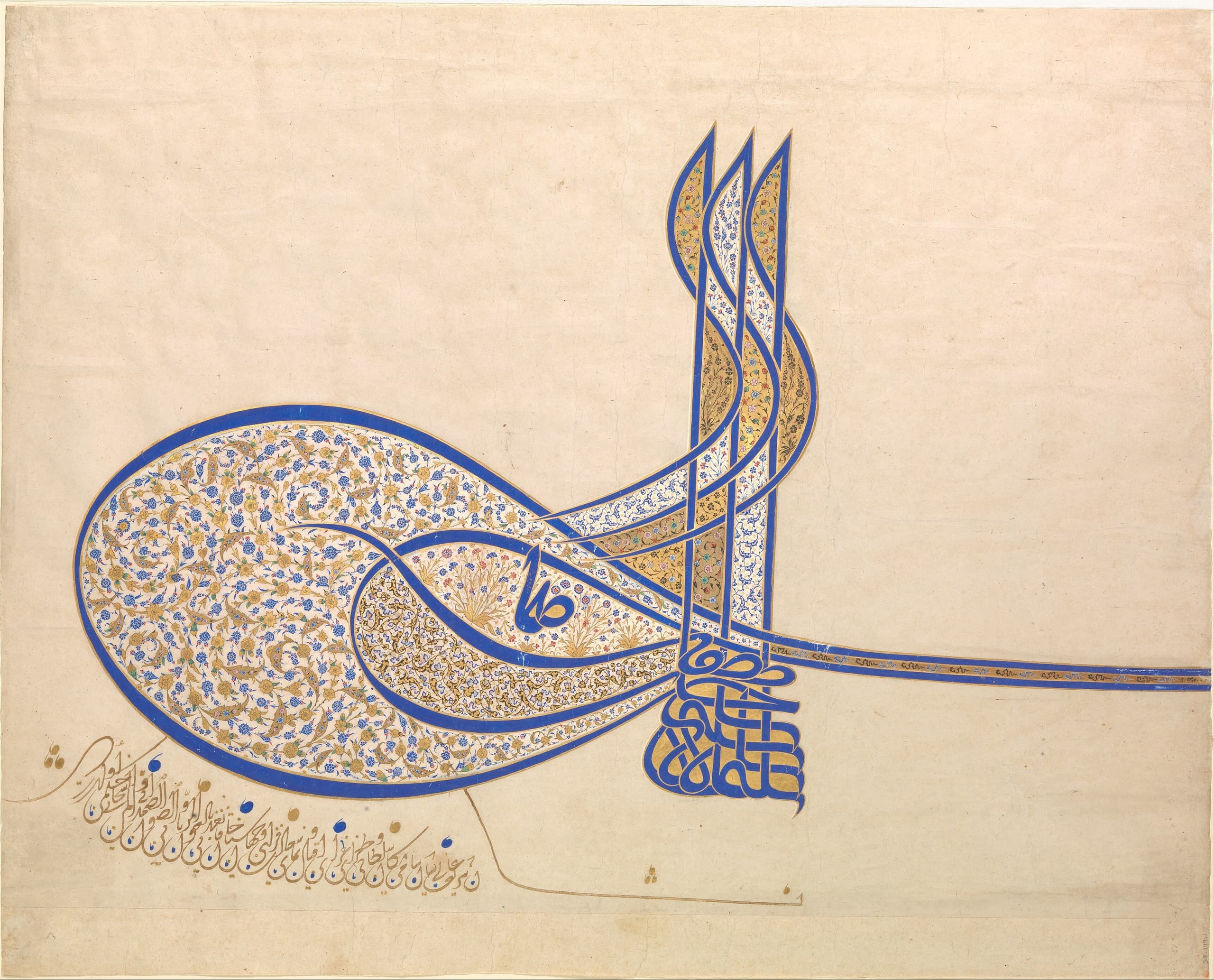
Three vertical shafts and a horizontal oval
The basic structure of a tughra has three tall vertical strokes rising on the left — these are called tuğ — and a horizontal oval loop to the right, which sweeps back underneath in a curve. The tuğ evoke upright standards or staffs; the loop encloses part of the text. Two curves extend outward from the loop, one above and one below, framing the design. Every sultan's tughra followed this template, but the proportions and the details of the calligraphy were individual.
The illumination competes with the letters
Elaborate versions made for important documents were painted by specialists in a technique called Ottoman illumination. Gold leaf, dense pattern and vegetal ornament fill the spaces between and around the letterforms. In examples like this, the decoration is so rich that the calligraphy and the ornament become hard to separate — the eye reads the overall shape before it picks out individual letters. The tughra functions as both text and image.
Drawn by hand each time
The tughra was not stamped or printed. It was drawn by the court calligrapher — an official called the nişancı — on each document that required it. That means every tughra was a fresh performance of the design, not a mechanical copy. For routine documents the calligrapher worked in ink without ornament; for treaties, decrees and ceremonial letters, the drawn tughra was then handed to an illuminator who added the painted decoration.
The story
A tughra is a calligraphic monogram that served as the signature and seal of an Ottoman sultan. It appeared on every official document and letter issued in his name, and was also carved on his personal seal and stamped on coins minted during his reign. The design was specific to each sultan — created at the beginning of his rule and used throughout it — so the tughra identified not just the office but the individual ruler.
The form is consistent across examples. Three vertical strokes rise on the left, and a horizontal oval loop extends to the right, curving back underneath. Two additional curves sweep outward from the loop, one above and one below, framing the composition. This structure is legible even in the most decorated versions, where gold and painted ornament nearly obscure the letterforms themselves.
The tughra is calligraphy, and it spells out text: the sultan's name, his father's name, and a formula such as "ever victorious". But it does not look like a line of writing. The letters are stacked, interlaced and stretched into a shape that reads as an emblem. Someone who could not read Ottoman Turkish would still recognise the tughra as a mark of authority, much as a royal cypher or a coat of arms works in European traditions.
The example shown here belonged to Suleiman, and it demonstrates the elaborate treatment reserved for important documents. The calligraphy was drawn by the nişancı — the court calligrapher — and then illuminated by a specialist painter. Gold leaf covers much of the surface, and the spaces between the letters are filled with dense vegetal ornament in the tradition of Ottoman manuscript decoration. The result is a tughra that functions simultaneously as text, as image, and as a display of the resources and craft the state could command.
Tughras are recorded from the fourteenth century onward. The form was inspired by the tamgha, a mark used by Turkic and Mongol rulers, though the Ottoman tughra developed into something more complex and more closely tied to the art of the calligrapher and the illuminator.
Why it mattered then
The tughra solved a practical problem and created a ceremonial opportunity at the same time. The practical problem was authentication: in a state that governed through written orders sent across a large territory, recipients needed a way to verify that a document genuinely came from the sultan. A signature that required the skill of a court specialist — and that could be checked against the known design for that reign — was harder to forge than a simple seal or mark. The ceremonial opportunity was that the tughra made every official document into a statement about the sultan's authority and the sophistication of his court. A letter that arrived with an illuminated tughra announced its importance before anyone read the text. The gold, the ornament and the intricacy of the calligraphy were not decorative extras; they were part of the message. The tughra said: this comes from a ruler who commands not just armies and taxes but also trained calligraphers and painters, and who considers the visual presence of the state worth that investment. The tughra also appeared on coins, which meant it circulated as a recognisable symbol of the sultan's rule. Someone who handled a coin minted during Suleiman's reign would see his tughra stamped on it, even if they could not read the script. The tughra was logo, signature and seal in one form.
Why it matters now
The tughra is a reminder that a signature does not have to be a scribbled name. It can be a designed object, drawn by a specialist, that carries information in its form as well as its content. In that sense it is closer to a logo or a trademark than to the signatures we use now, but it still functioned as a personal mark — it identified one sultan, not the office in general. It also demonstrates a way of thinking about official documents in which the visual treatment is part of the authority of the text, not separate from it. The illumination was not applied to make the document prettier; it was applied to make it more convincing, more memorable, and more clearly an object that came from the centre of power. The tughra is an example of a culture in which writing and image were not distinct categories, and in which a state's visual identity was taken as seriously as its legal or military apparatus. The form is still recognised as a symbol of that historical period, and it appears in contexts ranging from state ceremonies to commercial branding. The tughra has moved from a functioning part of government to a sign of a particular historical and cultural identity.
The surprising detail
The tughra was drawn fresh each time it was needed, not stamped or copied mechanically. That means a busy nişancı might draw the same design dozens or hundreds of times over the course of a reign, and each one was a performance of the form rather than a reproduction. The illuminated versions, like this example, required a second specialist to add the painted decoration after the calligrapher had finished. So an important document involved at least two people working in sequence, each contributing a layer of skill. The tughra was a collaboration, not a signature in the sense of something one person dashes off in a moment.
What is disputed
The exact origins of the tughra form are not fully documented. The connection to the tamgha is widely accepted, but the details of how the Ottoman design developed from that earlier mark, and when the illuminated versions became standard for important documents, are less clear. Tughras are recorded from the fourteenth century, but the evidence for the earliest examples and the evolution of the form is incomplete.
Remember this
A signature that was also a logo, drawn by a specialist for each document and illuminated when the occasion required it.
Test yourself
The tughra was inspired by an earlier form called the tamgha, used by Turkic and Mongol rulers. Why might the Ottomans have developed the tamgha into something much more elaborate, involving court calligraphers and illuminators?
The Ottoman state governed a large, diverse territory through written administration, and it placed a high value on the visual and literary arts as expressions of imperial authority. A tamgha was a mark — often a simple brand or seal — that identified a ruler or a clan. The Ottomans kept the identifying function but embedded it in a calligraphic and decorative tradition that required specialist training. That shift reflects a state that wanted its documents to do more than simply authenticate: they had to demonstrate the sophistication of the court and the resources it could deploy. The tughra became a place where administrative necessity and artistic ambition met, and where the sultan's identity was expressed not just in text but in the quality of the craftsmanship that rendered it.
Go deeper
Image: Thadswanek , taken from here (uploaded by Pagan ), Public domain. Licence: Public domain. Source.