I · THE OBJECT · BRITISH MUSEUM
The Royal Gold Cup
▶ Listen · narrated
This cup's ownership reads like a map of medieval politics: commissioned in France, given to England, taken back to France, returned to England, then carried to Spain for three hundred years.
At a glance
- Date
- 14th century
- Material
- Solid gold with basse-taille enamel and pearls
- Dimensions
- Height 23.6 cm, diameter 17.8 cm
- Weight
- 1.935 kg
Look closer
Basse-taille enamel: light through colour
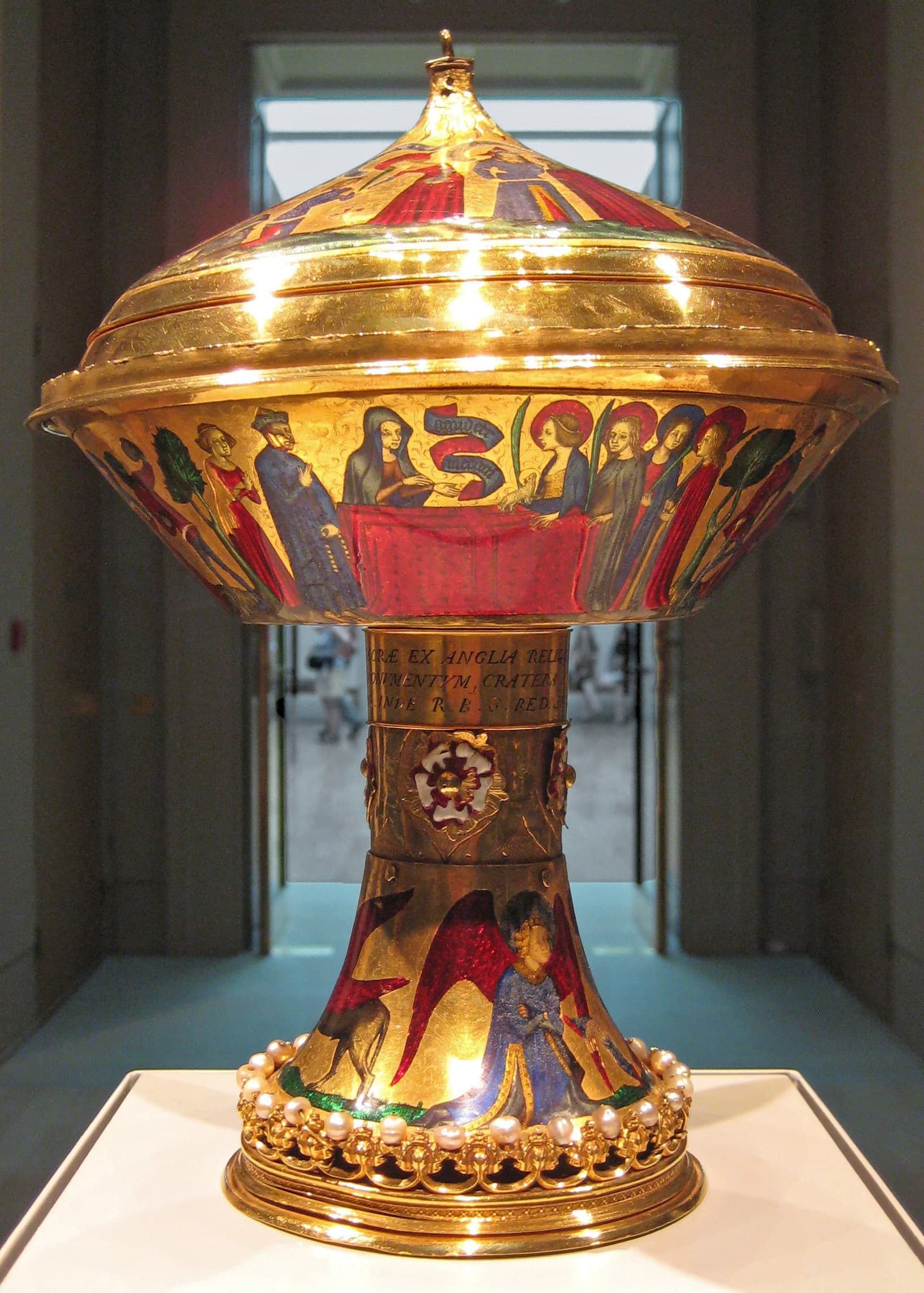
The decoration is worked in basse-taille, a technique where the goldsmith carves shallow relief into the metal surface, then floods it with translucent enamel. Light passes through the coloured glass and reflects back from the carved gold beneath, so the image glows rather than sits flat. The engraving underneath varies the brightness: deeper cuts appear darker through the enamel, shallower ones brighter. Large areas here are translucent red — rouge clair — which was the hardest colour to control in the kiln and the most prized when it succeeded. The red on this cup has survived in excellent condition.
Scenes from the life of St Agnes
The narrative runs in enamel panels around the cover and the sloping underside of the bowl. St Agnes was a Roman girl, traditionally said to have been martyred as a young Christian. The choice of subject is recorded but the reason for it is not: whether the cup was made for a specific saint's day, a particular devotion, or a patron named Agnes is not known. The symbols of the Four Evangelists appear around the foot, and there are enamel medallions inside both the cup and the cover.
Evidence of alteration
The stem has been lengthened twice by inserting cylindrical bands, so the cup was originally much shorter and stockier. The lower added band carries enamel Tudor roses on a patterned background, apparently added during the reign of Henry VIII. A strip of gold with jagged edges runs around the outer rim of the cover, where a moulding set with thirty-six pearls was removed at some point; a matching pearl band still circles the foot. The original finial on the cover is also lost.
The story
The cup is solid gold throughout. It stands just under twenty-four centimetres tall, weighs nearly two kilograms, and lifts apart: the cover comes off, and once sat on a triangular stand that is now missing. The shape would have been more compact originally — the stem has been extended twice with added bands of gold, making it taller and changing the proportions.
The surface is decorated with basse-taille enamel, a technique that depends on translucency. The goldsmith carves shallow relief into the gold, then applies powdered glass mixed with metallic oxides and fires it in a kiln until it fuses. The glass is transparent or translucent, not opaque, so light travels through the colour, strikes the engraved gold underneath, and reflects back. Where the engraving is deeper, less light returns and the colour reads darker; where it is shallow, the colour is brighter. The gold behind the enamel and the plain gold around it are also worked with engraved lines and punched dots — pointillé — that catch the light.
The red enamel here is particularly notable. Translucent red — rouge clair — was technically difficult: the colour came from copper oxide, and the firing had to be controlled precisely or the glass would darken, cloud, or fail to fuse. When it worked, the result was a brilliant, light-filled red. The red on this cup has lasted in excellent condition, which is unusual.
The narrative subject is the life of St Agnes, told in enamel scenes that wrap around the cover and the underside of the bowl. Agnes was a Roman girl martyred, according to tradition, as a young Christian. Why this particular saint was chosen is not recorded. Around the foot of the cup are the symbols of the Four Evangelists, and there are enamel roundels inside the cup and cover.
The cup was made for the French royal family in the late fourteenth century. After that it moved between royal households, changing hands as marriages were arranged, wars were fought, and thrones changed. It passed to English ownership, then back to French, then to English again, and eventually travelled to Spain, where it remained for nearly three hundred years. It came to the British Museum in 1892.
The alterations record some of this history. One of the added bands on the stem carries Tudor roses in enamel, which places that addition under Henry VIII. The pearls removed from the cover may have been taken for reuse, or lost, or removed during one of the times the cup changed hands. The missing stand may have been melted down or separated from the cup and lost track of.
The cup arrived at the museum with a case made for it, either at the same time as the cup or shortly after. The case is hexagonal, made of leather over a wooden frame, with iron lock, handles and mounts. It has incised and stamped plant decoration and an inscription in blackletter: YHE.SUS.O.MARYA.O.MARYA YHE SUS — Jesus, O Mary, O Mary, Jesus.
Why it mattered then
A cup like this was not for daily use. It was a statement object, made to be seen, to demonstrate wealth and access to skilled workshops, and to be given. Gold was valuable as metal, but a cup in solid gold decorated with difficult enamelwork and pearls was valuable as craft and as display. The choice to make it in basse-taille rather than opaque enamel or engraving alone mattered. Translucent enamel over carved gold required carving the relief, preparing the enamel, and controlling the firing so the glass fused without clouding or cracking. The risk of failure in the kiln was present at every stage. A cup that succeeded — especially one with large areas of rouge clair that had not clouded or cracked — was evidence of skill and resources. It said the patron could commission work at that level and the goldsmith could deliver it. The religious subject gave it another function. A cup decorated with the life of a saint was appropriate for ceremonial or devotional contexts, not just for display. It could be used in a chapel, given as a gift with religious significance, or kept as a piece of personal piety as well as wealth. Gifts between royal households were political tools. An object like this carried messages about alliance, favour, obligation. When it moved from one throne to another, it moved as part of a negotiation, a marriage settlement, or the redistribution of goods after a conflict. Its history of ownership is a history of relationships between ruling families.
Why it matters now
The cup survives as evidence of a kind of object that was once common among royal and noble households but has mostly been lost. Gold was valuable and reusable, so when a family needed money, or when ownership changed through war or confiscation, gold plate was often melted down. The metal was worth more than the craft. Cups, dishes, and ceremonial vessels were turned back into bullion and remade into currency or new objects. This cup was not melted, which is partly luck and partly the fact that it kept moving between contexts where it was valued as an object, not just as weight of gold. Each time it changed hands, someone chose to keep it intact. It is also evidence of basse-taille technique at a high level, with rouge clair enamel that has survived in good condition. Many enamelled objects from this period have lost colour, or the enamel has crazed or flaked away, or the red has darkened. This one has not, so it remains possible to see what the technique looked like when it succeeded. The alterations are part of the evidence. The added stem bands and the missing pearls show that the cup was used and adapted over centuries, not locked away. It was handled, changed to suit new tastes or needs, and kept in circulation. The case that came with it to the museum is also rare — a fitted case for a specific object, made in the fourteenth century or shortly after, and still paired with the object it was made for. The ownership history, where it is known, gives a framework for understanding how such objects moved and why. The gaps in that history — the periods where the record goes quiet, the moments when the cup changed hands and no document survives to say how — are also useful. They show how much of the movement of valuable objects happened outside formal record-keeping, or in contexts where records were later lost.
The surprising detail
The cup came to the British Museum with its original case still paired with it: a hexagonal leather case on a wooden frame, with iron fittings and a lock. The case has incised and stamped decoration and an inscription in blackletter reading YHE.SUS.O.MARYA.O.MARYA YHE SUS. It was made either at the same time as the cup or shortly after, which means case and cup have stayed together for over six hundred years — through multiple changes of ownership, across countries, and despite the usual tendency for containers and contents to become separated. That the case survived at all is unusual; that it remained matched to the specific object it was made for is rarer.
How it got here
The cup was made for the French royal family in the late fourteenth century. It passed into English royal ownership, returned to France, came back to England, and was then taken to Spain, where it remained for nearly three hundred years. It was acquired by the British Museum in 1892. The museum's records do not detail the circumstances of acquisition or the route by which it left Spain.
Remember this
A royal gift that moved between thrones for centuries, altered but not melted — evidence of the politics of gold and the luck of survival.
Test yourself
The cup's stem has been lengthened twice with added bands of gold, changing its proportions from short and stocky to taller and more slender. Why would someone alter a valuable object like this rather than commission a new one?
Because the value was not only in the gold or the workmanship, but in the object's history. A cup that had belonged to previous monarchs, that carried associations with royal lineage and legitimacy, was worth more than a new cup of the same weight and skill level. Altering it updated the form to suit contemporary taste while keeping the inherited authority intact. The added band with Tudor roses makes this explicit: it marks the cup as continuous with earlier royal ownership while also marking it as currently English, currently Tudor. Melting it down and starting fresh would have erased that lineage. The alteration says: this object has a past, and I am part of that past now.