I · THE OBJECT · BRITISH MUSEUM
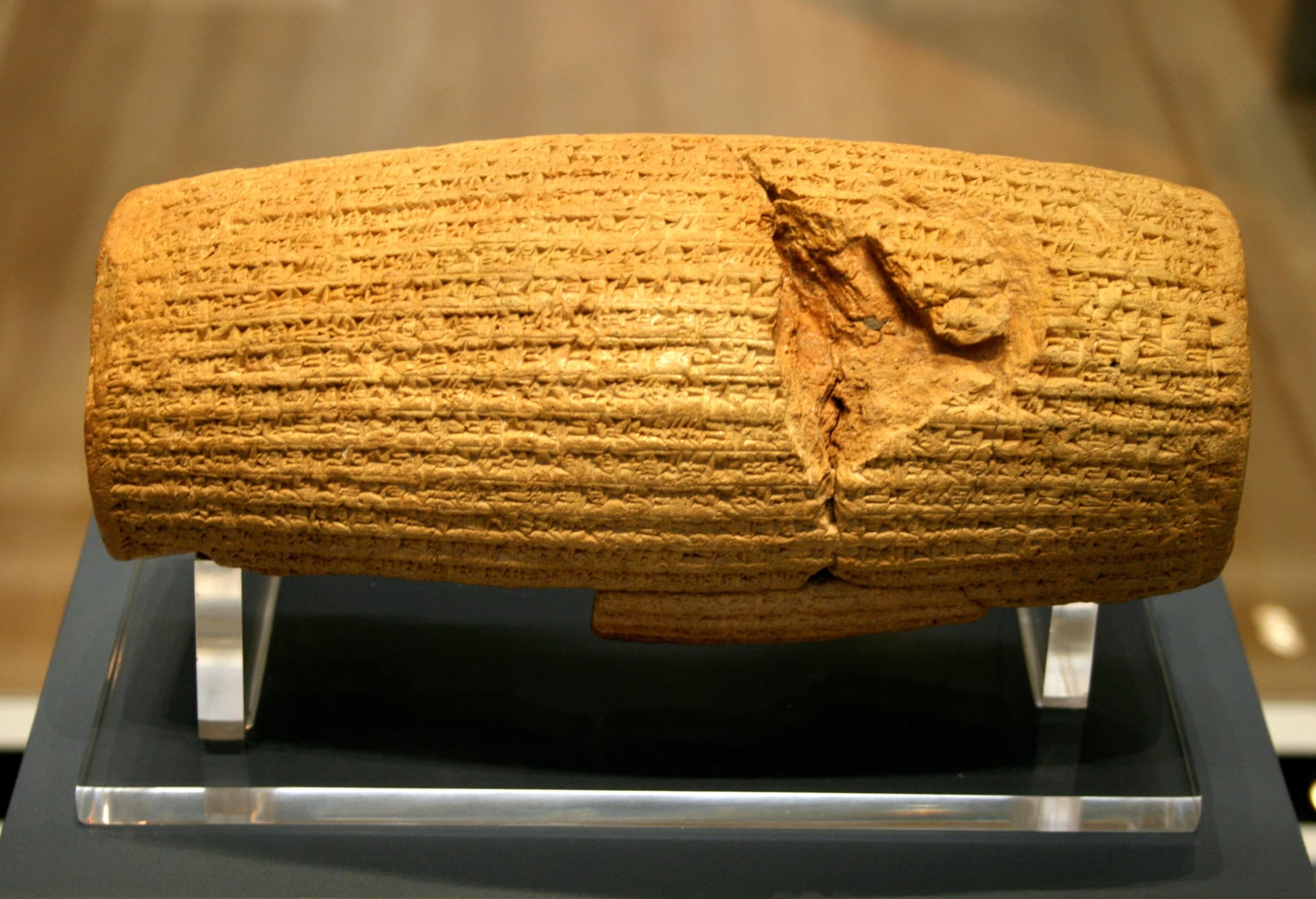
The Cyrus Cylinder
▶ Listen · narrated
This broken clay cylinder spent centuries underground as building fill. In the twentieth century it was put in a glass case and called the first charter of human rights.
At a glance
- Date
- 539 BC
- Material
- Clay
- Script
- Akkadian cuneiform
- Discovery
- Babylon, March 1879
- Museum number
- 90920
Look closer
Written in the conquered city's language
The cylinder is inscribed in Akkadian cuneiform — the administrative language of Babylon, not of Persia. Cyrus the Great had just conquered the city, but the text addresses a Babylonian audience in Babylonian script, praising the Babylonian god Marduk and presenting Cyrus as Marduk's chosen restorer of order. It is propaganda written in the voice of the defeated, a standard move in Mesopotamian conquest rhetoric but still a calculated one: the new ruler adopts the old forms to legitimise his presence.
A foundation deposit, not a public decree
The cylinder was not displayed where people could read it. It was buried in the foundations of Babylon's city wall, a ritual deposit meant for the gods and for future builders who might uncover it. Foundation deposits of this kind were a Mesopotamian tradition stretching back centuries: a new ruler or a rebuilder would bury an inscribed object describing their piety and their works. This one praises Cyrus, denounces his predecessor Nabonidus, and lists restorations of temples and repatriations of displaced peoples across the region.
Now broken into several pieces
The cylinder survives in fragments. What is displayed is a reconstruction from pieces that were found scattered in the ruins of Babylon. The text runs in neat horizontal lines around the curved surface, and where the clay has broken away the inscription stops mid-sentence. Enough remains to reconstruct the narrative: Cyrus as liberator, Nabonidus as impious oppressor, Marduk as divine sponsor, and a list of cult centres restored.
The story
In 539 BC, Cyrus the Great took Babylon without a siege. The city had been the capital of the Neo-Babylonian Empire, and its fall brought that empire to an end. Cyrus ordered a cylinder of clay to be inscribed and buried in the foundations of Babylon's wall — a foundation deposit, a genre older than his conquest.
The text, written in Akkadian cuneiform, presents Cyrus as the choice of Marduk, Babylon's chief god. It describes the previous king, Nabonidus, as an oppressor who neglected the gods and imposed forced labour on the population. Cyrus, by contrast, is portrayed as a restorer: he entered the city peacefully, returned displaced peoples to their homes, rebuilt temples across Mesopotamia, and repaired Babylon's walls. The cylinder closes by noting that Cyrus found an earlier king's inscription in the same wall — a detail that roots him in a long line of Babylonian builders.
This is not an unusual document. Mesopotamian kings had been burying foundation deposits for well over a millennium, and the rhetoric of the pious conqueror restoring what the wicked predecessor destroyed was a standard form. What is unusual is what happened to this one after it was dug out of the ruins in 1879.
For most of a century it was studied as a historical source, compared with biblical accounts of Cyrus' reign and used to corroborate the repatriation of peoples — including, some scholars argued, the return of Jews to Jerusalem described in the Book of Ezra. The cylinder does describe repatriations and temple restorations, but it names only Mesopotamian sites. It does not mention Jerusalem, Judea, or Jews. Whether it supports the biblical account depends on how general you take its claims to be.
Then, in the twentieth century, the cylinder acquired a second life. The Pahlavi dynasty, ruling Iran, adopted it as a national symbol. In 1971 it was flown to Tehran and displayed as part of a celebration of the Persian Empire. A replica was presented to the United Nations, and Shah Mohammad Reza Pahlavi promoted the cylinder as the first charter of human rights. The claim rested on the passages about repatriation and the restoration of cult sanctuaries — read as evidence of tolerance and respect for cultural diversity.
Most historians describe this interpretation as anachronistic. The cylinder is a piece of royal propaganda in a well-established genre, not a statement of universal principles. Its declarations serve Cyrus' legitimacy, not a theory of rights. But the modern myth has proved durable, and the cylinder remains a symbol in contexts far removed from the Babylon where it was buried.
Why it mattered then
The cylinder mattered in 539 BC because it did a specific job: it legitimised Cyrus' rule in Babylon by speaking Babylonian. Conquerors who wanted to govern rather than simply loot needed the cooperation of local elites — priests, administrators, landowners — and that cooperation was easier to secure if the new king presented himself as the restorer of the old order rather than its destroyer. Cyrus the Great had just ended the Neo-Babylonian Empire, but the text treats Nabonidus, not Cyrus, as the disruptor. It accuses Nabonidus of neglecting Marduk's temple, imposing forced labour, and ruling impiously. Cyrus, by contrast, is Marduk's chosen instrument, welcomed by the people, rebuilding what had been damaged. The cylinder does not record what happened; it records what the new administration wanted remembered. The repatriations and temple restorations it describes were real policies, but they were also strategic. Allowing displaced groups to return and rebuild their cult centres created grateful clients across a newly enlarged empire. The cylinder lists restorations in multiple cities, a catalogue that doubles as a claim of reach. Burying it in the wall was the final move: the document was placed where the gods and any future rebuilder would find it, a permanent assertion that Cyrus belonged in Babylon's long line of legitimate kings.
Why it matters now
The cylinder matters now partly because of what it is — a detailed inscription from a well-documented conquest — and partly because of what it has been called. The historical document and the modern symbol sit uneasily together, and both are still in play. As a source, the cylinder corroborates and complicates other accounts of Cyrus' reign. It confirms that he took Babylon without destroying it, that he pursued a policy of repatriation and temple restoration, and that he presented himself in Babylonian terms to a Babylonian audience. Compared with Greek sources, which tend to treat Persia as a monolithic despotism, the cylinder shows a more pragmatic and locally adapted administration. It is propaganda, but propaganda often tells you what a government thought would be persuasive, and that is valuable information. As a symbol, the cylinder has been enlisted in arguments about tolerance, human rights, and Persian identity. The claim that it is a charter of rights does not survive scrutiny — the text makes no general statements about the treatment of peoples, and the repatriations it describes served the empire's stability, not a principle of freedom. But the fact that it was adopted as a symbol, and remains one in some contexts, is itself part of its history now. The tension between these two readings — the historical document and the modern myth — makes the cylinder a useful case study in how objects acquire meanings long after they were made, and how those meanings can obscure as well as illuminate what the object originally was.
The surprising detail
The cylinder was flown to Tehran in 1971 and displayed as part of a celebration of the Persian Empire. A replica was presented to the United Nations by Princess Ashraf Pahlavi, who described it as embodying tolerance, courage, compassion, and human liberty. Her brother, Shah Mohammad Reza Pahlavi, promoted it as the first charter of human rights. The interpretation has been disputed by most historians, who point out that the text is a conventional foundation deposit in a genre centuries old, written to legitimise a conquest, and that reading it as a statement of universal principles is anachronistic. But the modern myth has outlasted the dynasty that promoted it, and the cylinder remains a potent symbol in debates about rights, tolerance, and Persian heritage.
What is disputed
The circumstances of the discovery in 1879 are not fully documented, and the exact findspot within the ruins of Babylon is not recorded in detail. The text itself has been reconstructed from fragments, and some passages remain unclear or disputed among scholars.
How it got here
The cylinder was discovered in Babylon in March 1879 and came into the possession of the British Museum. It was excavated during a period when archaeological material from Mesopotamia was routinely acquired by European institutions, often under agreements with the Ottoman Empire, which then controlled the region. In 1971 it was loaned to Iran for display in Tehran as part of the celebration of the Persian Empire, and replicas have since been exhibited in Iran and presented to international institutions. The cylinder remains in the British Museum's collection, and its status as a symbol of Persian heritage has made it a subject of discussion in debates about the repatriation of cultural objects.
Remember this
A Babylonian foundation deposit became a modern human rights symbol — a reminder that objects mean what their audiences need them to mean, not just what they originally said.
Test yourself
The cylinder describes repatriations and temple restorations, and some scholars initially saw this as corroboration of the biblical account of Cyrus allowing Jews to return to Jerusalem. Why has that interpretation been questioned?
Because the cylinder names only Mesopotamian cult centres. It does not mention Jerusalem, Judea, or Jews. The repatriations it describes are real, and they fit a broader pattern of Cyrus' policy, but the text itself does not extend beyond the region it lists. Whether it supports the biblical account depends on whether you read the cylinder's claims as examples of a general policy or as a specific catalogue. The text does not resolve that question — it simply does not say. The lesson generalises: a source can corroborate a pattern without mentioning every instance, but claiming it does requires an argument, not just a reading.
Go deeper
Image: Photograph by Mike Peel ( www.mikepeel.net ). Modifications by مانفی. Licence: CC BY-SA 4.0. Source.