III · THE WORK · ART HISTORY
The Florentine Codex
▶ Listen · narrated
The Florentine Codex documents Aztec society in both Nahuatl and Spanish. Read the columns side by side and the disagreements appear: what one language records, the other sometimes omits.
At a glance
- Date
- 1575
- Medium
- Ink and pigment on paper
- Collection
- Biblioteca Medicea Laurenziana, Florence
- Format
- Twelve-volume manuscript with parallel text columns
Look closer
Parallel Nahuatl and Spanish columns
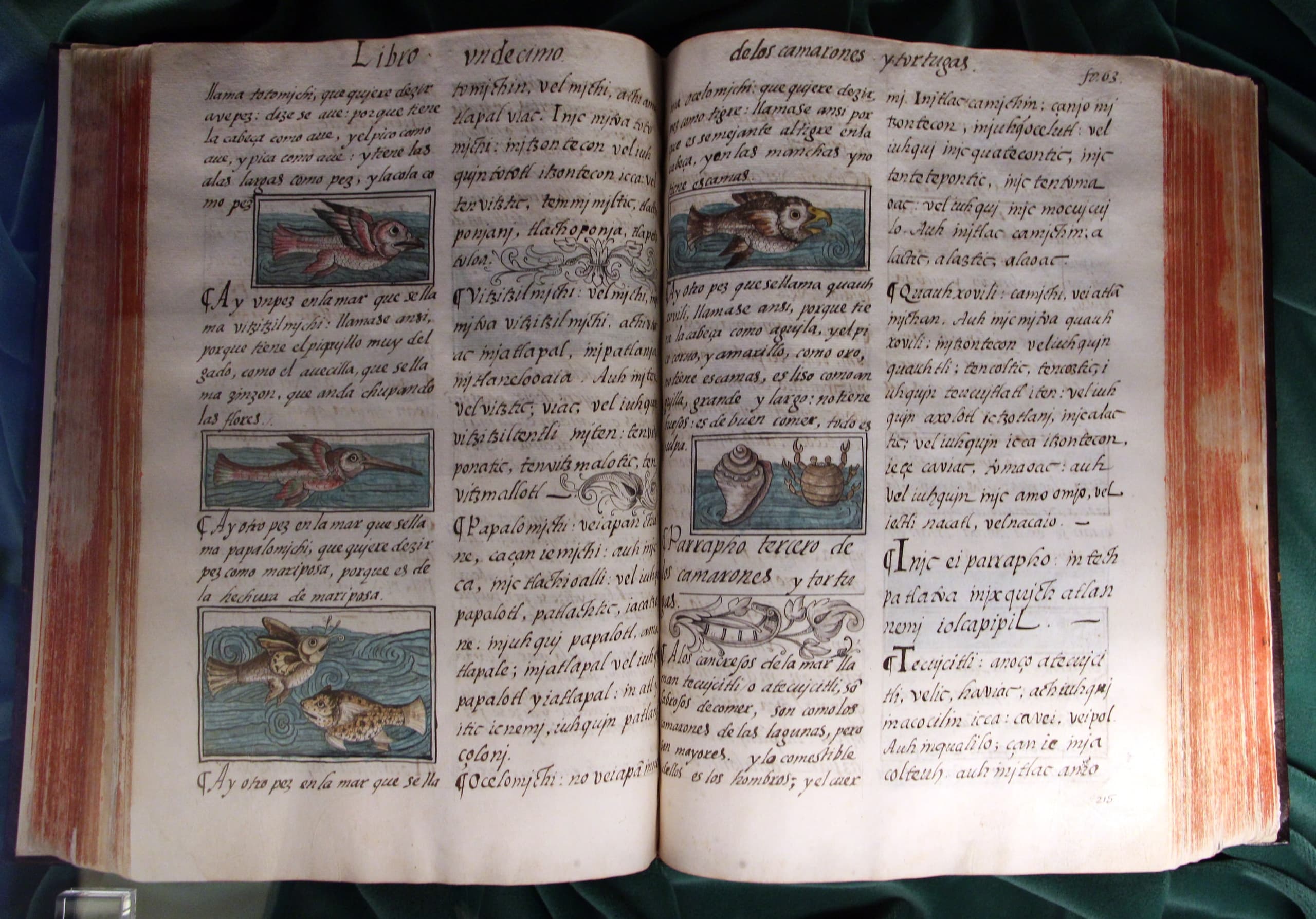
Each page is divided into two columns. The left carries text in Nahuatl, written by indigenous scholars; the right carries Spanish, a translation supervised by the Franciscan friar who organised the project. The arrangement suggests equivalence, but the columns do not always match. Details present in the Nahuatl sometimes disappear in the Spanish. Where the languages diverge, the page records not one account but two, and the gap between them becomes evidence of what could and could not be said under colonial supervision.
European shading applied to indigenous conventions
The illustrations were drawn by indigenous artists trained in both pre-conquest pictorial traditions and European techniques introduced by Spanish friars. Figures are often rendered with cross-hatching and modelled shading, methods that came from Europe, but the compositions and the symbolic vocabulary — the way a god is identified, the way a ritual is staged — follow indigenous conventions. The result is a visual language that belongs fully to neither tradition, a hybrid produced by the circumstances of the manuscript's creation.
Indigenous glyphs surviving inside the images
Scattered through the illustrations are glyphs — small symbolic images that function as writing in indigenous tradition. A footprint indicates a journey; a speech scroll indicates spoken words; a temple in flames indicates conquest. These glyphs carry information the surrounding text does not always spell out. They are remnants of a pictorial writing system that predates the Spanish arrival, embedded within a manuscript whose text is written in the Roman alphabet. Where the glyphs appear, the page is doing two kinds of writing at once.
The story
The Florentine Codex is a manuscript in twelve volumes, completed in 1575, documenting the culture, religion, society and natural history of the Aztec people. It was produced under the direction of a Spanish Franciscan friar, but the research, writing and illustration were carried out by indigenous scholars and artists, many of whom had been students at a college established in the decades following the Spanish conquest. The work runs to more than two thousand pages and contains more than two thousand illustrations.
The manuscript is organised as parallel columns of text: Nahuatl on the left, Spanish on the right. This layout suggests a straightforward translation, but the relationship between the columns is more complicated. The Nahuatl text was written by indigenous authors working from interviews with elders and from their own knowledge of pre-conquest traditions. The Spanish text was compiled later, under the supervision of the friar who commissioned the project. In many passages the Spanish follows the Nahuatl closely, but in others it condenses, omits or reframes what the Nahuatl records. Sections describing religious practices, for instance, are often fuller in Nahuatl than in Spanish. The result is a manuscript in which two versions of the same material exist side by side, and the differences between them are part of what the document preserves.
The illustrations are the work of indigenous artists who had been trained in both pre-conquest pictorial traditions and European drawing techniques introduced after the conquest. Figures are often modelled with cross-hatching and shading, methods that came from Europe, but the compositions and symbolic vocabulary are indigenous. A deity is identified by specific attributes; a ritual is staged according to conventions that predate Spanish arrival. Scattered through the images are glyphs — small symbolic pictures that function as writing. A footprint means movement, a speech scroll means spoken words, a burning temple means conquest. These glyphs are remnants of the pictorial writing system used before the Roman alphabet was introduced, and they carry information the alphabetic text does not always spell out.
The project took decades. The friar who organised it began gathering material in the 1540s and continued revising until his death in 1590. The indigenous scholars who worked on it were drawing on a culture that had been violently disrupted within living memory, and they were doing so under the supervision of representatives of the power that had disrupted it. The manuscript they produced is neither a neutral record nor a Spanish imposition. It is a negotiated document, and the terms of the negotiation are visible in the text.
The manuscript is held in the Laurentian Library in Florence, which is why it is now called the Florentine Codex, though that was not its original title. It was inscribed into a register maintained by an international organisation in 2015, recognising it as documentary heritage. High-resolution scans of the complete manuscript, showing both the Nahuatl and Spanish text and all illustrations, were made available online in 2012, and a further digital edition was released in 2023.
Why it mattered then
The Florentine Codex was compiled at a moment when the generation with direct memory of life before Spanish conquest was ageing. The indigenous scholars who worked on it were recording knowledge that would otherwise have been lost, but they were doing so within a colonial framework that constrained what could be recorded and how. The manuscript was intended, at least in part, as a tool for Spanish missionaries: understanding indigenous religion and society was seen as necessary for converting the population and administering the colony. But the indigenous authors were also documenting their own culture, and the Nahuatl text preserves details that the Spanish version does not. The manuscript is evidence of what could be said, what could be written down, and what could be illustrated under those conditions. It records not only Aztec culture but also the process by which that culture was being translated, interpreted and selectively preserved in the decades after conquest.
Why it matters now
The Florentine Codex is a source for the study of pre-conquest Aztec society, but it is also evidence of how knowledge is shaped by the circumstances of its recording. The parallel columns make visible the fact that translation is not neutral: what is said in one language is not always what is said in another, and the differences are not accidents but choices. Scholars working on the manuscript today read it not as a transparent window onto Aztec life but as a document produced under specific pressures, by specific people, at a specific moment. The disagreements between the Nahuatl and Spanish text, the survival of indigenous glyphs within European-style illustrations, and the gaps where information was omitted are all part of what the manuscript has to say. It is a record of a culture and a record of the recording itself.
The surprising detail
The Florentine Codex was translated from Nahuatl into English in a project that took thirty years to complete. The translators worked from the Nahuatl column, not from the Spanish, which meant that the English-speaking world gained access to the version written by indigenous scholars rather than the version produced under Spanish supervision. That decision changed what readers could see: details present in the Nahuatl but absent from the Spanish became visible in English for the first time. The translation made it possible to compare the two colonial-era versions and to read the gaps between them as evidence.
What is disputed
The manuscript was produced under the direction of a Spanish friar, but the extent to which indigenous authors retained control over what was recorded in the Nahuatl text is debated. Some scholars argue that the Nahuatl column reflects indigenous priorities and preserves knowledge the Spanish version omits; others caution that even the Nahuatl text was shaped by colonial pressures, since the project was supervised and its purpose was defined by Spanish authorities. The relationship between the two columns is evidence of negotiation, but what could be negotiated and what could not is not always clear from the text alone.
Remember this
The Florentine Codex is written in two languages, and the columns do not always agree. The disagreements are part of the record.
Test yourself
Why does the presence of parallel Nahuatl and Spanish columns matter more than it would if the manuscript had been written in only one language?
Because the parallel columns make it possible to see what was said in one language and not in the other. If the manuscript existed only in Spanish, readers would have no way to know what had been omitted, condensed or reframed in the process of translation. The Nahuatl column preserves what indigenous scholars recorded, and the Spanish column preserves what was deemed acceptable or useful to record under Spanish supervision. Where the columns diverge, the manuscript becomes evidence not only of Aztec culture but of the pressures under which that culture was being documented. The disagreements are not errors; they are part of what the manuscript records.