I · THE OBJECT · BRITISH MUSEUM
Amazigh Silver Jewellery
▶ Listen · narrated
Silver jewellery worn across the Maghreb was more than adornment: it was portable value, regional identity, and a craft tradition that crossed the boundaries its wearers observed.
At a glance
- Material
- Silver, often from melted coins
- Worn by
- Women in rural Amazigh communities
- Regions
- Morocco, Algeria, Tunisia, Libya
- Makers
- Berber and Jewish silversmiths
- Typical forms
- Triangular fibulae, necklaces, braceches, earrings
Look closer
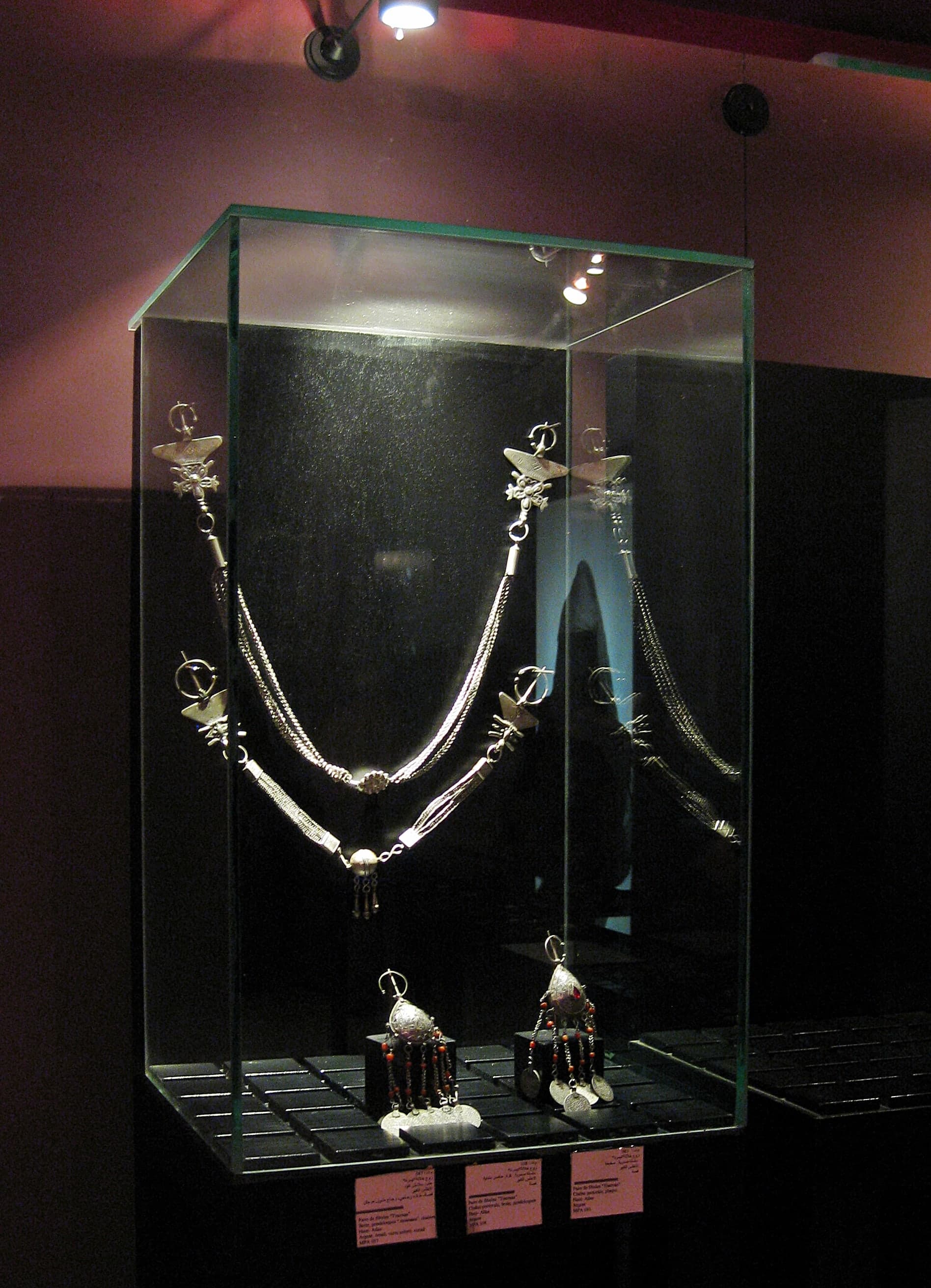
Triangular plates that were clasps first, ornaments second
The elaborate triangular plates were fibulae — functional pins that fastened garments at the shoulder or chest. The decorative surface was the result of that structural need: a large, flat area that could take engraving, filigree, or applied ornament while still doing the work of holding cloth. The design follows the same logic as Roman or medieval brooches, but the regional patterns — geometric, sometimes incorporating enamel or coral — are distinctly Maghrebi.
Melted coins as raw material
Silver jewellery in these communities was often made by melting down coins. That gave the metal a double function: it was currency converted into wearable wealth, portable and retrievable. A woman's jewellery was her own property, passed down through generations or, if necessary, melted back into coin or trade weight. The silversmith's skill lay in transforming legal tender into regionally legible ornament without losing the metal's exchange value.
Jewish silversmiths working in Berber styles
In many towns and cities, the silversmiths were Jewish. They produced jewellery in Berber styles alongside other forms, adapting to local demand and regional variation. This was a specialist craft that crossed community boundaries: the makers and the wearers observed different social and religious practices, but the objects themselves carried Amazigh visual identity. The arrangement reflects a broader pattern in North African craft economies, where certain trades were associated with particular groups.
The story
Amazigh jewellery was made to be worn, inherited, and if necessary, converted back into silver. Women in rural areas of the Maghreb — the region spanning Morocco, Algeria, Tunisia and Libya — wore necklaces, bracelets, earrings and large triangular brooches, all typically made of silver. The metal itself was often sourced from melted coins, so the jewellery functioned as portable wealth: property a woman owned herself, which could be passed to her daughters or, in harder circumstances, returned to its monetary form.
The triangular plates are fibulae, a term for brooches that fasten cloth. They pinned garments at the shoulder or across the chest, and their size and flatness made them ideal surfaces for decoration. Silversmiths engraved them, applied filigree, or set them with enamel and coral. The patterns vary by region, but they share a geometric vocabulary and a density of ornament that makes them immediately recognisable as Maghrebi work.
The makers were specialists, and in many places they were not Amazigh themselves. Jewish silversmiths worked in towns and cities across North Africa, producing jewellery in Berber styles as well as other forms. They adapted to regional preferences and evolving techniques, and their work was worn by women whose communities they did not belong to. The jewellery carried Amazigh identity — it was a visual marker of rural Berber culture, maintained by women and handed down through families — but the craft itself moved across social and religious boundaries that the wearers observed.
During the second half of the twentieth century, the tradition declined. Gold jewellery in different styles replaced silver, and the older pieces entered collections, public and private, alongside other rural artefacts like carpets and ceramics. Some motifs, particularly the hand symbol known in Arabic as hamsa or in Maghrebi dialect as khmissa, have been adapted into commercial fashion. But the historical jewellery itself — heavy, regional, made from coin silver by urban specialists for rural clients — represents a material culture that no longer functions as it did.
Why it mattered then
For the women who wore it, Amazigh jewellery was property they controlled. In societies where wealth and inheritance were often managed by men, a woman's silver was hers: it came to her from her mother or was given at marriage, and she could pass it on or, if circumstances required, convert it back into coin or trade it by weight. That made it both adornment and insurance. It was also identity. The jewellery marked regional and ethnic belonging in a way that was visible and specific. Different areas produced different forms and patterns, and a set of ornaments could place a woman within the Maghreb's cultural geography. Wearing silver jewellery, particularly the large fibulae, was part of the visual language of rural Amazigh life, maintained across generations by women even as other aspects of material culture shifted. The fact that much of it was made by Jewish silversmiths reflects the economic structure of North African towns. Certain crafts were associated with particular communities, and silversmithing was one of them. The relationship was commercial and sometimes longstanding, and it produced objects that carried the buyer's identity, not the maker's. The jewellery was Berber in style and function, even when the hands that shaped it observed different customs.
Why it matters now
Amazigh jewellery sits in collections now, and the tradition it belonged to has largely ended. Gold replaced silver, rural dress codes changed, and the objects that once moved from mother to daughter are more likely to be catalogued than worn. That shift happened within living memory, and it makes the jewellery a record of a material culture that functioned differently from the one that succeeded it. It also raises questions about what happens when an object's original use stops. The silver was valuable because it could be worn, inherited, or melted — it had a social and economic role that depended on it staying in circulation. Collected and displayed, it becomes something else: evidence of a tradition, a style, a set of regional variations. The hamsa motif has been commercialised and now appears in fashion contexts that have no connection to Maghrebi rural life, which is a common trajectory for symbols that lose their original function. The cross-community craft arrangement — Jewish silversmiths making Berber jewellery — is also part of a history that has mostly ended. Jewish communities in North Africa were large and longstanding, and their involvement in trades like silversmithing was a structural feature of the region's economy. That structure no longer exists in the same form, and the jewellery is one of the things that records it.
The surprising detail
The jewellery was often made from melted coins, which meant it held its value in a very direct way. If a family needed cash or faced economic hardship, the silver could be melted back down and converted into currency or traded by weight. This wasn't a degradation of the object — it was part of its design. The silversmith's work added value through skill and regional style, but the metal itself never stopped being a form of portable wealth. A fibula could be an heirloom, an ornament, and a financial reserve, all at once.
What is disputed
The demographic distribution of Amazigh communities across North Africa is recorded, but the historical scale and regional variation of jewellery production is less precisely documented. The transition away from silver jewellery is described as happening during the second half of the twentieth century, but the timing and causes varied by region and are not uniformly recorded.
Remember this
Silver jewellery in the Maghreb was wealth you could wear, inherit, or melt back into coin — and it was often made by specialists outside the community that wore it.
Test yourself
Why would jewellery made from melted coins be particularly suited to a system where women controlled their own wealth?
Because the metal retained its exchange value even after it was shaped into ornament. A woman's jewellery was her property, but unlike land or livestock, it was portable and could be converted back into currency or traded by weight if needed. Melting coins into jewellery didn't destroy their worth — it stored it in a form that could be worn, displayed as a marker of status and identity, passed to daughters, and still retrieved as silver if circumstances changed. The craft added value through design and regional style, but the underlying asset remained liquid. That made it a form of wealth that could move through inheritance along female lines and be accessed independently of male-controlled property.