III · THE WORK · ART HISTORY
Klimt's The Kiss
▶ Listen · narrated
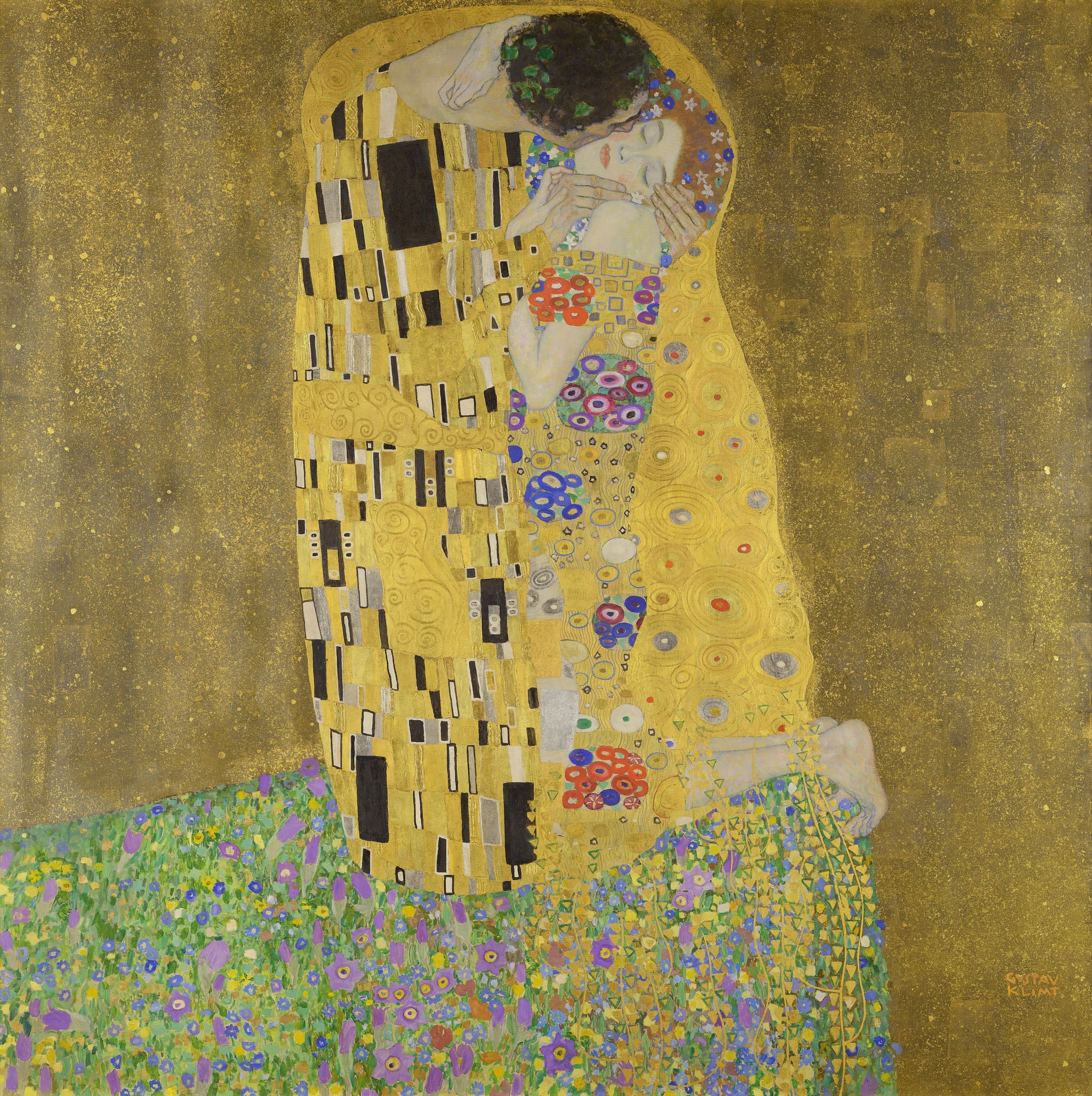
The figures are wrapped in robes patterned with rectangles and circles in gold leaf, but their skin is modelled with the shadowed naturalism of a Renaissance portrait.
At a glance
- Artist
- Gustav Klimt
- Date
- 1907
- Materials
- Oil paint, gold leaf, silver, platinum on canvas
- Dimensions
- 180 × 180 cm (square)
- Collection
- Belvedere, Vienna
Look closer
Rectangles on his robe, circles on hers
The man's robe is covered in vertical black and white rectangles, arranged in irregular columns. The woman's dress carries concentric circles and spirals, along with flower-like forms. Both patterns are worked in gold leaf, silver and platinum applied to the canvas, so they catch the light as flat metallic surfaces rather than as painted illusions of fabric. The gold is real metal, not pigment mixed to look like it.
Naturalistic hands and faces inside the pattern
The hands and faces are painted with conventional three-dimensional modelling: shadows under the cheekbones, highlights on the knuckles, warm and cool tones in the skin. They read as solid forms in space. Everything else — the robes, the ground, the flowers — is treated as flat pattern. The painting sets two incompatible systems against each other in the same frame: one that describes volume and one that describes surface.
The flowered ledge they kneel at the edge of
The couple kneels on a patch of ground that tilts up toward the picture plane, covered in stylised flowers rendered as flat shapes. The ledge or slope they are on appears to drop away just beyond them, though the background gives no depth cues — it is a continuous gold field. The flowers continue the decorative treatment of the robes, but the precarious angle of the ground introduces a spatial tension the rest of the picture refuses to resolve.
The story
Klimt painted The Kiss in 1907, using oil paint, gold leaf, silver and platinum on a square canvas 180 centimetres on each side. It depicts two figures embracing, their bodies almost entirely hidden by robes decorated with geometric and organic patterns. The man's robe is covered in vertical black and white rectangles. The woman's dress carries circles, spirals and flower-like forms. Both are worked in gold leaf and other metals applied directly to the canvas, so the surface is physically metallic, not an illusion of it.
The faces and hands are painted in a completely different manner. They are modelled with the three-dimensional techniques of naturalistic portraiture: shadows, highlights, warm and cool tones that describe volume. The woman's face tilts back, eyes closed. The man's face is turned away, visible only in profile. Their hands — his cradling her face, hers resting on his neck and wrist — are painted with the same attention to anatomical form.
The ground they kneel on is treated as flat pattern, covered in stylised flowers that continue the decorative logic of the robes. It tilts steeply upward, so the couple appears to be at the edge of a drop, though the gold background offers no spatial information to confirm or deny this. The entire composition except the hands and faces is organised as surface ornament, not as a description of three-dimensional space.
The painting was exhibited in 1908 under the title Liebespaar, meaning the lovers, as recorded in the exhibition catalogue. It now hangs in the Belvedere museum in Vienna. Scholars refer to the period when Klimt made this work as his Golden Period, a phase in which he used gold leaf extensively. The decorative style is influenced by Art Nouveau, the international movement characterised by organic and curvilinear forms, and by the earlier Arts and Crafts movement.
The result is a painting that operates in two registers at once. The gold leaf and geometric ornament belong to a world of flat decorative pattern. The faces and hands belong to a world of illusionistic volume. Klimt does not reconcile them. He places them in the same frame and lets the tension stand.
Why it mattered then
The painting was made during a period when Klimt was working extensively with gold leaf, a technique that connected his work to Byzantine mosaics and to the decorative arts rather than to the traditions of easel painting. The use of real metal on canvas was a deliberate choice to treat the picture surface as a material object, not as a transparent window. This aligned with broader movements in European art and design at the time — Art Nouveau and the Vienna Secession, the local variation — which sought to break down the hierarchy between fine art and decorative art, and to treat pattern, surface and ornament as worthy of the same attention as narrative or representation. The painting was exhibited in 1908 as Liebespaar, and it was received as part of this wider conversation about what painting could be when it stopped pretending to be something other than paint, metal and canvas.
Why it matters now
The painting remains a clear example of a picture that refuses to choose between decoration and representation. Most paintings either describe space or they decorate a surface; this one does both, and does not resolve the contradiction. The faces are painted as though they belong to a Renaissance portrait. The robes are treated as though they belong to a textile design. The two systems are incompatible, and Klimt has placed them in direct contact. This makes the painting useful for thinking about what happens when an image operates in two modes at once — when it is both a depiction of something and a patterned object. It is also a painting whose physical materials are part of its meaning: the gold is not a representation of gold, it is gold, and that flatness is set against the illusionistic depth of the hands and faces. The clash is the subject.
The surprising detail
The canvas is square — 180 centimetres on each side — which is an unusual format for a painting of two figures. Most portraits and figure compositions are vertical or horizontal rectangles. The square format gives equal weight to the decorated robes and the figures inside them, so neither the ornament nor the bodies dominate the composition. It also makes the picture symmetrical in a way that reinforces the decorative reading: the square is a shape associated with pattern and design, not with the framing of narrative space.
What is disputed
The identities of the figures are not recorded in the verified material, and the painting was exhibited under the generic title Liebespaar — the lovers — rather than as a portrait of named individuals. Interpretations of the spatial arrangement and the symbolic meaning of the patterns are matters of scholarly discussion, not of documented intent.
Remember this
Real gold leaf over naturalistic faces — the painting is about the clash between the two systems, not their harmony.
Test yourself
Why does using real gold leaf instead of gold-coloured paint change what the robes mean in the picture?
Because gold leaf is a flat, reflective surface that catches light as a physical material, not as an illusion of depth. When you use gold paint, you are creating the appearance of gold within the pictorial space — it recedes, it models form, it participates in the fiction of three dimensions. When you use actual gold leaf, you are asserting that the canvas is a material object with a metallic surface. The gold does not recede; it stays on the picture plane. This makes the robes function as decoration rather than as clothing in a depicted space. The choice of real metal forces the viewer to read those areas as pattern and surface, which sharpens the contrast with the naturalistically painted faces and hands. The painting becomes about the collision of two incompatible modes: one that describes volume and one that describes surface.
Go deeper
Image: Gustav Klimt, Public domain. Licence: Public domain. Source.