III · THE WORK · ART HISTORY
The Bust of Nefertiti
▶ Listen · narrated
Nefertiti's portrait was found in the ruins of a sculptor's studio, and the missing eye tells us it was never meant to leave that room.
At a glance
- Date
- 1350 BC
- Material
- Limestone with stucco coating and pigment
- Sculptor
- Thutmose
- Found
- 6 December 1912, Amarna
- Dimensions
- 49 cm high, 24.5 cm wide
- Collection
- Egyptian Museum of Berlin, Neues Museum
Look closer
The missing left eye inlay
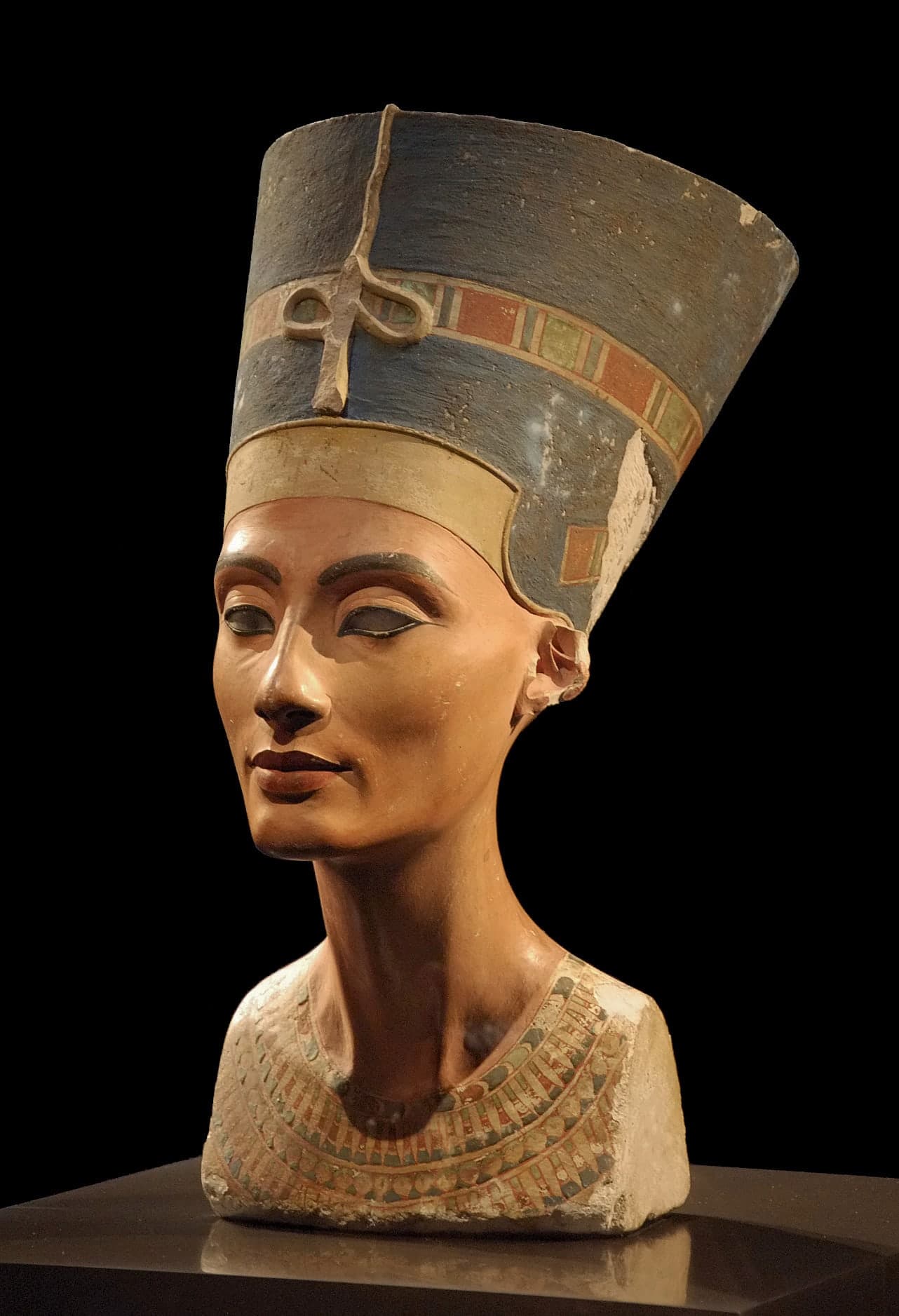
The right eye is complete: a piece of rock crystal set into the socket, with a painted black pupil behind it. The left eye is an empty hollow, smoothed and prepared but never filled. This is not damage from burial or handling. The socket is clean, finished work, waiting for an inlay that was never installed. The asymmetry suggests the bust remained in the workshop, a reference piece the sculptor could consult when carving royal portraits to be finished and installed elsewhere.
The flat-topped crown
Nefertiti wears a tall blue crown with a flat top and a single ribbon descending the back. The form is distinct in surviving images of her — other royal women of the period are shown in different headdresses. The crown's sides taper inward as they rise, and a band wraps the base where it meets the brow. The blue pigment, applied over stucco, remains vivid. Whether this crown had a symbolic or ceremonial function, or was simply a recognisable element of her iconography, is not recorded in surviving texts.
Neck lines cut to suggest tendon and strain
Three horizontal grooves are carved across the front of the neck. They are shallow, deliberate, and placed where the platysma muscle — the thin sheet that tenses the neck — would crease the skin when the head is held upright. The lines are a sculptural choice, not a naturalistic portrait of aging. They give the neck a sense of structure and tension, as though the weight of the crown is being carried. Other Egyptian royal portraits of the period show smooth, unlined necks. The decision to include these lines is specific to this bust.
The story
A German archaeological team led by Ludwig Borchardt found this bust on 6 December 1912, in the buried ruins of a sculptor's workshop at Amarna, the short-lived capital city built by the pharaoh Akhenaten. The workshop belonged to a sculptor named Thutmose, identified from inscribed material found at the same site. The bust was one of several royal portraits recovered from the same rooms, along with plaster casts, trial pieces, and unfinished work — the contents of a studio abandoned in haste or simply left when the city was depopulated after Akhenaten's death.
The bust is limestone, shaped and smoothed, then coated in a layer of stucco — a fine plaster that could be modelled and painted. The surface was coloured: the skin a pale ochre, the lips red, the blue crown still vivid, the ribbon yellow. The right eye is inlaid with a piece of rock crystal, backed with black paint to form the pupil, and set into a surround of black wax. The left eye socket is finished and smooth, but empty. No matching inlay was found in the workshop debris, and the surface of the socket shows no sign that one was ever installed and later lost.
This asymmetry suggests the bust was not a finished portrait meant for display in a temple or tomb. It was a model — a reference object kept in the studio so that other sculptors or apprentices could copy the features, the proportions, the details of costume and regalia when carving other images of Nefertiti. The completed right side showed what the finished work should look like. The unfinished left side showed the underlying structure: how the eye socket was prepared, how deep the inlay should sit, how the transition from stone to stucco to paint was managed. A model that would never be seen by the public did not need both eyes.
The face is symmetrical, idealised, and calm. The cheekbones are high, the jawline smooth, the mouth small and level. There is no individualising detail that would let us say whether this resembles the historical woman. Egyptian royal portraiture of this period followed conventions — what mattered was the iconography, the regalia, the readability of the image as a representation of royal authority, not a likeness in the sense a modern portrait aims for. The flat-topped crown, the particular proportions of the face, the way the neck is carved — these are the elements that identify the subject as Nefertiti, not a unique physiognomy.
The bust has been in Germany since its excavation. It was taken to Berlin, displayed briefly, then moved repeatedly during and after wartime: to a bank cellar, to a salt mine at Merkers-Kieselbach for safekeeping, then to various Berlin museums as buildings were rebuilt and collections reorganised. It has been kept at the Dahlem museum, the Egyptian Museum in Charlottenburg, and the Altes Museum. It is now in the Neues Museum, the same building where it was displayed before the war. Egypt has called for its return since 1924, when it was put on public view. The argument turns on the terms under which the excavation was conducted and the documentation signed at the time. A protocol, signed by the German excavators and the French-led Egyptian Antiquities Service, is cited by German officials as evidence of legal transfer. Egypt disputes the circumstances of that agreement and argues that an object of such significance should not have left the country under any terms. The dispute has continued for a century and remains unresolved.
Why it mattered then
Nefertiti was married to Akhenaten, the pharaoh who briefly moved Egypt's religious and political centre to Amarna and promoted the worship of the Aten — the sun disc — above the traditional pantheon. The move was radical and short-lived. After Akhenaten's death, the court returned to Thebes, the old temples were restored, and Amarna was abandoned. Nefertiti's prominence during Akhenaten's reign is clear from the number and scale of images that survive, though the details of her political role are not recorded in texts that have come down to us. The bust was made around 1350 BC, during or shortly after her lifetime, in a workshop that produced royal images for temples, palaces, and tombs. Thutmose's workshop at Amarna held reference models, trial pieces, and works in progress when it was abandoned — evidence of an industrial process for producing the repetitive, idealised imagery that Egyptian royal iconography required. The bust's function as a studio model rather than a public monument tells us something about how that system worked: a master image, refined and approved, kept on hand so that the same face, the same proportions, the same details could be reproduced across multiple commissions without variation. Consistency mattered. A goddess or a queen had to be recognisable, and recognisability required standardisation.
Why it matters now
The bust has been displayed continuously in Berlin since 1924, with interruptions only for wartime storage. It has been photographed, reproduced, and adapted widely since then. That familiarity has made it a symbol in arguments about museum collections, colonial-era excavations, and the return of cultural property. Egypt's request for repatriation has been repeated by successive governments for a century, and the German refusal has been equally consistent. The case is cited whenever museums are asked to account for how their collections were assembled and whether legal acquisition at the time is sufficient justification for permanent retention now. The bust also sits uncomfortably in discussions of authenticity and reconstruction. The stucco surface, the pigments, the inlaid eye — all of these are restoration decisions as well as ancient techniques. How much of what we see is original material and how much is modern repair or stabilisation is not always visibly clear, and that ambiguity complicates the object's status as evidence. It is both an archaeological find and a curated image, shaped by the choices of conservators as well as the sculptor who made it. The missing eye, which makes the bust so distinctive, is also the detail that marks it as unfinished — a reminder that what we are looking at was never meant to be the final version.
The surprising detail
The bust has been moved repeatedly since its discovery, but never returned to Egypt, not even temporarily. During wartime it was stored in a salt mine at Merkers-Kieselbach for safekeeping, alongside other Berlin museum collections. After the war it was held in the Dahlem museum, then moved to the Egyptian Museum in Charlottenburg, then to the Altes Museum, and finally to the Neues Museum, where it is now displayed in the same room it occupied before the war. Each move has been within Germany. Egypt's requests for return, or even for temporary loan, have been refused on the grounds that the object is too fragile to travel — an argument that applies to a journey of any distance, including the short trip back to the building where it was found. The bust that has survived three thousand years, a salt mine, and six museum relocations is now officially too delicate to leave Berlin.
What is disputed
The identification of the subject as Nefertiti rests on the context of the find — the bust was recovered from a workshop at Amarna that produced royal images during Akhenaten's reign, and the iconography matches other depictions labelled as Nefertiti. No inscription on the bust itself names her. The flat-topped crown is associated with her in other images, but whether it had a specific ceremonial or symbolic function is not recorded in surviving texts. The legal status of the bust's transfer from Egypt to Germany is disputed: German officials cite a protocol signed at the time of excavation as evidence of lawful acquisition, while Egypt argues that the terms of that agreement were misrepresented or that objects of such significance should not have been permitted to leave the country under any circumstances. The argument has not been resolved.
Remember this
The missing eye is not damage. It is evidence that the bust was a sculptor's reference model, not a finished portrait meant to be seen.
Test yourself
Why does the fact that the bust was found in a sculptor's workshop, rather than in a tomb or temple, change how we should interpret the missing eye?
Because a workshop model had a different function from a public monument. A bust made for display in a temple or tomb would need to be complete — both eyes inlaid, all surfaces finished — because it would be seen by priests, mourners, or the gods. A reference model kept in a studio for apprentices to copy needed only one side finished, to show what the completed work should look like, and one side unfinished, to show the underlying structure and technique. The empty eye socket is not a flaw or an accident. It is evidence that the bust was a teaching tool, not a devotional object, and that it was never meant to leave the room where it was made. That changes what the object is: not a portrait of Nefertiti for her own time, but a template for making portraits of Nefertiti, preserved by chance when the workshop was abandoned.
Go deeper
Image: Philip Pikart, CC BY-SA 3.0. Licence: CC BY-SA 3.0. Source.