I · THE OBJECT · BRITISH MUSEUM
The Statue of Tara
▶ Listen · narrated
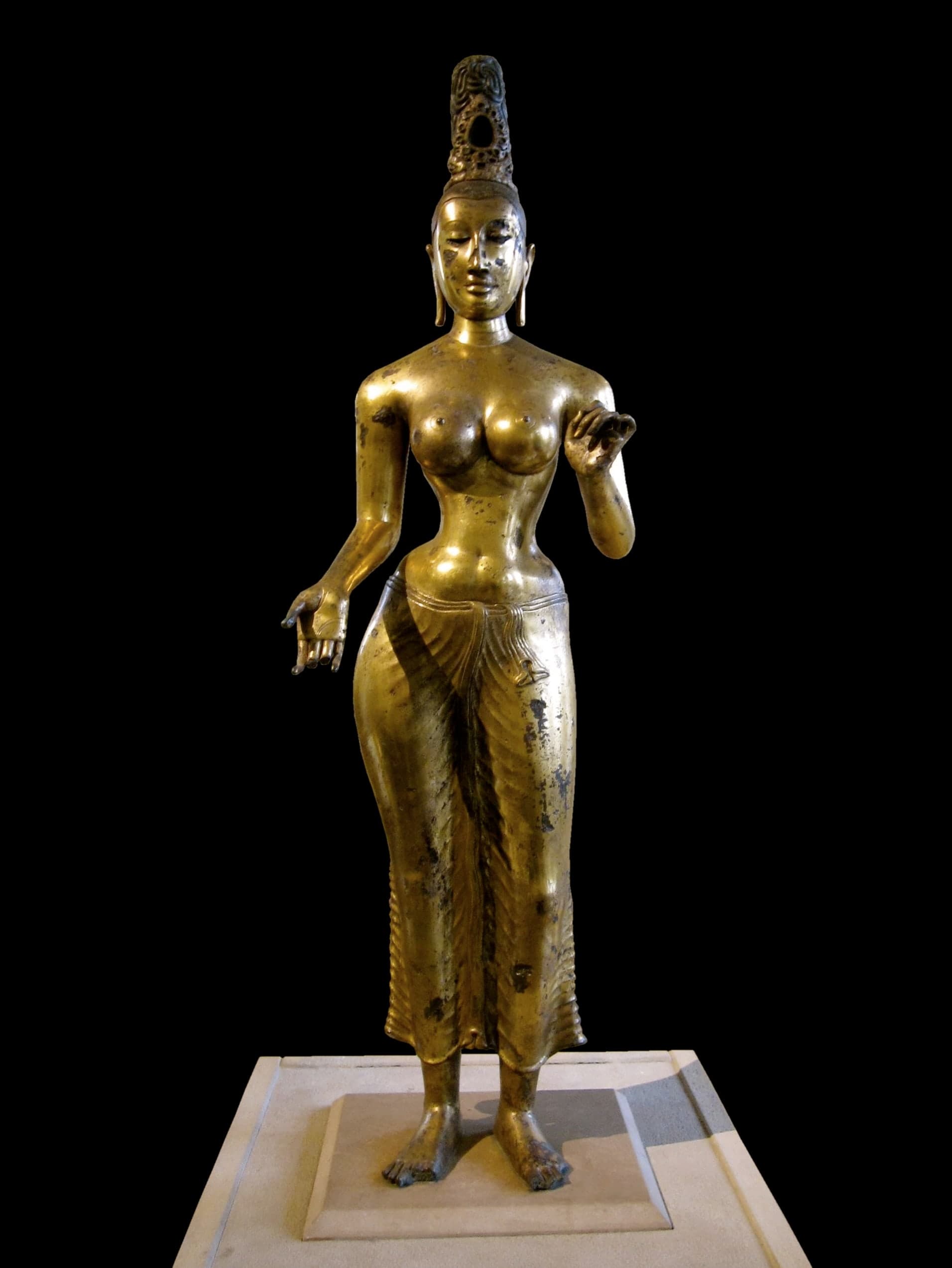
She stands life-size, gilded, one hip shifted in a pose that ninth-century Sri Lankan sculptors understood as grace. Victorian curators saw immodesty, and locked her away for sixty years.
At a glance
- Date
- 9th century
- Material
- Bronze with gilding
- Height
- 143 cm
- Width
- 44 cm
- Technique
- Lost-wax casting
Look closer
The gilding survives in patches
The surface shows bronze beneath a layer of gold. The gilding — gold applied over the cast bronze — remains visible in places, particularly in recessed areas where handling and cleaning were less likely to wear it away. The contrast between the dark bronze and the surviving gold traces gives a sense of how the statue would have appeared when the gilding was intact: a figure that caught light across its entire surface, gleaming in lamplight or daylight inside a shrine.
Lost-wax casting at this scale
At 143 centimetres tall, this statue required a sophisticated lost-wax casting process. The sculptor modelled the figure in wax over a clay core, encased that model in an outer clay mould, then melted the wax out and poured molten bronze into the cavity left behind. Casting a hollow figure of this size without cracking or distortion during cooling demanded control of metal temperature, mould thickness, and pouring speed. The technique was established in the region by this period, but each large work still carried the risk of failure — a flawed cast meant starting again.
The posture is tribhanga
The figure stands with weight on one leg, the opposite hip shifted outward, creating a gentle S-curve through the torso. This posture, described in Sanskrit texts on sculpture as tribhanga — three bends — was a standard way of showing a deity at ease rather than in formal symmetry. The shift in the hips, the turn of the shoulders, and the tilt of the head each contribute to the curve. It is a sculptural language for grace, widely used across Buddhist and Hindu traditions in representations of both male and female deities.
The story
The statue represents Tara, a figure central to Buddhist practice across much of Asia. In Sri Lanka, as in Tibet, Nepal, and parts of India and Southeast Asia, Tara was invoked as a protector and guide — a bodhisattva, meaning a being who has attained enlightenment but remains accessible to those who call on her. The iconography is consistent with other depictions of Tara from the region and period: the posture, the hand gestures, the ornaments.
The statue was made in the ninth century using lost-wax casting, a technique that allowed the sculptor to model fine detail in wax before casting the form in bronze. Once cast, the surface was gilded. Gold was applied over the bronze, probably by one of two methods: mercury gilding, in which gold is mixed with mercury, painted on, and then heated so the mercury evaporates and leaves a bonded gold layer; or gold leaf, pressed and burnished onto an adhesive ground. The gilding survives in patches, enough to show that the entire figure was once covered.
The statue entered the British Museum in 1830. It was given by Robert Brownrigg, who had served as governor of Ceylon — the colonial name for Sri Lanka. The circumstances under which Brownrigg acquired the statue are not recorded in detail. Some accounts suggest it was taken from the last King of Kandy when the British annexed Kandy in the early nineteenth century; others leave the provenance unspecified.
Once in the museum, the statue was not displayed. It was kept in storage for much of the nineteenth and early twentieth centuries. The reason, documented in museum correspondence and catalogue notes, was that curators considered the figure's body — bare-breasted, the torso and limbs visible beneath jewellery and a lower garment — unsuitable for public exhibition. The same judgment applied to other sculptures from Sri Lanka and the wider region in the collection, but the Tara statue, being life-size and prominently gilded, seems to have attracted particular concern.
It was not until the mid-twentieth century that the statue was put on display. Attitudes toward the representation of the body in religious art had shifted, and the museum's galleries were reorganised to present sculpture in a context that emphasised religious function rather than Victorian propriety. The statue has been on public view since then.
Why it mattered then
In ninth-century Sri Lanka, a gilt-bronze statue of this scale represented a significant allocation of resources and skill. Bronze casting required access to copper and tin, control of high-temperature furnaces, and sculptors trained in a specific visual and technical tradition. Gilding added another layer of expense and meaning: gold, which does not tarnish, was associated with the incorruptible and the divine. Tara's role in Buddhist practice meant that a statue like this would have been housed in a temple or shrine, where it served as a focus for offerings, prayers, and ritual. The physical presence of the statue — its size, its gleaming surface, its posture — was part of the practice. It was not a representation in the sense of a picture standing in for an absent figure. It was understood as a locus, a place where the deity's presence could be accessed. The statue's survival suggests it was valued and protected, possibly moved or hidden during periods of instability. Sri Lanka in the medieval period saw shifting political centres, invasions from neighbouring regions, and periodic disruptions to monastic and temple life. A work of this scale and material value would have been vulnerable, and the fact that it was not melted down or destroyed indicates it retained religious significance even as political circumstances changed.
Why it matters now
The statue is now part of ongoing discussions about the provenance of objects acquired during colonial rule. The connection to Robert Brownrigg and the British annexation of Kandy places it within a broader pattern: objects that left their places of origin during periods of conquest or political control, and that are now held in institutions far from where they were made and used. Sri Lanka has requested the return of objects taken during British rule, and the Tara statue is among those named in repatriation discussions. The museum's position is that objects in its collection are held in trust for a global public, and that questions of return are considered case by case, taking legal and ethical factors into account. The debate is not settled, and the statue remains in London. The history of the statue's display — or non-display — also matters now as a case study in how museums have shaped public access to art on moral grounds that later generations find arbitrary. The decision to keep the statue in storage was not about protecting the object; it was about protecting visitors from what curators assumed they should not see. That history is part of the object's biography, and it raises questions about whose standards govern what is shown and what is hidden.
The surprising detail
The statue was kept in storage for decades, not because it was fragile or damaged, but because curators judged it indecent. The concern was not unique to this object — other sculptures from Sri Lanka and neighbouring regions in the British Museum's collection were similarly withheld from display during the same period — but the Tara statue, being nearly life-size and visibly gilded, seems to have been considered particularly unsuitable for public view. Museum records show that the decision was explicitly about the representation of the female body, not about conservation or space. It was not displayed until the mid-twentieth century, when the museum's approach to religious sculpture changed.
How it got here
The statue was given to the British Museum in 1830 by Robert Brownrigg, who served as British governor of Ceylon (now Sri Lanka). Some accounts suggest the statue was taken from the last King of Kandy when the British annexed Kandy in the early nineteenth century, though the details of its acquisition are not fully documented. Sri Lanka has requested the return of objects acquired during British rule, and the statue is among those named in repatriation discussions. The British Museum's position is that it holds objects in trust for a global public and considers questions of return on a case-by-case basis.
Remember this
A goddess cast in bronze and covered in gold, then locked away for sixty years because Victorian curators could not separate religious iconography from their own discomfort.
Test yourself
Why does the statue's long period in storage matter to how we understand museum collections now?
Because it shows that access to objects has never been neutral. The decision to withhold the statue was not based on the object's condition or scholarly importance — it was based on a judgment about propriety that had nothing to do with the statue's original function or meaning. That history reveals how museums have acted as gatekeepers, shaping what the public could see according to the moral standards of a particular time and place. It also raises a question that remains unresolved: when an institution holds objects from other cultures, whose standards should govern how they are interpreted, displayed, and made accessible? The statue's biography — made in ninth-century Sri Lanka, acquired in the context of colonial annexation, hidden for decades, now displayed and also subject to repatriation requests — is a compressed version of the larger history of museums and empire.
Go deeper
Image: CC BY-SA 3.0. Licence: CC BY-SA 3.0. Source.