III · THE WORK · ART HISTORY
Al-Wasiti's Maqamat al-Hariri
▶ Listen · narrated
The Maqamat al-Hariri records a fictional swindler's adventures across the Islamic world, illustrated with scenes of daily life rarely preserved in other manuscript traditions.
At a glance
- Author
- Al-Ḥarīrī of Basra (1054–1122)
- Genre
- Maqāma — a form of rhymed prose tale
- Protagonist
- Abū Zayd of Saruj, a fictional trickster
- Illustrated manuscripts
- Thirteen known, from over a hundred total
- Production centres
- Syria, Iraq (1200–1256); Egypt (c.1300–1337)
Look closer
Faces individuated by expression, not rank
The figures in these manuscripts are not idealised or arranged by social hierarchy alone. A slave being inspected in a market is drawn with as much attention to posture and gesture as the men examining him. Courtroom audiences show individuals leaning, whispering, attending or ignoring the speaker. The illustrator — named as Yahya ibn Mahmud al-Wasiti in the 1237 manuscript — used facial expression and body language to distinguish character, not merely to signal status.
The camel caravan crossing the page
A caravan scene shows camels in profile, their necks and legs forming a rhythm across the width of the page. The animals are loaded with goods, their heads turned at different angles. The composition treats the caravan as a procession through space, not a static group. Travel is central to the Maqamat's structure — Abū Zayd moves from town to town — and the illustrations record the vehicles, animals and routes that made that movement possible.
Text and image sharing one ruled frame
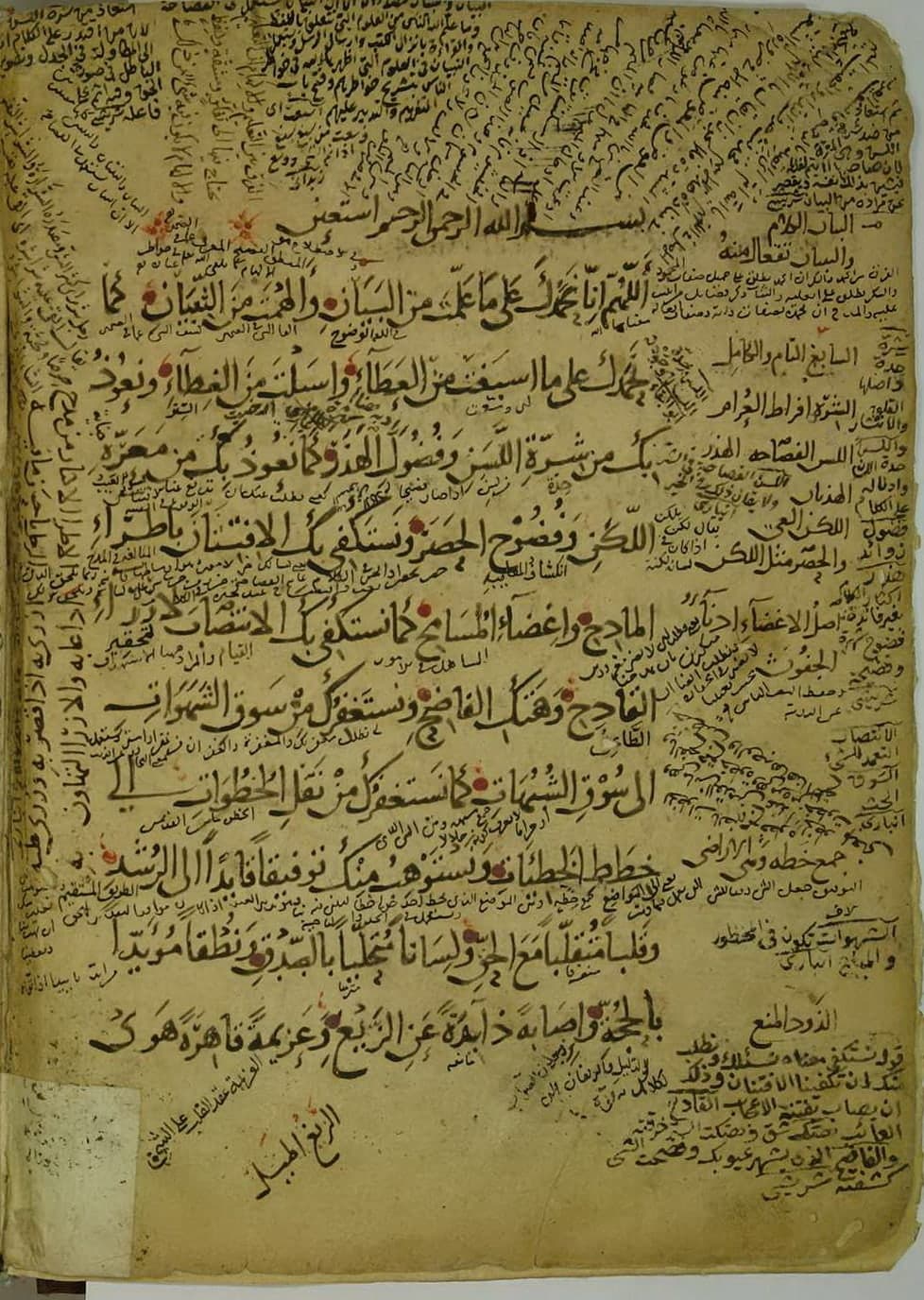
The manuscript pages are ruled, with text in horizontal lines and illustrations occupying rectangular zones within the same grid. The images are not separate plates inserted into the book; they sit on the same surface as the writing, bounded by the same red or black lines. This layout treats picture and prose as parts of a single designed page, both contained within the structure of the codex.
The story
The Maqāmāt al-Ḥarīrī is a collection of fifty tales written at the end of the eleventh or the beginning of the twelfth century by al-Ḥarīrī of Basra, a poet and government official of the Seljuk Empire. The text follows the adventures of Abū Zayd of Saruj, a fictional character who travels from place to place and deceives those around him using his skill in the Arabic language to earn rewards. The form — called a maqāma, meaning an assembly or a session — combines rhymed prose with verse, and had been established by an earlier writer whose work survives from the late tenth century. Al-Ḥarīrī's version became extremely popular, with reports that seven hundred copies were authorised by the author during his lifetime.
The text itself contains no pictures. The illustrated manuscripts came later. The earliest known copies date from the thirteenth century, and eight illustrated manuscripts are recorded from that period. Altogether, more than a hundred manuscripts of the Maqamat are known, but only thirteen are illustrated. They were produced over a period of about a hundred and fifty years, in two phases. The first runs from around 1200 to 1256, in areas between Syria and Iraq. Then there is a gap of about fifty years, corresponding to the Mongol invasions — the invasion of Persia and Mesopotamia, including the siege of Baghdad in 1258, and the invasion of the Levant. The second phase runs from around 1300 to 1337, during the Egyptian Mamluk period, with production probably centred around Cairo.
The 1237 manuscript, now in the Bibliothèque Nationale de France, was made in Baghdad and is signed by an illustrator named Yahya ibn Mahmud al-Wasiti. Another well-known manuscript dates from 1334 and was made in Egypt or Syria; it is now in the National Library of Austria. The illustrations show scenes from the tales: caravanserais, courtrooms, libraries, mosques, markets including a slave market, and journeys by camel and boat. The figures are drawn with attention to posture, gesture and expression, and the settings include architectural detail and objects of daily use.
The Maqamat manuscripts belong to the category of secular Arabic manuscripts, as distinct from religious works such as illustrated Qur'ans. The tales themselves are literary performances, showcasing virtuosity in language, but the illustrations record a material world — the spaces, tools, animals and social encounters of the Abbasid period — that survives in few other illustrated manuscripts from this time and place.
Why it mattered then
The Maqamat was popular because it displayed mastery of the Arabic language. The tales are constructed around rhetorical set pieces — speeches, poems, word games — delivered by Abū Zayd in different disguises and settings. For a reader in the twelfth or thirteenth century, the pleasure was partly in the plot twists and partly in the linguistic performance itself: the rhymes, the puns, the shifts in register. The text was copied, studied and memorised. The fact that al-Ḥarīrī reportedly authorised seven hundred copies during his lifetime suggests a readership that valued the work as a literary model, not merely as entertainment. The decision to illustrate the Maqamat was not inevitable. Most manuscripts were not illustrated, and the text does not require pictures to function. The illustrated copies were presumably commissioned by patrons who wanted a more elaborate object, and who were willing to pay for the additional labour of an illustrator. The choice to depict the scenes visually — rather than leaving them to the reader's imagination — created a record of how the settings and encounters were understood at the time the manuscript was made. The illustrations are not neutral: they interpret the text, choosing which moments to show and how to arrange the figures. But they also preserve details of dress, architecture, transport and social interaction that the text itself does not describe in full.
Why it matters now
The illustrated Maqamat manuscripts are among the surviving visual records of daily life in the Abbasid and early Mamluk periods. Religious manuscripts such as Qur'ans were illustrated with geometric and vegetal ornament, not with scenes of people and places. Secular illustrated manuscripts are rare, and those that survive are often courtly in subject — royal hunts, astronomical treatises, medical texts. The Maqamat illustrations are unusual because the tales themselves are set in ordinary urban and rural spaces: markets, inns, courtrooms, roads. The protagonist is not a king or a scholar but a wandering con artist, and the people he encounters are merchants, judges, travellers and slaves. This makes the manuscripts valuable as historical documents, even though they are works of fiction. The illustrators drew settings and objects that would have been recognisable to their audiences. The architecture, the clothing, the animals, the goods being sold — these details were not invented from nothing; they were drawn from observation or convention, and they reflect what a thirteenth- or fourteenth-century viewer would have expected to see in such a scene. The manuscripts do not give us photographs, but they do give us a visual vocabulary: the forms and arrangements that were used to represent these spaces at the time. The gap in production between 1256 and around 1300 is also significant. The Mongol invasions disrupted the cultural and economic networks that had supported manuscript production in Iraq and Syria. The fact that illustrated Maqamat manuscripts resumed under Mamluk patronage in Egypt suggests a shift in where such work was valued and funded, and by whom.
The surprising detail
The Maqamat text became so widely copied that al-Ḥarīrī reportedly authorised seven hundred manuscripts during his own lifetime. That figure, if accurate, would mean that the author was directly involved in checking and approving copies for decades — an unusual level of authorial control for a medieval text. It also suggests that demand was high enough, and the copying process organised enough, that hundreds of manuscripts could be produced and distributed while the author was still alive to verify them. Most medieval texts circulated in versions that diverged over time, with scribes introducing errors or deliberate changes. The Maqamat seems to have been managed differently, at least in its early years, with the author acting as a guarantor of the text's correctness. Whether this arrangement continued after his death, and how it related to the later decision to add illustrations, is not recorded.
What is disputed
The exact number of illustrated Maqamat manuscripts is given as thirteen, but the phrase 'more than a hundred manuscripts of the work are known' leaves it unclear whether this count includes fragments, incomplete copies, or manuscripts that have been lost and are known only from records. The report that seven hundred copies were authorised by al-Ḥarīrī during his lifetime is a figure transmitted by later sources, not a documented inventory, and should be understood as an indication of the text's popularity rather than a precise count.
Remember this
The Maqamat manuscripts illustrate a con artist's travels, and in doing so preserve scenes of Abbasid daily life in a form that few other illustrated manuscripts from this period provide.
Test yourself
Why might the fifty-year gap in illustrated Maqamat production, between around 1256 and 1300, matter more than just a pause in copying?
Because the gap corresponds to the Mongol invasions of Persia, Mesopotamia and the Levant, including the siege of Baghdad in 1258. These invasions disrupted the political, economic and cultural networks that had supported manuscript production in Iraq and Syria. When illustrated Maqamat manuscripts resumed around 1300, they were being made in Egypt under Mamluk patronage, not in the earlier centres. This shift means that the manuscripts produced after the gap were made in a different political context, for different patrons, and possibly with different conventions of illustration. The gap is not just a pause; it marks a change in who was commissioning these manuscripts, where they were made, and what cultural infrastructure supported them.
Go deeper
Image: Al-Qāsim ibn 'Alī al-Ḥarīrī, CC0. Licence: CC0. Source.