I · THE OBJECT · BRITISH MUSEUM
Asante Goldwork
▶ Listen · narrated
These gold objects were made to measure value, display authority, and embody belief. Then they became plunder, catalogued in a museum whose acquisition records tell a different story from its labels.
At a glance
- Culture
- Asante Empire
- Date range
- 17th–19th century
- Material
- Gold, cast using lost-wax technique
- Acquisition
- Largely taken during the 1874 Anglo-Asante War
Look closer
Goldweights as portable value
Many of these small cast objects are goldweights — standardised masses used to measure gold dust in trade. They were made in geometric and figurative forms: abstract spirals, miniature tools, animals, human figures. Each weight corresponded to a specific mass, part of a system that let traders weigh out exact amounts of gold dust as currency. The abstraction is double: gold measuring gold, and value encoded in a form you could carry in a pouch.
Lost-wax casting in miniature
The weights were made by the lost-wax method: a model carved in wax, coated in clay, then heated so the wax melts out and molten gold pours into the void. The technique allows fine detail at small scale — some weights are no larger than a thumbnail — and each cast is unique, since the wax model is destroyed in the process. What survives is a record of a hand carving something that no longer exists.
Regalia and ritual objects
Alongside the weights are larger gold objects: ornaments, ritual items, objects associated with the court. Gold in the Asante Empire was not only a medium of exchange but a material of authority and spiritual significance. The worked gold in these collections was part of a system where material, craft, and power were inseparable — and where taking the gold meant taking more than metal.
The story
The Asante Empire, which lasted from 1701 to 1902 in what is now Ghana, built its wealth and power on gold. The empire controlled gold-producing regions and traded extensively with Europeans on the coast and with markets to the north. Gold was currency, but it was also regalia, ritual object, and symbol of the state itself.
Gold dust was the everyday medium of trade, and it had to be weighed. Asante craftsmen cast small brass and gold weights in standardised masses, each corresponding to a unit in a system that allowed precise transactions. The weights took geometric and figurative forms — spirals, crescents, animals, tools, human figures — and were made using the lost-wax technique. A model was carved in wax, encased in clay, and heated until the wax melted away. Molten metal poured into the cavity left behind. The clay mould was broken open to retrieve the cast, which meant each weight was unique. The figurative designs were not arbitrary: many represented proverbs, animals with symbolic meanings, or objects from daily life. A weight might depict a crocodile, a reference to a proverb about power and patience, or a sword, a sign of authority.
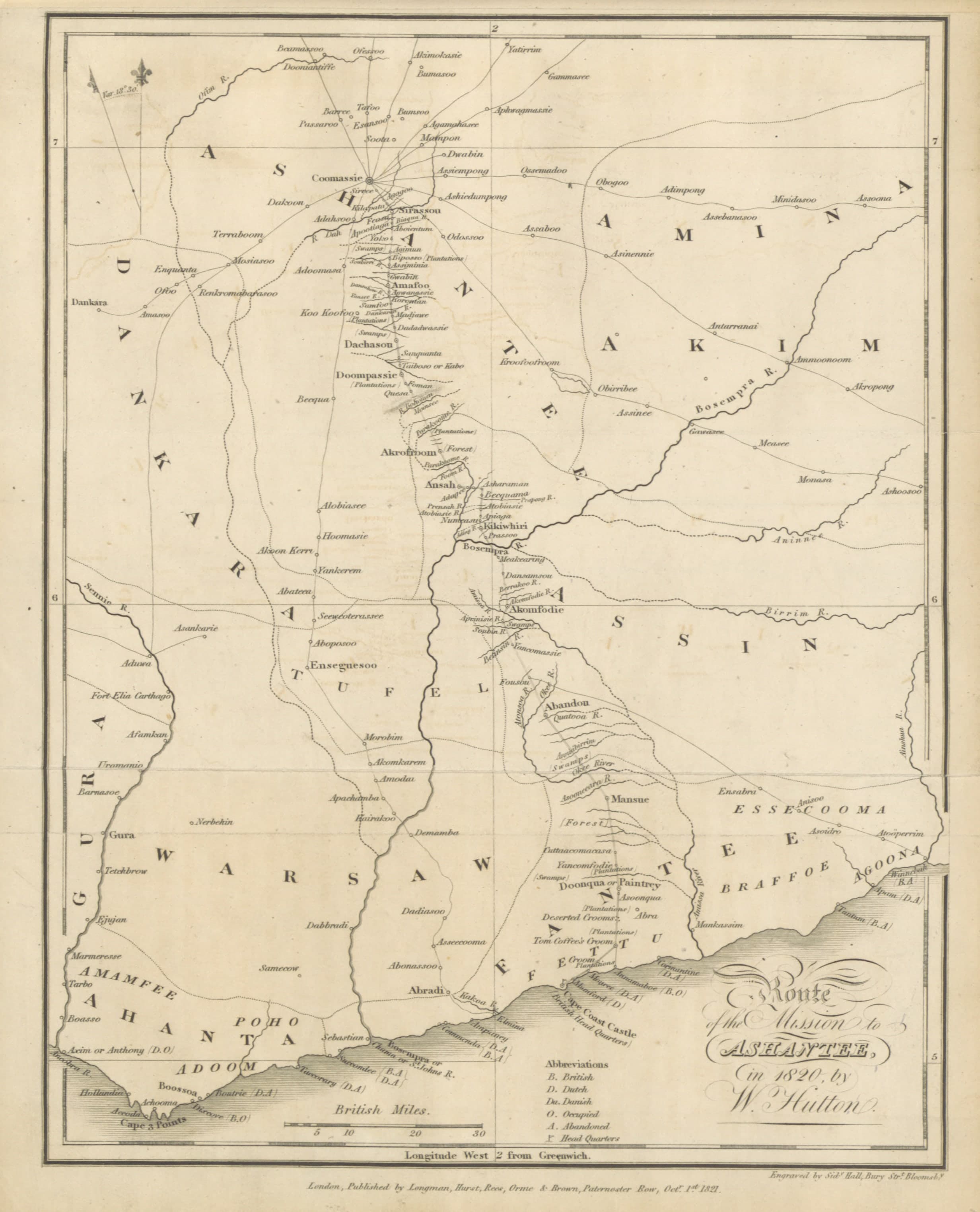
The British fought several wars with the Asante Empire across the nineteenth century. The Asante held their own in two of the five Anglo-Ashanti Wars. In 1824, Asante fighters killed British general Sir Charles MacCarthy; records state his skull was kept as a gold-rimmed drinking cup. But in 1874, British forces reached and burnt the Asante capital, Kumasi. They took gold objects from the court and from the city — regalia, weights, jewellery, ritual items. These objects were shipped to Britain, where they entered museum collections and private hands.
The goldweights and other objects now held in British museums were not ethnographic specimens collected through negotiation. They were taken during a military campaign that destroyed the capital. The records of acquisition often note the war but rarely name the individuals or institutions from whom the objects were taken, or under what immediate circumstances. What the labels call provenance is, in many cases, a record of seizure.
Why it mattered then
Gold was the material foundation of the Asante Empire's economy and the substance of its political authority. The empire's expansion in the late seventeenth and early eighteenth centuries gave it control of gold-producing regions and access to coastal trade with Europeans. Gold dust was currency, and the system of weights made it measurable and portable. The weights themselves were craft objects, often carrying symbolic meaning through their figurative forms, and they circulated widely in trade. But gold also had ritual and political significance. Worked gold objects were part of court regalia, and gold was associated with the authority of the Asante king and the unity of the state. When British forces took gold from Kumasi in 1874, they were not simply seizing wealth. They were taking objects that embodied the power and continuity of the Asante state. The act of removal was both economic and symbolic, a dismantling of the material culture that held the empire together.
Why it matters now
The Asante goldwork held in British museums is part of a wider debate about objects taken during colonial wars and held far from where they were made. The objects were not sold or donated. They were taken by force during a campaign that burnt the Asante capital, and they remain in collections whose acquisition records describe the war but rarely the individuals or communities from whom the objects were seized. Ghana, the modern state that includes the former Asante Empire, has called for the return of objects taken in 1874. The Asante kingdom survives as a constitutionally protected traditional state within Ghana, and the current king, Otumfuo Osei Tutu II, has been involved in discussions about repatriation. Some institutions have begun to return objects, while others have resisted or proposed loans instead of permanent return. The goldwork in British collections is not simply historical material. It is contested property, and the question of where it belongs is unresolved.
The surprising detail
In 1824, during the Anglo-Ashanti Wars, Asante forces killed British general Sir Charles MacCarthy. Records from the period state that his skull was kept as a gold-rimmed drinking cup, a claim that appears in multiple British accounts and became part of the narrative used to justify later military action against the Asante. Whether the skull cup existed, and whether it was used in the way described, is harder to confirm. The story served British purposes, framing the Asante as barbaric and the wars as civilising missions. But the detail about gold is consistent with Asante practice: gold was the material of authority, and turning an enemy's remains into a gold object was a statement of power. The cup, if it existed, was not a trophy in the European sense. It was a ritual object, a transformation of defeat into substance.
How it got here
Most of the Asante goldwork in British museums was taken during the 1874 Anglo-Asante War, when British forces burnt the capital, Kumasi, and seized gold objects from the court and the city. The objects were shipped to Britain and entered museum collections, often with acquisition records that note the war but not the specific individuals or institutions from whom they were taken. Ghana has called for the return of objects seized in 1874, and the Asante kingdom, which survives as a traditional state within Ghana, has been involved in repatriation discussions. Some institutions have returned objects or are in negotiation; others have resisted or proposed loans instead of permanent return. The question of ownership remains contested.
Remember this
Gold measuring gold, and then gold taken as plunder — the abstraction of value, and the violence that moved it across the world.
Test yourself
Why would taking gold objects from the Asante court have been understood as more than economic seizure?
Because gold in the Asante Empire was not only currency but also the material of political authority and ritual significance. Worked gold objects were part of court regalia and embodied the power and continuity of the Asante state. Removing them was an attack on the symbolic and spiritual foundations of Asante authority, not just a transfer of wealth. The British forces who burnt Kumasi in 1874 understood this, at least in part — the seizure of gold was both a financial and a political act, intended to weaken the empire by taking the material that represented its power.
Go deeper
Image: The British Library, No restrictions. Licence: No restrictions. Source.