III · THE WORK · ART HISTORY
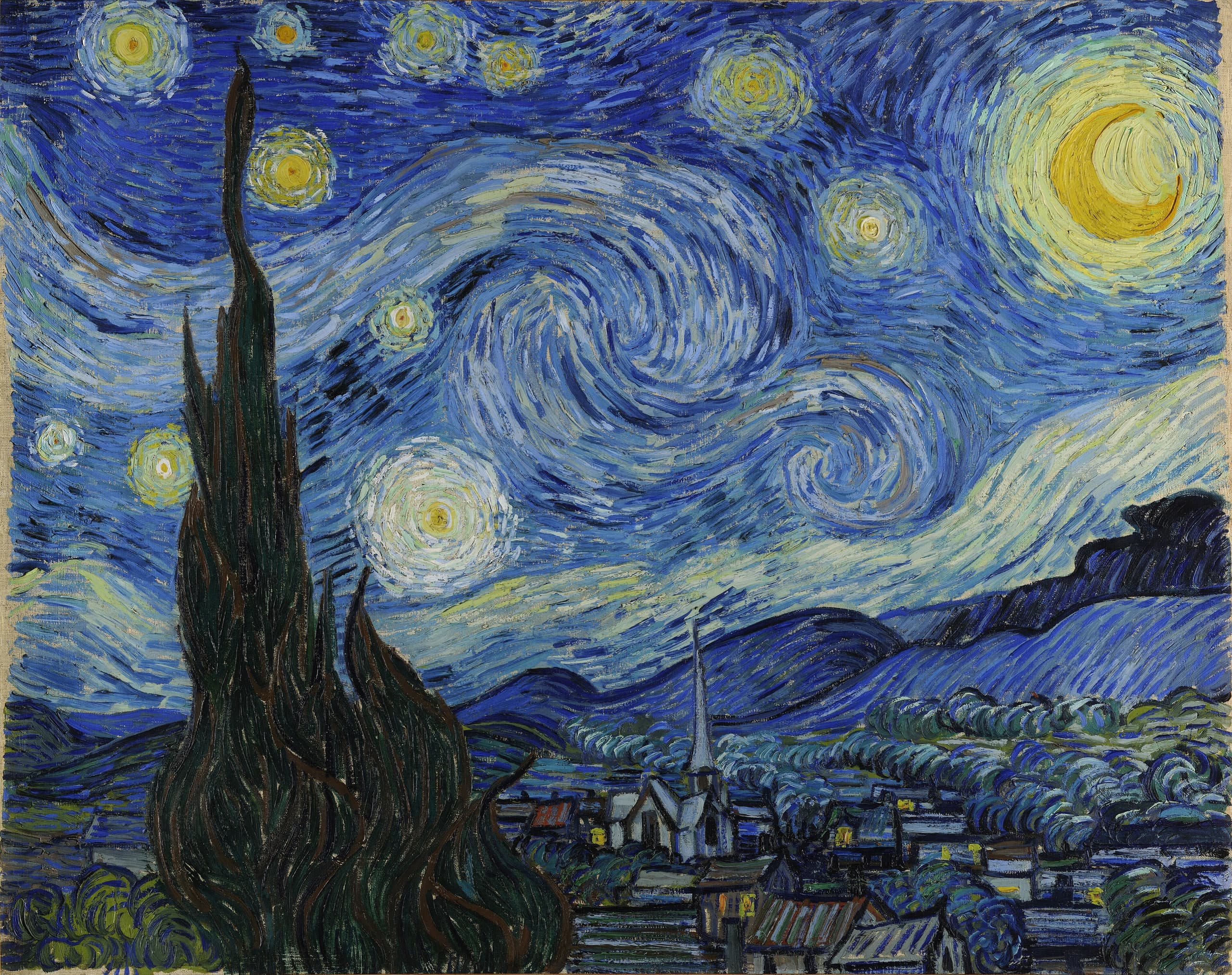
Van Gogh's The Starry Night
▶ Listen · narrated
The turbulent sky is famous, but the village beneath it was never visible from the asylum window where Van Gogh stood. He painted what he saw, then painted over it with what he imagined.
At a glance
- Artist
- Vincent van Gogh
- Date
- 1889
- Dimensions
- 73.7 × 92.1 cm
- Medium
- Oil on canvas
- Location
- Museum of Modern Art, New York
Look closer
Paint thick enough to measure
Van Gogh built the sky in ridges of paint applied wet-on-wet, each swirl sitting proud of the canvas surface. The technique — called impasto, meaning the paint is laid on thickly enough to hold the shape of the brush — creates actual shadows across the picture plane when light strikes it at an angle. The turbulence is not only depicted but physical: you could run a fingernail along the crest of a painted wave and feel it.
A cypress drawn larger than the village
The dark tree rising through the left side of the composition is a cypress, a species Van Gogh painted repeatedly during his time in the south of France. Here it has been drawn at a scale that dwarfs the houses below and reaches nearly to the top edge of the canvas. Van Gogh's letters describe cypresses in aesthetic terms — their colour, their flame-like shape — rather than as carriers of symbolic meaning. The exaggeration in scale is visible when compared to other works he made in the same period.
An invented village with a church spire
The cluster of houses and the prominent church spire in the lower half of the painting do not correspond to the view from Van Gogh's asylum window. The village is an imaginary addition, worked from sketches rather than from the landscape visible at Saint-Rémy. The spire itself has been noted as resembling northern European church architecture rather than the Provençal buildings that surrounded the asylum, though the exact models Van Gogh drew on are not recorded.
The story
Van Gogh painted The Starry Night in June 1889, during a stay at the Saint-Paul-de-Mausole asylum near Saint-Rémy-de-Provence. He had admitted himself voluntarily the previous month, following a mental breakdown. The asylum, a former monastery, was not full at the time, and Van Gogh was given access to both a second-storey bedroom and a ground-floor studio. He remained productive throughout his time there, completing numerous paintings including this one.
The painting depicts the view from the east-facing window of his asylum room, but with significant alterations. The sky — worked in swirling bands of ultramarine and cobalt blue, with stars and moon rendered in indian yellow and zinc yellow — includes Venus, which was visible at the time. The depiction of the moon, however, is not astronomically accurate. Below the sky, the village that occupies the lower portion of the canvas is not the landscape Van Gogh could see from his window. It is an imaginary construction, based on sketches rather than observation.
The cypress tree rising on the left is exaggerated in scale compared to the treatment of similar trees in other works from the same period. Van Gogh's letters suggest he was interested in cypresses for their visual qualities — their dark colour, their vertical thrust — rather than for symbolic content, though interpreters have read various meanings into them since.
Van Gogh himself was critical of the painting. In letters to his brother Theo, he referred to it as a failure. After Vincent's death, the painting passed to Theo, who died six months later. Theo's widow sold it in 1901, bought it back in 1905, and it changed hands twice more before the Museum of Modern Art in New York acquired it in 1941. It has remained in that collection since, and the museum rarely lends it out.
The swirling forms in the sky have attracted attention from outside art history. Some observers have compared the turbulence to patterns described in fluid dynamics, though the nature and significance of any such resemblance remain matters of interpretation rather than settled fact. Scientific analysis has confirmed the pigments Van Gogh used: ultramarine and cobalt blue for the sky, indian yellow and zinc yellow for the celestial elements.
Why it mattered then
Van Gogh painted The Starry Night during a period of enforced rest and observation. The asylum at Saint-Rémy catered to wealthy patients, and the regime was not harsh; he had space to work and was producing paintings steadily. The decision to paint the view from his window, then alter it by adding an imaginary village, suggests a deliberate choice about what kind of landscape he wanted to make. He was working from memory and invention as much as from observation. His letters indicate dissatisfaction with the result, calling it a failure. This was not unusual — Van Gogh was often critical of his own work — but it suggests the painting did not meet whatever standard he had set for it at the time. The thick application of paint, the exaggerated scale of the cypress, and the invented village were all choices that set the work apart from straightforward landscape observation, but Van Gogh does not appear to have valued those choices in the way later viewers have.
Why it matters now
The painting has been described as a touchstone of modern art and is widely recognised in the Western canon, though those assessments come from later reception rather than from Van Gogh's own estimation. The swirling sky has been compared to discoveries in fluid dynamics, with some observers noting resemblances between the painted turbulence and mathematical descriptions of certain flow patterns. Whether such resemblances are coincidental, intuitive, or evidence of some other relationship is debated; the comparison itself, however, has drawn attention from scientists as well as art historians. The painting's status in the Museum of Modern Art's collection — acquired in 1941 and rarely loaned since — has made it a fixed point in the museum's galleries. The decision to keep it in place rather than circulate it has shaped how it is seen: as an object tied to a particular location, encountered by visitors to that location rather than traveling to them.
The surprising detail
Van Gogh called the painting a failure in letters to his brother. The work that has since been described as a touchstone of modern art and is among the most widely recognised images in Western painting did not meet the artist's own expectations at the time he made it. His dissatisfaction was recorded in correspondence, not inferred from silence, and it was specific to this painting rather than a general expression of doubt about his work.
What is disputed
The comparison between the swirling sky and fluid dynamics patterns has been made by observers from outside art history, but the nature of any relationship — whether coincidental, intuitive, or indicative of some deeper correspondence — is not settled. The resemblance has been noted, not explained. Similarly, Van Gogh's letters describe cypresses in aesthetic terms, but interpreters have read symbolic meanings into them; which reading, if any, Van Gogh intended is not recorded.
Remember this
The village in The Starry Night was never visible from Van Gogh's asylum window. He painted the sky from observation and the land from invention.
Test yourself
Van Gogh replaced the actual view from his window with an imaginary village. Why does this matter for how we interpret the painting's relationship to observation and memory?
Because it shows that the painting is not a record of a single moment seen from a single place, even though it is often treated as if it were. The sky may have been based on what Van Gogh observed from his asylum window, but the land below is a construction worked from sketches and memory, not from the landscape visible at Saint-Rémy. This means the painting is a composite: part observed, part invented. That division is not visible on the surface — the village sits beneath the sky as if it belonged there naturally — but it changes what the painting is doing. It is not a view; it is an assembly of views, and the choices about what to include and what to invent become as significant as the swirling brushwork that draws attention in the sky.
Go deeper
Image: Vincent van Gogh, Public domain. Licence: Public domain. Source.