III · THE WORK · ART HISTORY
The Goryeo Water-Moon Avalokiteshvara
▶ Listen · narrated
Korean painters in the Goryeo period worked out how to make gold appear to glow from within a painting, by applying it to the wrong side of the silk.
At a glance
- Origin
- Korea, Goryeo period
- Date
- 14th century
- Material
- Ink, colour and gold on silk
- Dimensions
- 114.5 × 55.6 cm
- Collection
- Metropolitan Museum of Art
Look closer
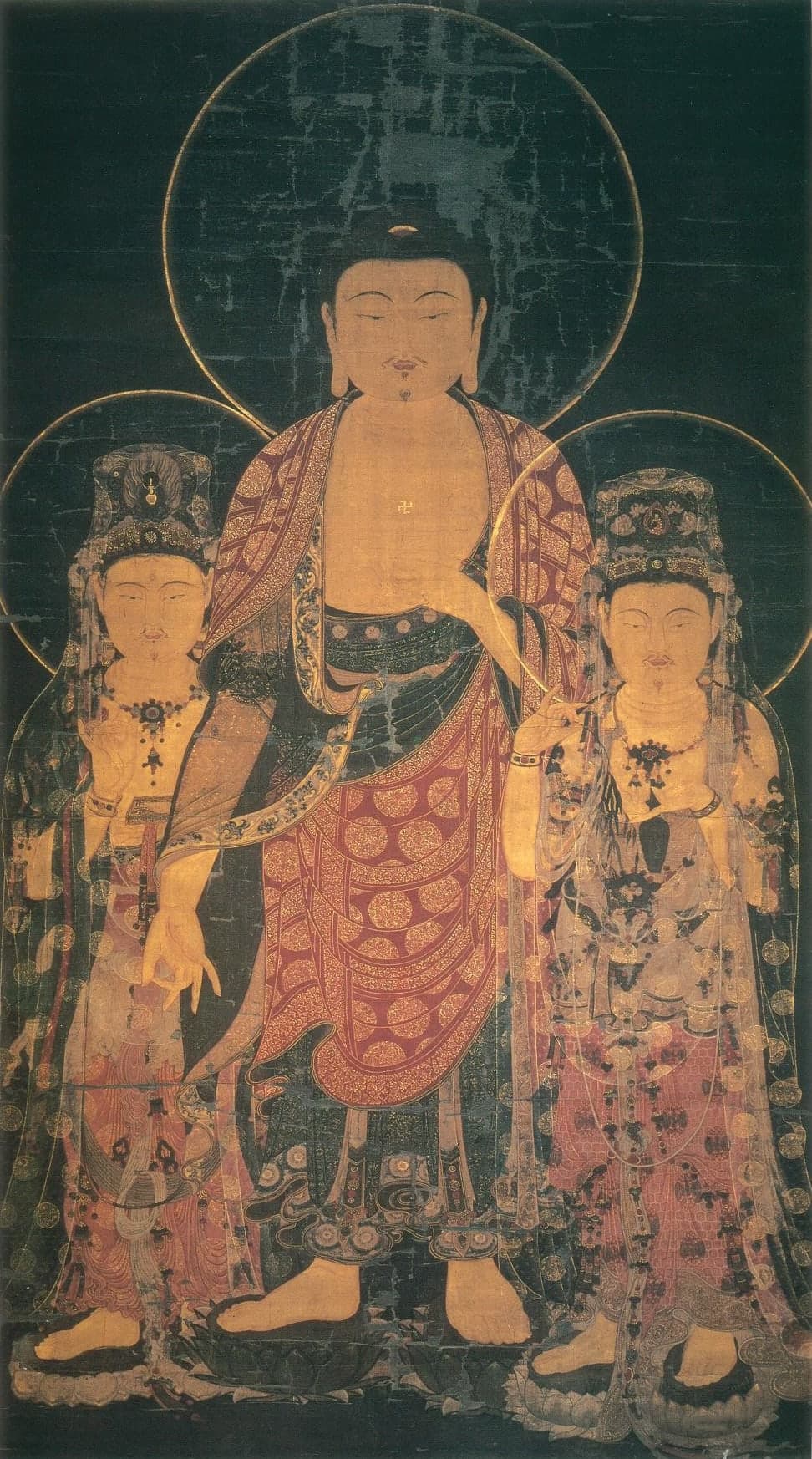
The transparent veil over the shoulder
A gauze scarf falls across the figure's left shoulder and chest. It has been painted to behave as real gauze would: you can see the body through it, slightly dimmed, and the edge of the scarf is rendered as a fold of translucent fabric rather than an opaque line. The painter did not simplify this. Where the veil overlaps the arm, the skin tone beneath it is cooler and less distinct, as if seen through a layer of silk in actual space.
Gold applied from the reverse of the silk
The halo, the jewellery, and the linear details of the robe were drawn in gold on the back of the silk, so that the metal would glow through the weave rather than sit as a surface layer. This reverses the usual sequence: the gold goes down first, on the reverse, and the pigment is painted over it from the front. The result is a soft radiance instead of a flat metallic sheen. The technique requires the silk to be thin enough to transmit light but sturdy enough to accept paint on both sides without buckling.
The tiny donor figure at the lower edge
A small human figure, painted at a much reduced scale, kneels at the bottom edge of the composition. This is the donor — the person who commissioned the painting, likely for a temple or private devotional use. The figure is dressed in the costume of a Goryeo official or aristocrat, and the inclusion records both the act of patronage and the hope that the merit of commissioning the image would be spiritually effective.
The story
The figure is Avalokiteshvara, a bodhisattva — in Buddhist teaching, a being who has delayed full enlightenment in order to help others. The specific form shown here is known as Water-Moon Avalokiteshvara, in which the figure is seated in a pose of relaxed contemplation beside water, with the moon reflected in it. The painting does not show the water or the moon directly; the title describes the iconographic type, which would have been recognised by anyone familiar with Buddhist devotional images in fourteenth-century Korea.
The painting is vertical, just over a metre tall and half a metre wide, worked in ink, colour and gold on silk. The figure occupies most of the height, seated with one knee raised, the body turning slightly to the left, the head inclined. The face is calm, the eyes downcast. The hands rest lightly, one on the raised knee, the other lowered. The pose suggests ease rather than formality, which is characteristic of this iconographic type: Water-Moon Avalokiteshvara is shown in a moment of rest, approachable, not distant.
The technical achievement is in the layering. Silk is translucent when thin, and Goryeo painters used that property deliberately. Gold was applied to the reverse of the silk in fine lines — the halo, the jewellery, the decorative borders of the robe — so that it would glow through the fabric when seen from the front. Pigment was then painted on the front surface, over the areas where the gold had been applied from behind. The result is that the gold does not sit on top of the paint as a separate metallic layer; it appears to be embedded in the silk itself, radiating through it.
The robe is painted as if it were actually transparent. A gauze scarf crosses the figure's shoulder and chest, and where it overlaps the body, the skin tone beneath is visible but slightly muted, as it would be if seen through a layer of real fabric. This is not a simplification or a symbolic gesture — it is a sustained attempt to represent transparency as a physical phenomenon, worked out across the entire area where the veil falls.
The donor figure kneels at the lower edge, much smaller than the bodhisattva, dressed in the clothing of a Goryeo aristocrat or official. The inclusion of the donor in the composition was standard practice: it recorded the act of commissioning the painting and expressed the hope that the merit of that act would have spiritual effect. The difference in scale is not a mistake in perspective; it is a hierarchy of importance, with the sacred figure large and the human patron small.
Buddhism was the state religion of Goryeo, which was founded in 918 and lasted until 1392. The capital had seventy temples in the eleventh century, and the period is described by historians as the golden age of Buddhism in Korea. This painting was made in the fourteenth century, during the later part of the Goryeo period, when the kingdom was a vassal state of the Yuan dynasty. The style and technique reflect a tradition that had developed over centuries, and the level of skill in handling gold and transparency suggests that this was work made within a well-established workshop practice, not an experiment.
Why it mattered then
Buddhism in Goryeo was not a private matter. It was the state religion, supported by the court and the aristocracy, and temples were centres of both devotional practice and political influence. The capital had seventy temples in the eleventh century, and the production of paintings, sculptures and manuscripts with Buddhist subjects was a sustained activity, funded by royal and aristocratic patronage. A painting like this one would have been commissioned for use in a temple or in private devotional practice. The inclusion of the donor figure suggests that the person who paid for it expected the act of commissioning to generate merit — a concept in Buddhist teaching in which good actions contribute to a better rebirth or progress toward enlightenment. The image itself was not simply a decoration; it was understood to make the presence of the bodhisattva available, to function as a focus for meditation or prayer. The technical refinement — the gold applied from the reverse, the transparent veil painted as actual transparency — was not ornament for its own sake. It was a way of making the image more effective, more present. The glow of the gold, the softness of the veil, the calm face: these were means of creating an image that could hold attention and invite contemplation. The skill involved was valued, and the resources required to produce work at this level were considerable, which is why surviving examples are associated with wealthy patrons and important temples.
Why it matters now
The technique of applying gold to the reverse of silk is fragile and rarely survives intact. Silk deteriorates, gold flakes, and paintings that were handled, rolled, transported and stored over centuries are often damaged or lost. The fact that this painting is in good condition makes it a rare record of a practice that was more common in the fourteenth century than the surviving evidence suggests. It is also a reminder that transparency — the representation of one surface seen through another — was not invented in Europe during the Renaissance. Painters in Goryeo were solving the same problem in the fourteenth century, using silk and pigment, and their solutions were different. The veil in this painting is not rendered with the geometric perspective that would become standard in European painting two centuries later, but it is rendered as a physical phenomenon, with attention to how light behaves when it passes through fabric. The painting is held by the Metropolitan Museum of Art, where it is part of the collection of Korean art. It is one of several surviving examples of paintings from this period with Buddhist subjects, and it is studied both for its technique and for what it records about devotional practice in medieval Korea. The donor figure at the bottom edge is a direct link to the person who commissioned it, a rare survival of a name or face attached to an object from this period.
The surprising detail
The gold was drawn onto the back of the silk before the front was painted, which means the painter had to work in reverse. Any line drawn on the back would appear as a mirror image when the silk was turned over, so the design had to be planned in reverse as well, or traced through the silk before the gold was applied. The process required the silk to be held taut and stable while both sides were worked, and any mistake in registration — any misalignment between the gold on the back and the pigment on the front — would be permanent. There is no evidence in this painting that such a mistake was made.
Remember this
Gold applied to the back of silk glows through the weave, and transparency was painted as a physical phenomenon, not a symbol.
Test yourself
Why would a painter choose to apply gold to the reverse of the silk rather than to the front, where it would be easier to control and align with the rest of the composition?
Because gold applied to the front sits as a flat metallic surface, opaque and reflective, while gold applied to the reverse glows through the weave of the silk and appears to be embedded in the fabric rather than resting on top of it. The effect is softer, more luminous, and more integrated with the painted areas. The technique requires more planning and precision — the design must be worked out in reverse, and the gold must be aligned with the pigment that will be applied later to the front — but the result is a different quality of light. The halo and the decorative elements of the robe do not look like metal laid onto cloth; they look like light coming through it. That difference would have been understood as making the image more effective, more present, more worthy of the subject.
Go deeper
Image: Unknown author Unknown author, CC0. Licence: CC0. Source.