I · THE OBJECT · BRITISH MUSEUM
Statue of Mausolus
▶ Listen · narrated
Every above-ground tomb is called a mausoleum because of one structure, built in 351 BC and lost to earthquakes. This statue may be the man himself.
At a glance
- Date
- 351 BC
- Origin
- Ancient Greece
- Context
- Wonder of the Ancient World
- Current state
- Ruins
Look closer
Scale intended to be seen from below
The proportions of the surviving figures suggest they were carved to be viewed from ground level looking upward. The heads are slightly enlarged relative to the bodies, and details are more deeply cut in the upper portions — adjustments that would correct the foreshortening a viewer experiences when looking up at a sculpture placed high on a building. This was not sculpture made to stand at eye level.
Greek sculptors working for a Persian satrap
The tomb was built for Mausolus, a satrap — a provincial governor — in the Achaemenid Persian Empire, and his sister-wife Artemisia. But the sculptors named in ancient accounts are Greek, and the architectural form blends Greek columned design with tomb types from Lycia, a region Mausolus had annexed. The building was a hybrid, made by Greek hands for a ruler who governed on behalf of Persia.
Identified by elimination, not inscription
No inscriptions survive on the statue that would confirm whose portrait this is. The identification as Mausolus rests on the figure's scale, its quality, and the fact that it was found among the ruins of his tomb. Ancient sources record that the Mausoleum held hundreds of sculptures, so certainty is not possible. What is clear is that this was a figure of importance, carved to dominate the space around it.
The story
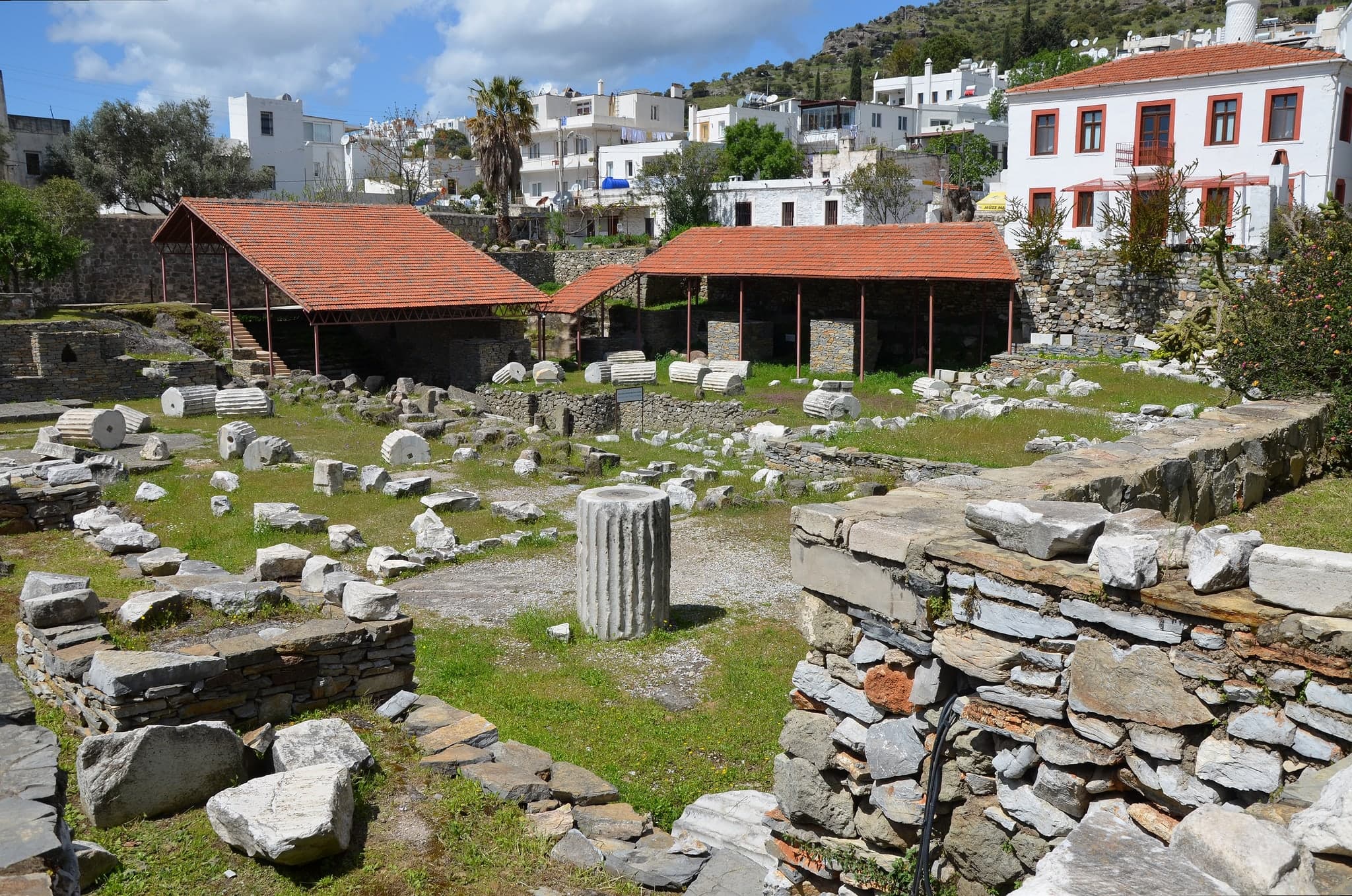
The word mausoleum — any above-ground tomb — comes from one building, erected in 351 BC in Halicarnassus, on the coast of what is now Turkey. It was built for Mausolus, a satrap in the Achaemenid Persian Empire who governed Caria, and for his sister-wife Artemisia. Ancient writers listed it among the seven wonders of the world. It stood for more than fifteen hundred years, surviving into the medieval period, before a series of earthquakes between the twelfth and fifteenth centuries brought it down. It was the last of the six destroyed wonders to fall.
What survives now are fragments. The structure itself is gone. Earthquakes reduced it to rubble, and much of that rubble was later quarried for other buildings. What remains are pieces of sculpture — reliefs, freestanding figures, architectural elements — recovered from the site and now scattered across collections. The colossal statue shown here is one of these fragments. It is usually identified as Mausolus himself, though no inscription confirms this. The identification rests on the figure's scale, its quality of carving, and the context of its discovery among the ruins of the tomb.
Ancient descriptions give some sense of what the building looked like, but they do not agree on all details. The structure seems to have been approximately forty-five metres tall, raised on a base and surrounded by columns, with sculptural decoration on all four sides. Ancient sources name four Greek sculptors who worked on the reliefs, each responsible for one side of the building. The Mausoleum is also recorded as having contained four hundred freestanding sculptures. The architectural form was not purely Greek: it drew on tomb types from neighbouring Lycia, a territory Mausolus had invaded and annexed.
The statue itself is carved in a style consistent with Greek sculpture of the period. The proportions suggest it was made to be seen from below, with the head slightly enlarged and details more deeply cut in the upper portions — adjustments that would correct the distortion a viewer experiences looking upward. This was not a figure intended to stand at eye level. It was made to be placed high on the building, dominating the space around it.
The Mausoleum was a hybrid structure. It was built for a Persian satrap by Greek architects and sculptors, blending Greek columned design with Lycian tomb forms. It stood in a city that was Greek in culture but governed as part of the Persian Empire. The building's fame in antiquity rested not only on its scale but on the richness of its sculptural decoration. What remains now is enough to suggest that reputation, but not enough to reconstruct the whole.
Why it mattered then
The Mausoleum was a statement of power and permanence, built by a ruler who governed a contested region on behalf of a distant empire. Mausolus was a satrap, a provincial governor under Persian authority, but he ruled Caria with considerable independence. He moved the capital to Halicarnassus, fortified the city, and commissioned a tomb that would outlast him. The scale of the building and the expense of its decoration were both assertions: that his rule mattered, and that his name would endure. The choice to employ Greek architects and sculptors was not incidental. Halicarnassus was a Greek city, and Greek culture dominated the coastal cities of Anatolia even under Persian rule. A tomb in the Greek manner, decorated by named Greek sculptors, was a way of aligning Mausolus with the cultural prestige of the Greek world while asserting his own authority within it. The building was a monument to a ruler who operated between empires, and it was designed to be legible to both.
Why it matters now
The Mausoleum matters now because it gave a word to every language that borrowed from Greek. Every above-ground tomb called a mausoleum carries the name of this one building, erected for a satrap whose rule would otherwise be a footnote. The building is gone, but the word remains, and that linguistic survival is a form of permanence Mausolus could not have anticipated. It also matters as a case study in how we know about lost structures. The Mausoleum is recorded in ancient texts, but those texts do not agree on all details, and none of them is a complete architectural description. What we know comes from combining written sources with archaeological fragments, and the result is provisional. The statue shown here may be Mausolus, but the identification is not certain. The building was famous in antiquity, but reconstructing it now requires guesswork. This is the norm for ancient architecture, not the exception. Most of what was built has been lost, and what we think we know rests on incomplete evidence.
The surprising detail
The Mausoleum stood for more than fifteen centuries before earthquakes brought it down. It survived the fall of the Persian Empire, the conquests of Alexander, the rise of Rome, and the spread of Christianity. It was still standing in the medieval period, long after the other six wonders had been destroyed. When it finally fell, it fell slowly, over several centuries of successive earthquakes. The ruins were then quarried for building stone, so that pieces of the Mausoleum were built into later structures. The tomb designed to make one man's name permanent ended up anonymous, broken into fragments and reused by people who had no memory of what it had been.
What is disputed
The identification of this statue as Mausolus is not certain. No inscription survives on the figure itself, and ancient sources do not describe the specific sculptures in enough detail to confirm which figure this is. The identification rests on the statue's scale, the quality of its carving, and the fact that it was found among the ruins of the Mausoleum. It is also possible that it represents another figure from the tomb's extensive sculptural programme, which ancient sources say included four hundred freestanding sculptures.
How it got here
The statue was excavated from the ruins of the Mausoleum during archaeological work in the nineteenth century. The Mausoleum site is in present-day Bodrum, Turkey. The removal of sculptures from the site and their transfer to collections took place during a period when such acquisitions were common practice, but the ethics of retaining antiquities excavated from other countries is now contested. Turkey has not formally requested the return of the Mausoleum sculptures, but the broader question of repatriation for objects acquired during the nineteenth century remains an active discussion in museum practice.
Remember this
The tomb gave its name to every mausoleum, but the building itself is gone. What remains are fragments, and a word.
Test yourself
Why would a ruler commission a tomb decorated by named Greek sculptors, even though he governed on behalf of the Persian Empire?
Because cultural prestige and political authority did not align neatly in the ancient Mediterranean. Mausolus ruled Caria as a Persian satrap, but Halicarnassus was a Greek city, and Greek culture carried weight along the Anatolian coast. A tomb in the Greek manner, decorated by sculptors whose names would be recorded and repeated, was a way of aligning himself with that cultural prestige while asserting his own authority within it. The building had to speak to multiple audiences: to the Greek cities he governed, to the Persian court he answered to, and to posterity. Employing Greek artists was not a contradiction of his position; it was a strategic use of the cultural resources available to him. The lesson generalises: monuments are not built for one audience, and the choice of style is always a political choice.
Go deeper
Image: FollowingHadrian, CC BY-SA 4.0. Licence: CC BY-SA 4.0. Source.