III · THE WORK · ART HISTORY
Monet's Impression, Sunrise
▶ Listen · narrated
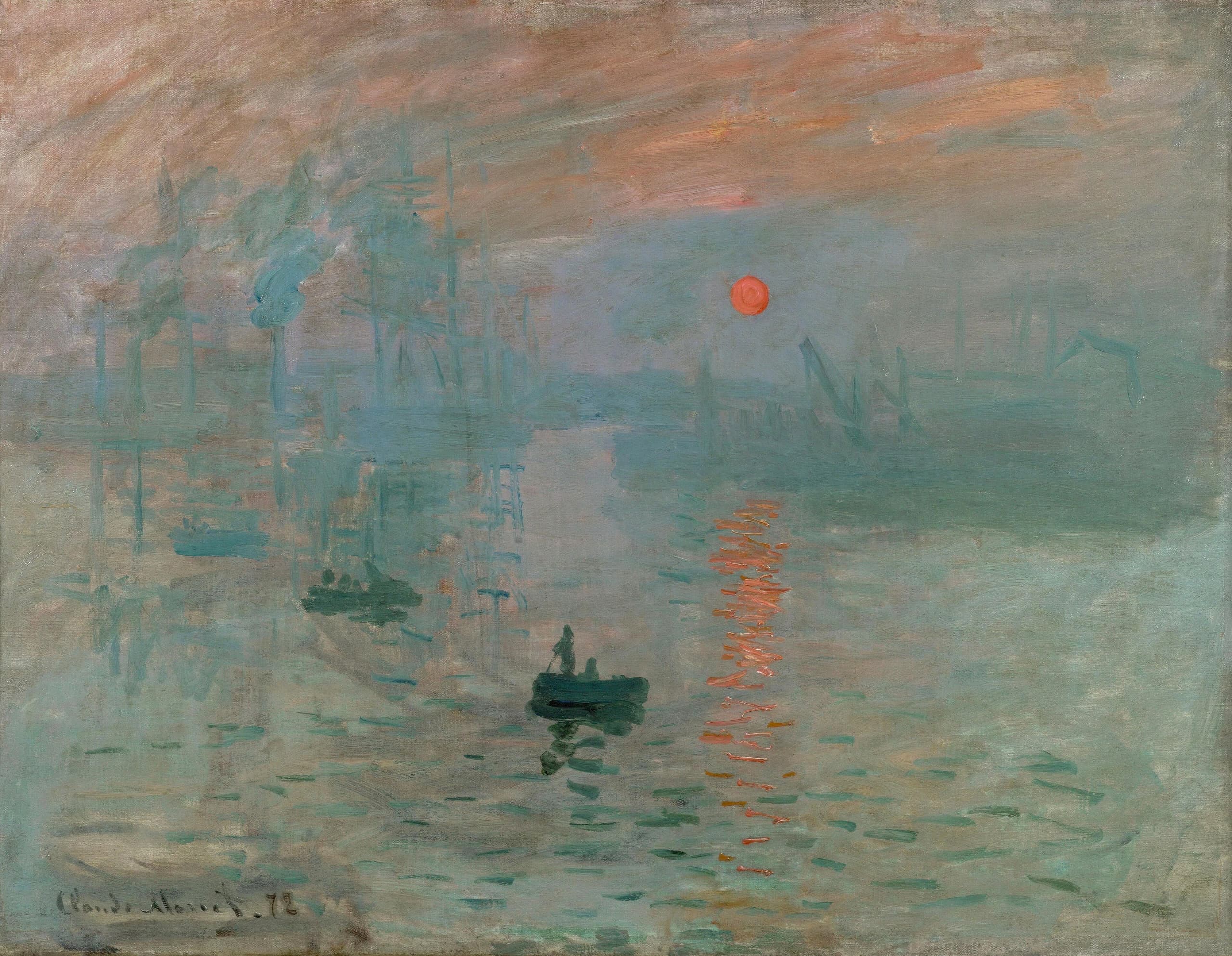
The sun in this painting is almost exactly as bright as the sky around it. The effect is not colour contrast but luminance — a perceptual trick.
At a glance
- Artist
- Claude Monet
- Date
- 1872
- Medium
- Oil paint on canvas
- Dimensions
- 48 × 63 cm
- Collection
- Musée Marmottan Monet, Paris
Look closer
The sun, matched in luminance to the sky
The orange disc of the sun is painted in thick strokes of vermilion and chrome orange, but it is not dramatically brighter in colour than the grey-blue sky behind it. What makes it appear luminous is that Monet has kept the tonal value — the lightness — of the sun almost identical to the sky. Your eye registers the warmth of the orange against the cool grey as a glow, not as a contrast in brightness. This is a perceptual effect: the sun seems to emit light because the painting has balanced luminance and hue in a way that mimics how a rising sun looks through mist, where atmosphere scatters light and reduces contrast.
Three strokes making the foreground boat
The dark boat in the lower left is built from just a few strokes: a horizontal for the hull, a vertical for the mast, and a suggestion of a figure. There is no detail of planking, rigging or cargo. The boat exists as a silhouette, a dark note against the water. This is typical of how Monet worked across the canvas: forms are stated with the minimum information needed to register as a thing. The viewer's eye completes the rest. The technique was what hostile critics called unfinished, and what Monet and his colleagues understood as a record of perception rather than description.
Cranes and masts of the industrial port
Behind the small boats, the harbour is lined with cranes, masts and the vertical structures of a working port. They appear as thin, dark lines against the pale sky, barely more than marks. Monet painted the port of Le Havre, his hometown, and these are the cranes and ships of a commercial harbour rebuilt after the Napoleonic Wars. The painting does not dwell on them: they are background, atmospheric, part of the haze. But their presence makes clear that this is not a pastoral sunrise but an industrial one, the light rising over a harbour where cargo is loaded and unloaded.
The story
Claude Monet painted this view of the port of Le Havre in 1872. Le Havre was his hometown, a harbour city on the Normandy coast that had grown rapidly as a commercial port. The painting shows the harbour at sunrise, with small boats in the foreground, the industrial cranes and masts of the port in the middle distance, and the sun rising through mist.
Monet worked quickly, using loose brushstrokes to capture the light and atmosphere rather than the details of the scene. The water is rendered in horizontal strokes of blue, grey and orange, reflecting the sky. The boats are simplified to silhouettes. The sun is a thick disc of orange paint, applied with a few strokes, and the sky around it is a pale grey-blue that barely contrasts with the sun in brightness.
The painting was shown in April 1874 at an exhibition in Paris organised by Monet and a group of colleagues who had been rejected by the official Salon. The exhibition included works by several painters who would become known as Impressionists. It was held in the former studio of a photographer, on the Boulevard des Capucines.
When the exhibition opened, critics were largely hostile. The paintings looked unfinished, sketchy, lacking in detail. One critic wrote a satirical review in which he mocked the works on display. He singled out Monet's painting, which had been listed in the catalogue as Impression, Sunrise. The critic used the word "impression" to imply that the painting was not a finished work but merely a preliminary sketch, an impression of a scene rather than a proper rendering of it. He used the term to deride the whole group, calling them "Impressionists".
The name stuck. Within a few years, the artists had adopted it themselves, and "Impressionism" became the accepted term for the movement. Monet's painting, with its loose brushwork, its focus on light and atmosphere, and its title, became the work that gave the movement its name.
The painting is now held by the Musée Marmottan Monet in Paris, a museum that houses a large collection of Monet's works. It is usually on display there.
Why it mattered then
The painting mattered in 1874 because it was exhibited at a moment when the official Salon — the annual state-sponsored exhibition in Paris — controlled access to the art market and to critical attention. Monet and his colleagues had been repeatedly rejected by the Salon jury, which favoured highly finished, academic work. The 1874 exhibition was an attempt to bypass that system and show their work directly to the public. The hostile reception the exhibition received was not a surprise. The loose brushwork, the lack of detail, and the focus on capturing a fleeting moment rather than producing a polished composition were all at odds with what the Salon and its critics expected. But the fact that the group exhibited together, and that a critic gave them a collective name, meant that they were visible as a movement rather than as isolated individuals. The mockery helped to define them.
Why it matters now
The painting matters now because it is the origin point for the name of a movement that reshaped how we think about painting. Impressionism is now so familiar that it is easy to forget how radical it was to paint quickly, to leave brushstrokes visible, to prioritise the perception of light over the description of objects. The painting also matters because of the specific technical choice Monet made with the sun. The orange disc is not dramatically brighter than the sky in terms of tonal value — the amount of light it reflects. What makes it appear luminous is the contrast between its warm hue and the cool grey around it. This is a perceptual effect, and it relies on the viewer's eye to complete the illusion. Monet was painting how light feels, not how objects look, and that shift in focus is what Impressionism was about.
The surprising detail
The painting was stolen from the Musée Marmottan Monet in Paris. Several men broke into the museum and took Impression, Sunrise along with other works by Monet. The theft was carried out in daylight, in under three minutes. The paintings were later recovered and returned to the museum after being found in Porto-Vecchio. The painting has been on display at the museum since its recovery.
Remember this
A critic used the title to mock the painting as unfinished. The artists kept the name, and it became the term for a movement.
Test yourself
Why does the sun in this painting appear luminous even though it is not dramatically brighter in tonal value than the sky around it?
Because Monet has balanced luminance and hue in a way that creates a perceptual effect. The sun is painted in warm orange tones, and the sky is a cool grey-blue, but they are close in brightness — in the amount of light they reflect. Your eye registers the warmth of the orange against the cool grey as a glow, interpreting it as light rather than as a simple colour difference. This mimics how a rising sun looks through mist, where the atmosphere scatters light and reduces contrast. The painting is not showing the sun as a bright object against a dark sky; it is showing how the sun feels when it is just above the horizon, surrounded by haze.
Go deeper
Image: Claude Monet, Public domain. Licence: Public domain. Source.