I · THE OBJECT · BRITISH MUSEUM
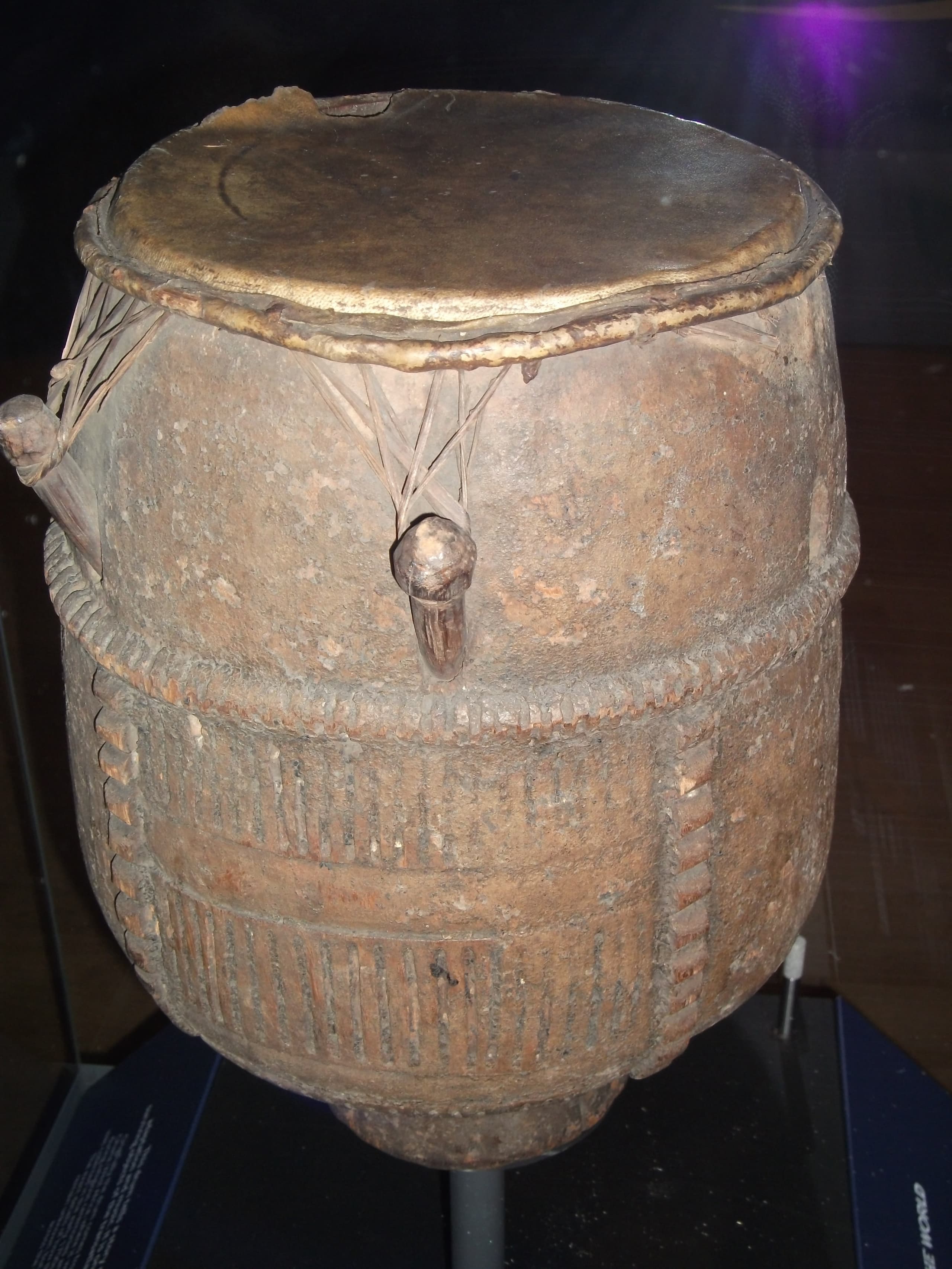
The Akan Drum
▶ Listen · narrated
Most of what enslaved people carried across the Atlantic was lost or destroyed. This drum survived, and it is one of the oldest African-American objects in the British Museum.
At a glance
- Culture
- Akan
- Made
- West Africa
- Found
- Colony of Virginia, North America
- Type
- Archaeological artefact
Look closer
Carved from a single piece of wood
The drum is hollowed from a single trunk. The maker shaped the body, carved the pegs that hold the skin taut, and fitted them without metal fasteners. The wood itself and the method of construction are consistent with Akan drummaking traditions in West Africa, where drums served ceremonial, social and communicative functions.
It was found, not purchased
The drum was discovered in Virginia, not acquired through trade or commission. That it was found rather than bought suggests it was discarded, hidden, or lost — the circumstances are not recorded. What is clear is that it was made in West Africa and later turned up in the colony, placing it in the narrow channel of material culture that survived the transatlantic crossing.
No date is recorded
The drum has no inscription, no maker's mark, and no documentation of when it was made or when it arrived. It is placed in the early modern period based on context — the transatlantic slave trade, the presence of enslaved Akan people in Virginia — but the wood itself has not been dated. The drum is old, but how old remains uncertain.
The story
The drum was made in West Africa by an Akan craftsperson. The Akan are a cultural and linguistic group whose territory spans parts of present-day Ghana and Côte d'Ivoire. Drumming in Akan societies was not entertainment in the modern sense; it was a language. Different rhythms signalled different messages, marked ceremonies, accompanied dance, and structured communal life. A drum was a tool of communication as much as a musical instrument.
At some point this drum left West Africa. It crossed the Atlantic, almost certainly on a slave ship. An estimated twelve million people were transported across the ocean as part of the transatlantic slave trade, and the material record of what they carried with them is vanishingly thin. Enslaved people were cargo, not passengers. They were stripped, inspected, chained, and packed into holds. Personal possessions were not part of the business model. Most of what survived the crossing was either small enough to hide or useful enough to be tolerated.
The drum was later found in the Colony of Virginia. How it got there, who brought it, and whether it was used after arrival are not recorded. Virginia imported enslaved Akan people, and the drum is consistent with Akan manufacture, but no document links this object to a specific ship, a specific person, or a specific year. It exists now as physical evidence of a crossing that left almost no physical evidence.
The drum is now held in the British Museum, where it is displayed in the North American gallery. It is described as being among the oldest African-American objects in the museum's collection. That claim is difficult to verify, because so few objects from this period and this context still exist. What is certain is that the drum is rare — not because it was precious when it was made, but because almost everything like it was lost.
Why it mattered then
In Akan communities, drums were not simply instruments. They carried messages, marked time, structured ritual, and held social authority. A drummer could summon a community, announce a chief, or communicate across distances where speech would not carry. The drum was a technology of coordination and memory. When the drum crossed the Atlantic, it entered a different system. Enslaved people in Virginia were legally property. Their labour was extracted, their families were separated, and their cultural practices were suppressed wherever those practices threatened control. Drumming was often banned on plantations, particularly after uprisings, because it allowed communication the enslavers could not understand. A drum in Virginia was a risk. That this drum survived suggests it was either hidden, tolerated for a time, or abandoned before it could be confiscated. Its presence in the colony is evidence that enslaved people carried cultural knowledge and practice with them, even when the conditions of their bondage were designed to erase both.
Why it matters now
The drum is a physical link to the transatlantic slave trade, the forced crossing of the Atlantic that underpins the histories of three continents. Most of the material culture of that crossing is gone. Ships' logs survive, account books survive, but the objects that enslaved people made, carried, or used are almost entirely absent from the archive. The drum is an exception. It matters because it is evidence of survival — not the survival of the object alone, but of the knowledge embedded in it. Someone knew how to carve a drum from a single trunk, how to fit the pegs, how to stretch the skin. That knowledge crossed the ocean, even when the conditions of the crossing were designed to destroy it. The drum is a record of what was carried in memory and in hands. It also matters because it sits in a museum in London, far from both West Africa and Virginia. Questions of where objects like this belong, who has the right to hold them, and what their presence in European collections represents are active and unresolved. The drum is a reminder not only of the slave trade but of the long afterlife of that trade in institutions, collections, and the movement of objects across borders.
The surprising detail
The drum is normally displayed in the North American gallery, not in the African galleries. That placement reflects a curatorial decision about what the drum represents: it is treated as an African-American object, not an African one. The drum was made in West Africa, but its significance is understood to lie in the crossing. Where you put it is a statement about what you think it means.
What is disputed
The drum has not been dated by scientific methods, and no documentation records when it was made or when it arrived in Virginia. Its attribution to the Akan culture and its identification as an object carried by enslaved people rest on stylistic analysis and historical context, not on direct evidence. The description of it as being among the oldest African-American objects in the British Museum is plausible but difficult to verify, because so few comparable objects exist and fewer still have secure dates.
How it got here
The drum was found in Virginia and later acquired by the British Museum, where it is held as part of the North American collection. How and when the museum acquired it is not detailed in the available records. As an object made in West Africa, carried by an enslaved person, and now held in a British institution, the drum sits within ongoing debates about the ownership and repatriation of objects connected to the transatlantic slave trade. Some argue that such objects belong in the communities from which they were taken, or in the communities whose histories they document. The museum's position is that the drum is part of a collection held in trust for global audiences, and that its display in London contributes to public understanding of the slave trade and its legacies.
Remember this
An Akan drum that crossed the Atlantic and survived — one of the very few objects from the transatlantic slave trade that still exists.
Test yourself
Why is the material record of the transatlantic slave trade so thin, when twelve million people made that crossing?
Because enslaved people were treated as cargo, not as passengers with possessions. They were stripped, inspected, and chained before being loaded into ships. Personal belongings were not part of the system. What little survived had to be small enough to hide, durable enough to last, or useful enough to be tolerated by enslavers. Most of what people carried — in knowledge, in memory, in practice — left no physical trace. The drum is rare not because it was valuable when it was made, but because almost everything like it was destroyed or lost.
Go deeper
Image: Johnbod, CC BY-SA 3.0. Licence: CC BY-SA 3.0. Source.