I · THE OBJECT · BRITISH MUSEUM
The Amaravati Sculptures
▶ Listen · narrated
A monument dismantled for building stone, its carvings scattered across three continents. What survives shows how a religion depicted its founder without ever carving his face.
At a glance
- Type
- Buddhist stupa
- Location
- Amaravathi, Palnadu district, Andhra Pradesh
- Construction period
- Probably third century BCE to about 250 CE
- Major renovation
- Beginning about 50 CE, with replacement sculptures
Look closer
Absence as presence
The Buddha does not appear as a human figure in these early reliefs. Instead, the carvings mark his presence through symbols: a pair of footprints for where he stood, an empty throne for where he sat, a parasol held over nothing, a tree alone. The crowds press in around these vacant centres. Art historians call this aniconic representation — depicting a figure without showing the figure itself. Whether this was a theological prohibition or an artistic convention is not certain from the surviving evidence.
The stupa within the stupa
Several of the relief panels show the stupa itself, carved in miniature on its own railings. These representations differ from one another, probably reflecting different building phases, but together they offer the clearest record of what the monument looked like when intact. The carvings show a dome on a high drum, ringed by railings, with gateways and processional paths. Without these sculptural records, reconstructing the original form would be largely guesswork, since the physical structure is now ruined.
Density and rhythm
The limestone panels are carved with figures packed so tightly that individual bodies become difficult to separate. Heads, limbs, jewellery and drapery overlap in shallow relief. The effect is not confusion but visual rhythm — the repetition of forms creates a sense of movement and collective presence. This density is a choice, not a limitation: the carvers could render individual anatomy with precision when they wished to, as isolated figures on the same panels demonstrate.
The story
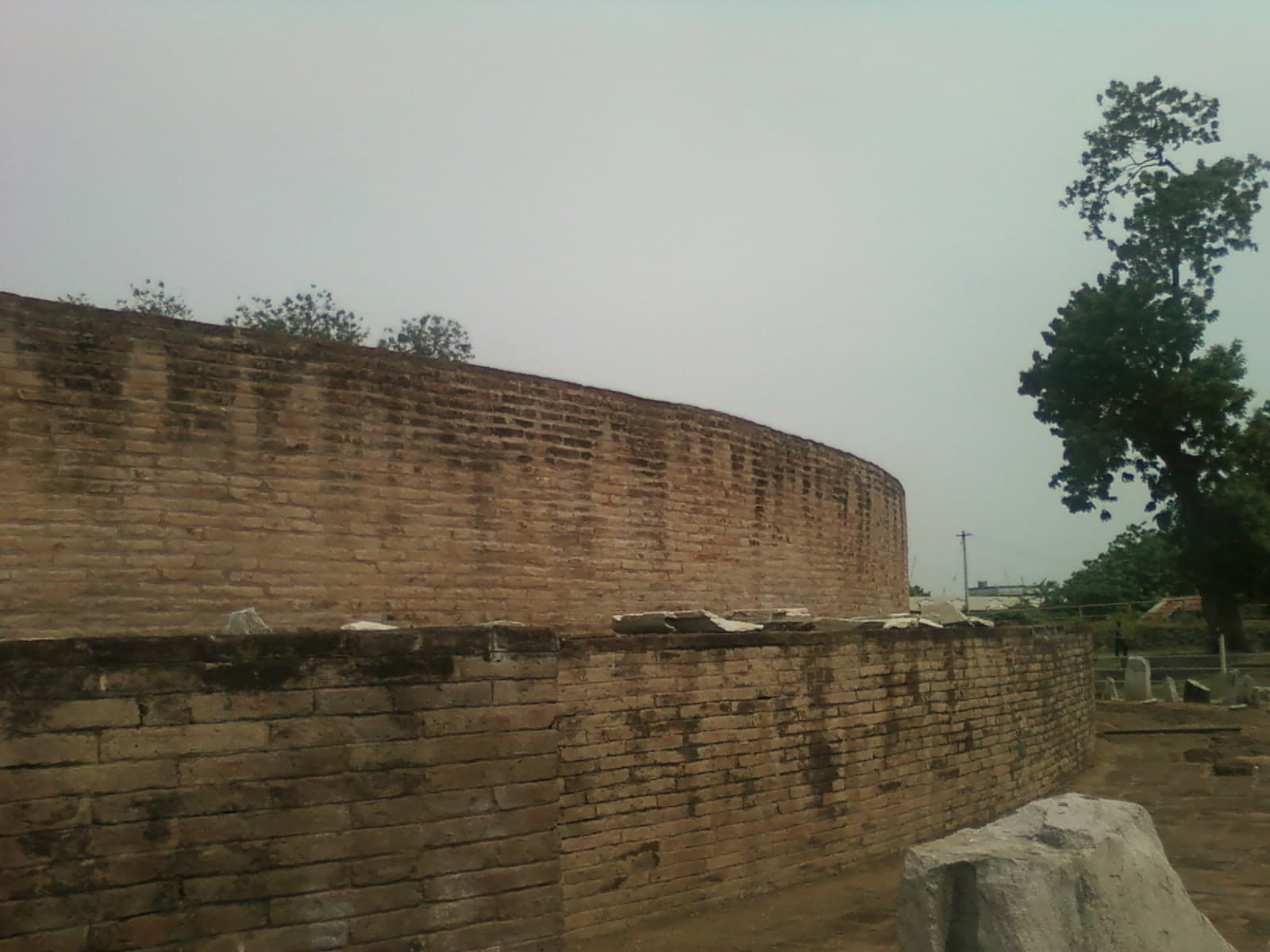
The stupa at Amaravathi was built in phases, probably beginning in the third century BCE and continuing to around 250 CE. It was enlarged over time, and beginning around 50 CE, new sculptures replaced earlier ones. What stood there was a domed structure on a raised drum, surrounded by carved limestone railings and gateways. It was, for a period, a major monument in Buddhist architecture, though the exact chronology of its construction and decoration remains uncertain.
The site is now ruined. The stupa itself has been dismantled, and the surviving sculptures are scattered. The Archaeological Survey of India protects what remains at Amaravathi, including a museum on site. But the carvings that once decorated the railings and gateways are now divided among collections in India and abroad. The largest groups are in the Government Museum in Chennai, the Archaeological Museum at the site, and the British Museum in London. Many are damaged, some severely.
The reliefs that survive are mostly narrative panels — scenes of processions, worship, royal visits, and episodes from the Buddha's life and previous lives. They are carved in low relief, meaning the figures project only slightly from the background. The style is distinctive: figures are shown in profile or three-quarter view, bodies are rendered with volume and weight, and drapery clings to forms in fine pleats. The limestone takes detail well, and the carvers used it to pack scenes with incident.
What is missing from these early reliefs is the Buddha himself, shown as a human figure. Instead, his presence is marked by symbols. A pair of footprints indicates where he stood. An empty throne shows where he sat. A parasol is held over a vacant space. A tree stands alone, marking the spot of his enlightenment. The crowds of worshippers and attendants are carved in full, but the central figure is absent. Whether this absence was a religious rule or an artistic convention is not stated in the surviving sources, and scholars disagree.
Large iconic Buddha figures — sculptures of the Buddha in human form — once existed at the site. The evidence for this is clear, though the figures themselves do not survive. The shift from symbolic to iconic representation happened during the period when the stupa was being renovated and expanded, but exactly when and why is not recorded.
The style of carving seen at Amaravathi is recognised by art historians as one of three major schools of ancient Indian sculpture, alongside the styles associated with Mathura and Gandhara. The Amaravathi style, sometimes called the Andhra style, had wide influence. The east coast of India had strong maritime trading links, and the sculptural idiom developed in this region travelled to South India, Sri Lanka, and South-East Asia. How much of that influence was carried by trade, by pilgrimage, or by the movement of craftsmen is not certain, but the visual echoes are documented in later Buddhist art across those regions.
Why it mattered then
The stupa at Amaravathi was a pilgrimage site and a focus of patronage. Stupas are reliquary monuments — they enshrine relics of the Buddha or other venerated figures — and they function as places of circumambulation, where worshippers walk clockwise around the structure as an act of devotion. The railings and gateways that carried these carvings were part of that ritual architecture. They defined the processional path and displayed scenes that reinforced the stories and teachings central to Buddhist practice. The renovation and expansion of the stupa, beginning around 50 CE, coincided with a period of wealth and stability in the region. Patronage for such projects came from royal donors, merchants, and monastic communities. The inscriptions that survive from the site record gifts and dedications, though many are fragmentary. The decision to replace earlier sculptures with new ones suggests both resources and ambition — a desire to update the monument and perhaps to align it with changing artistic and religious conventions. The symbolic representation of the Buddha, rather than a human figure, was not unique to Amaravathi. It was widespread in early Buddhist art. But the density and complexity of the narrative scenes, and the skill with which the carvers rendered crowds and movement, gave the Amaravathi sculptures a particular character. They were not simply didactic — they were visually compelling, designed to hold attention and reward close looking.
Why it matters now
The Amaravathi sculptures are now studied as evidence of how a religious tradition negotiated the depiction of its central figure. The shift from aniconic to iconic representation — from symbols to human images of the Buddha — is a major question in the history of Buddhist art, and the Amaravathi material sits at that transition. The fact that both modes coexisted at the site, and that the change happened during a documented renovation, makes the surviving carvings a key reference point. The dispersal of the sculptures is itself a subject of study and debate. The stupa was dismantled over the nineteenth and early twentieth centuries, and the carvings were removed, sometimes by official excavation, sometimes by other means. The division of the collection among museums in India and abroad reflects colonial-era practices of acquisition and export. Discussions about the repatriation of cultural property often cite the Amaravathi material as an example, though the fragmented state of the site and the carvings complicates any straightforward resolution. The influence of the Amaravathi style on later Buddhist art in South and South-East Asia is well documented. Scholars trace formal and iconographic elements from these limestone panels to later sculptures in Sri Lanka, Thailand, and Indonesia. The Amaravathi carvings help to map the movement of ideas, styles, and religious practices across maritime networks that connected coastal regions. The art is evidence of contact, exchange, and adaptation — not a fixed tradition, but one that travelled and changed as it moved.
The surprising detail
The stupa at Amaravathi was described in the nineteenth century as having been almost entirely dismantled for building material. Limestone from the structure and its carvings was burned for lime — a process that destroys the stone — or reused in local construction. Some of the sculptural panels were reportedly found built into walls and floors of nearby buildings. The scale of the loss is difficult to assess because no complete record of the monument was made before its destruction. What survives in museums is a fraction of what once existed, and the archaeological context for most pieces is uncertain or lost. The fact that the site was not systematically documented before being taken apart means that reconstructing the original arrangement of the carvings, or even the full extent of the decoration, is now largely speculative.
What is disputed
The chronology of the stupa's construction and renovation is not precisely dated. The range from the third century BCE to around 250 CE is probable but not certain, and the beginning of the major renovation around 50 CE is an estimate based on stylistic analysis rather than inscription evidence. The original appearance of the monument is inferred largely from the sculptural representations of the stupa carved on its own railings, which differ from one another and may reflect different phases or idealised versions rather than accurate records. The reasons for the shift from aniconic to iconic representation of the Buddha are not explained in surviving sources, and whether the absence of human Buddha figures in early reliefs was a religious prohibition or an artistic convention remains debated among scholars.
How it got here
The stupa was dismantled over the nineteenth and early twentieth centuries, and carvings were removed from the site during that period. Some were acquired through official excavations conducted by the British colonial administration, and others were taken by private collectors or removed by other means. The division of the sculptures among museums in India, Britain, and elsewhere reflects those colonial-era acquisitions. The British Museum holds a significant collection of Amaravathi sculptures, acquired largely in the nineteenth century. Discussions about the repatriation of these objects are ongoing, though the fragmented state of both the site and the surviving carvings, and the lack of clear archaeological records for many pieces, complicates the question of where and how they might be reunited.
Remember this
A monument dismantled and scattered, leaving behind fragments that show a religion learning to depict its founder — first as footprints, then as a figure.
Test yourself
If the Buddha is shown only as symbols in the early Amaravathi reliefs — footprints, thrones, trees — how do we know the scenes depict specific events from his life rather than generic acts of worship?
The surrounding narrative details identify the event. A tree alone might be any tree, but a tree with a throne beneath it, a crowd of attendants, and a specific arrangement of figures matches the iconography of the enlightenment at Bodh Gaya. Footprints on a lotus, accompanied by kneeling figures and parasols, indicate a moment of teaching or arrival. The symbols are not arbitrary — they are embedded in compositions that include enough context for an informed viewer to recognise the story. The system works because the audience knew the narratives already. The carvings were not introducing the stories but commemorating them, so the symbols could stand in for the central figure as long as the rest of the scene was legible.
Go deeper
Image: Adityamadhav83, CC BY-SA 3.0. Licence: CC BY-SA 3.0. Source.