I · THE OBJECT · BRITISH MUSEUM
Hoa Hakananai'a
▶ Listen · narrated
The front was shaped around 1000. The back was carved much later, when the island's religion had changed. Both remain visible, and both are now in London.
At a glance
- Date
- 1000 (front carving)
- Material
- Basalt
- Height
- 2.42 metres
- Original location
- Orongo, Rapa Nui
- Current location
- British Museum, London
Look closer
The front: a standing figure
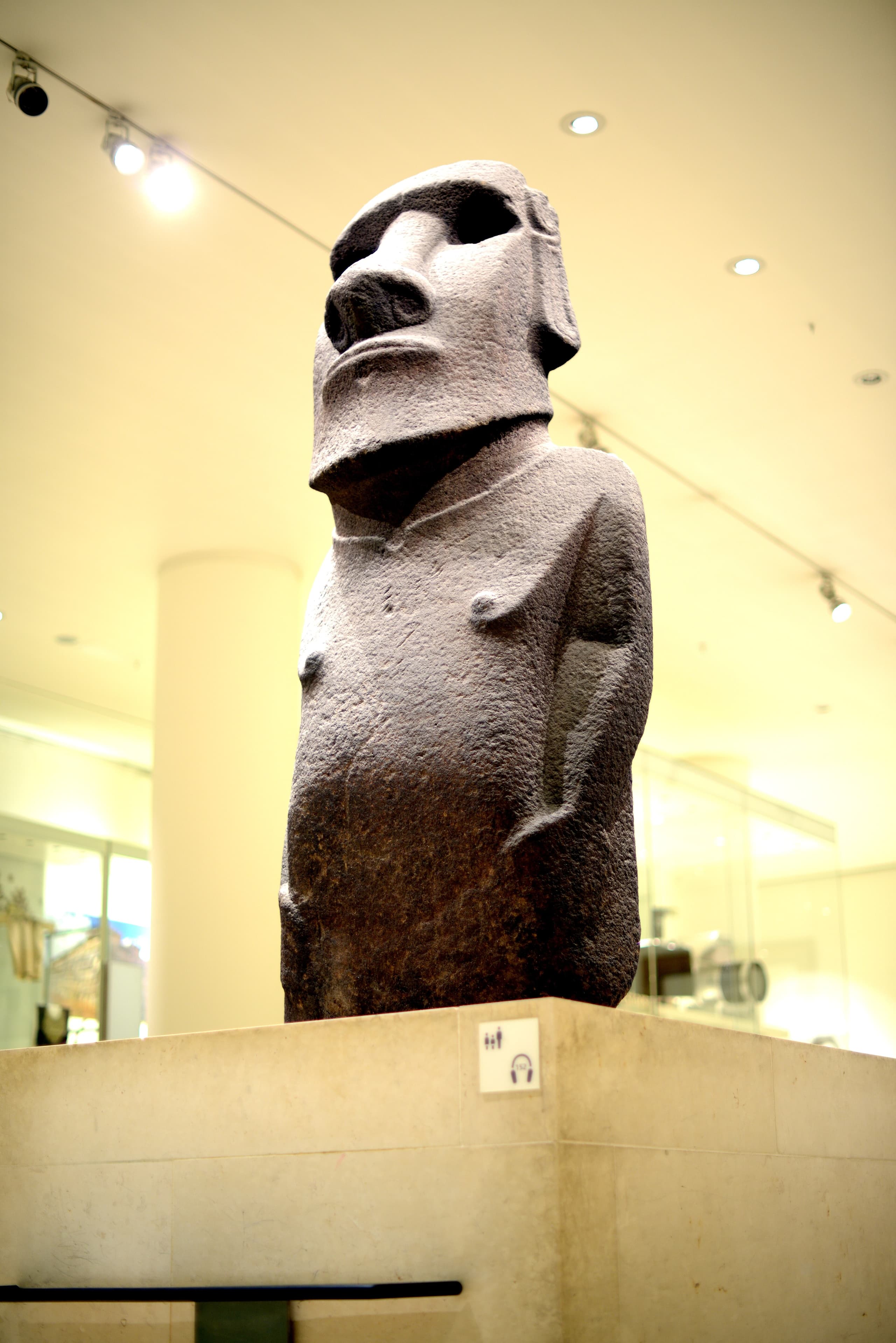
The front shows the form familiar from photographs of Rapa Nui statuary: a standing human figure, upright and stylised, carved from dark grey basalt. The surface is worked smooth. The figure has a heavy brow, a long nose, and a small mouth. The arms hang at the sides, hands meeting at the lower abdomen. The proportions are consistent with other moai — the head is large relative to the torso, and the legs are short. At 2.42 metres it is shorter than many of the island's statues, but the form is typical.
The back: birdman reliefs
The back is carved with designs that were added later, after the front was finished. These include motifs associated with the birdman cult — a belief system that developed on Rapa Nui centuries after the moai tradition. The carvings include images of birdmen, figures that combine human and bird features, and other symbols. The style and iconography are distinct from the front, and the work appears to have been done at a different time, when the statue was already standing. The back carvings are shallower and less formal than the front.
The name
Hoa Hakananai'a is the name by which the statue is known, but its meaning is not settled. It has been translated in different ways, and the circumstances under which it was named are not fully recorded. The statue was taken from Orongo in 1868, and the name appears in accounts from that period, but whether it was a name used on the island before removal, or assigned later, is unclear. The translation often given is 'lost friend' or 'stolen friend', but this is not certain.
The story
Moai are the monumental stone figures carved on Rapa Nui, the island in the southeastern Pacific also called Easter Island. They were carved over several centuries, and Hoa Hakananai'a was made around 1000. It is basalt, a hard volcanic rock, and stands 2.42 metres tall. The front shows a standing human figure, carved in the style shared by moai across the island: upright, stylised, with a large head, a prominent brow, and arms at the sides.
What makes this statue unusual is not the front, but the back. Centuries after the front was carved, someone added reliefs to the reverse side. These carvings show motifs associated with the birdman cult, a religious system that developed on Rapa Nui long after the moai tradition. The birdman cult centred on an annual competition held at Orongo, the clifftop site where this statue stood. Competitors raced to retrieve the first egg of the sooty tern from an offshore islet, and the winner's sponsor became the birdman for the year, holding ritual authority. The back of Hoa Hakananai'a was carved with birdman figures and related symbols, turning the statue into a surface for the newer belief system.
Two religions are visible on one stone. The front represents the moai tradition, which involved carving and erecting these figures, often on coastal platforms. The back represents the birdman cult, which came later. The statue was not destroyed or replaced; it was adapted. The original carving remained, and the new one was added to it.
In 1868, the crew of a British ship took the statue from Orongo. The ship was HMS Topaze, and the removal was carried out by the crew. The statue was transported to Britain and given to the British Museum, where it has been held since. It is now displayed in the museum's collection.
The government of Chile, which includes Rapa Nui, has requested the return of Hoa Hakananai'a. The request has been made formally, and the island's community has also called for repatriation. The British Museum has stated that it holds the statue in trust for the world, and that its legal framework prevents permanent return. The disagreement continues.
Why it mattered then
The front of the statue was carved during the period when moai were being made and erected across Rapa Nui. The reasons for carving moai are not fully understood, but they are thought to have represented ancestors or chiefs, and to have held religious or social significance. They were placed on platforms, often facing inland, and were part of a tradition that involved significant communal effort. The back carvings came later, during the time of the birdman cult. This was a different kind of religious practice, organised around an annual competition rather than permanent monuments. The cult was centred at Orongo, where this statue stood. Adding birdman reliefs to the back of an older moai suggests that the statue remained important, but that its meaning had shifted. It was not discarded; it was reused. The layering of one belief system onto another, without erasing the earlier one, is not unique to Rapa Nui, but it is clearly visible here. The statue records a change in religious practice, and the fact that the older carving was not removed suggests that both traditions could coexist, at least on the same stone.
Why it matters now
Hoa Hakananai'a is held by the British Museum, but it is claimed by Chile and by the Rapa Nui community. The request for return is active, and the statue has become a focal point in discussions about repatriation. The argument from Rapa Nui is that the statue belongs to the island, that it was taken without proper consent, and that it holds cultural and spiritual significance that cannot be served by display in London. The British Museum's position is that it holds the statue in trust for a global audience, and that its legal framework does not permit permanent return. The disagreement is not about legal technicalities alone. It is also about who has the authority to speak for an object's meaning, and whether a museum in one country can hold, in perpetuity, objects central to the identity of a community elsewhere. The statue is part of a broader pattern of contested museum holdings, and the discussions around it continue. The statue also remains evidence of religious change. The two carvings, front and back, show that belief systems can overlap and that objects can carry more than one meaning across time. That layering is still readable, and it is one reason the statue is studied.
The surprising detail
The statue was taken from a stone house at Orongo, not from an open-air platform. It had been moved indoors at some point before 1868, and was found inside a structure rather than standing in the open. Why it was moved, and when, is not recorded. The fact that it was sheltered may have protected the back carvings, which are shallower and more vulnerable to weathering than the front.
How it got here
The statue was taken from Orongo, Rapa Nui, in 1868 by the crew of HMS Topaze and transported to Britain, where it was given to the British Museum. The government of Chile and the Rapa Nui community have formally requested its return. The British Museum states that it holds the statue as part of a collection in trust for the world, and that its legal framework does not permit permanent repatriation. The disagreement remains unresolved.
Remember this
Two belief systems on one stone: the front carved around 1000, the back added centuries later when the island's religion had changed.
Test yourself
Why might the addition of birdman carvings to the back of an older moai tell us something about how religious change happened on Rapa Nui?
Because the older carving was not destroyed or defaced. The front of the statue, representing the moai tradition, was left intact, and the new birdman reliefs were added to the back. This suggests that the shift from one belief system to another did not require erasing the earlier one. The statue was adapted rather than replaced, which implies that the two traditions could coexist, at least in some form. If the new religion had demanded the destruction of older symbols, the front would not have survived. The fact that both carvings remain visible suggests a more layered process of change, where new practices were added alongside older ones rather than overwriting them entirely.
Go deeper
Image: James Miles, CC BY-SA 4.0. Licence: CC BY-SA 4.0. Source.