I · THE OBJECT · BRITISH MUSEUM
The Nereid Monument
▶ Listen · narrated
When a provincial ruler borrows the architecture of an empire, the result is not imitation but translation — and this tomb speaks both languages.
At a glance
- Type
- Mausoleum
- Date
- Circa 390 BC
- Discovery site
- Xanthos, Lycia
- Current location
- British Museum
Look closer
The figures between the columns
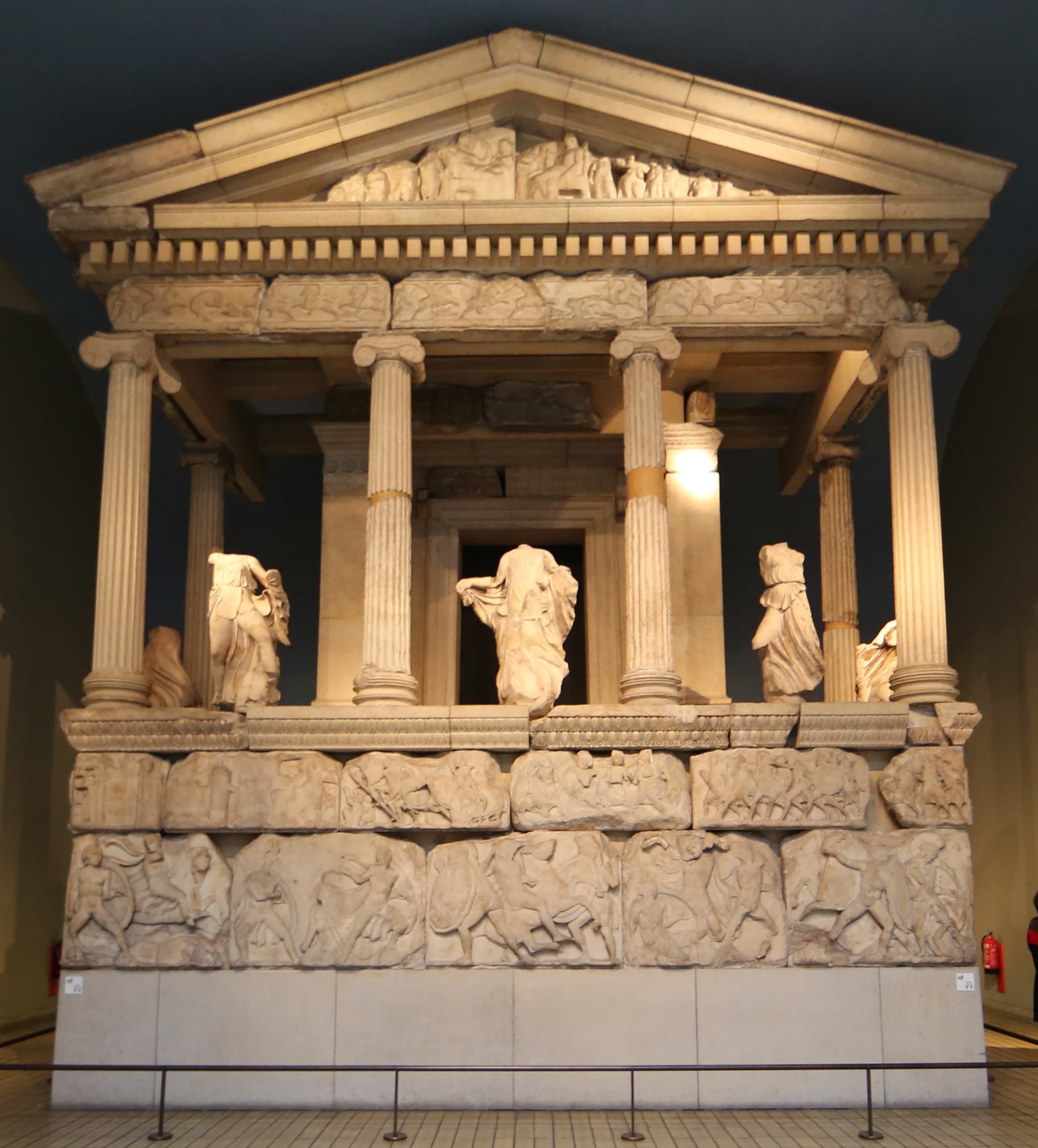
The monument takes its modern name from the carved female figures that stood between the columns of the upper structure. Their windswept drapery and raised arms suggested sea nymphs — Nereids — to the archaeologists who reconstructed the façade. Whether that identification matches Lycian intention is uncertain. What is clear is that the figures animate the colonnade, turning architectural rhythm into something more like a procession frozen mid-gesture.
Greek form, not Greek function
The structure mimics the proportions and column order of a small Greek temple, but it housed no cult and held no congregation. It was a tomb. The temple form served as monumental wrapping for a burial chamber. This was not a Greek practice: Athenian tombs were marked with stelae, not architecture. The borrowing was selective — the dynast wanted the visual authority of Greek public building, not its religious programme.
Sculptured friezes on the base
The platform beneath the temple structure carried sculpted friezes showing scenes of combat, siege, and what may be ceremonial or hunting activity. The style mixes Greek sculptural conventions with subject matter that appears to record local events or assert dynastic power. Reading them as straightforward narrative is difficult: the scenes do not form an obvious sequence, and without inscriptions the figures remain unidentified.
The story
The monument was built at Xanthos, a city in Lycia on the southwest coast of what is now Turkey. At the time, Lycia was part of the Persian Empire, but its cities were ruled by local dynasts — leaders who held power under Persian oversight but maintained their own courts, armies, and ambitions. The tomb is thought to have been commissioned by Arbinas, a dynast who ruled western Lycia under the Achaemenid Empire.
The structure took the form of a Greek temple set on a high rectangular base. The base itself was decorated with sculpted friezes. Above it, a colonnade surrounded a central chamber — the burial space — and carved figures stood between the columns. The whole thing was built of stone and stood raised off the ground on its platform.
This was not a common tomb type in Greece, but it was not a common tomb type in Lycia either. Lycian tombs were often cut into rock faces or built as free-standing pillar monuments. What Arbinas commissioned was a hybrid: a structure that used Greek architectural language but served a Lycian purpose and followed — according to some interpretations — principles that may have had Persian or Zoroastrian associations. The thick stone construction, the raised platform, and the single windowless chamber have been read as consistent with Zoroastrian funerary practice, though this interpretation is not universally accepted.
The monument stood for centuries. It is thought to have survived into the Byzantine era before collapsing or being dismantled. By the time it was rediscovered in the early nineteenth century, it was in ruins.
Charles Fellows, a British traveller and archaeologist, found the site in the early 1840s. He arranged for the sculptural elements and architectural fragments to be shipped to Britain, and they arrived at the British Museum, where parts of the east façade were reconstructed to show what the monument would have looked like. The reconstruction is partial: it represents one face of the building, not the whole structure, and the arrangement of some elements remains conjectural.
What survives is a record of a moment when a local ruler reached for a visual language that was not his own but was legible across the region. Greek architectural forms had become a kind of currency of power in the eastern Mediterranean, and Arbinas spent it.
Why it mattered then
Lycia in the early fourth century BC was politically complex. It was under Persian control, but that control was exercised at a distance, and local dynasts had considerable autonomy. They raised taxes, commanded troops, struck coins, and built monuments. They also competed with one another, and monumental architecture was one way to assert status. Arbinas built his tomb in a visual language that was not native to Lycia but was widely understood as prestigious. Greek architecture carried associations with civic order, military success, and cultural sophistication. By clothing his tomb in that style, Arbinas was not declaring himself Greek — he was declaring himself powerful enough to command the visual grammar of Greek public buildings. At the same time, the monument was not purely Greek. The friezes may have depicted events from Arbinas's own career or from Lycian history. The structure itself, with its raised platform and enclosed chamber, may have followed principles that had more to do with Persian or local tradition than with Greek practice. The result was a monument that could be read in multiple registers: as a temple by someone familiar with Greek architecture, as a dynastic statement by someone familiar with Lycian politics, and possibly as a Zoroastrian-compliant tomb by someone familiar with Persian funerary norms. Whether all those readings were intended or whether some are modern projections remains uncertain.
Why it matters now
The monument is a record of cultural translation. It shows what happens when a visual language moves across borders and is put to new purposes by people who understand its prestige but are not bound by its original meanings. The result is not a copy but a reinterpretation. It also raises questions about how we reconstruct the past. The monument as it stands in the British Museum is a partial reconstruction, assembled from fragments and informed by assumptions about Greek architectural norms. Some of those assumptions may be correct; some may impose a Greek order on a structure that was never quite Greek. The reconstruction is valuable as a scholarly hypothesis, but it is not the same as the monument as it stood at Xanthos. Finally, the monument is part of a broader conversation about how objects move from their original sites to museums. Fellows removed the sculptures and architectural elements in the 1840s, at a time when such removals were common practice among European archaeologists and collectors. The monument is now in London, not in Turkey, and that displacement is part of its history.
The surprising detail
The monument is thought to have been the main inspiration for the Mausoleum at Halicarnassus. If that connection is correct, then a tomb built by a provincial dynast in Lycia became the model for a monument that was famous across the ancient Mediterranean. The influence would have run from the periphery to the centre, not the other way around.
How it got here
The monument was discovered at Xanthos by Charles Fellows in the early 1840s. Fellows arranged for the sculptural and architectural elements to be removed and shipped to Britain, where they were acquired by the British Museum. The removal took place during a period when such practices were common among European archaeologists and collectors, and the monument has remained in London since. Turkey has not formally requested the return of the Nereid Monument, but the broader question of objects removed from Ottoman-controlled territories in the nineteenth century remains a subject of ongoing discussion between Turkey and European institutions.
Remember this
A local ruler borrowed an imperial style and made it say something new — and the result may have travelled back to inspire the Mausoleum at Halicarnassus.
Test yourself
Why might a Lycian dynast choose to build his tomb in the form of a Greek temple rather than in a traditional Lycian style?
Because Greek architectural forms had become a widely recognised visual language of power and prestige across the eastern Mediterranean. By adopting that language, Arbinas was not claiming to be Greek but asserting that he commanded the resources and sophistication to build in a style associated with Greek civic and religious authority. At the same time, the monument was not purely Greek: the friezes may have depicted Lycian subjects, and the structure may have followed principles that had more to do with Persian or local tradition. The choice was strategic, not imitative — it allowed the monument to be read as prestigious by multiple audiences.
Go deeper
Image: geni, CC BY-SA 4.0. Licence: CC BY-SA 4.0. Source.