I · THE OBJECT · BRITISH MUSEUM
The Double-Headed Serpent
▶ Listen · narrated
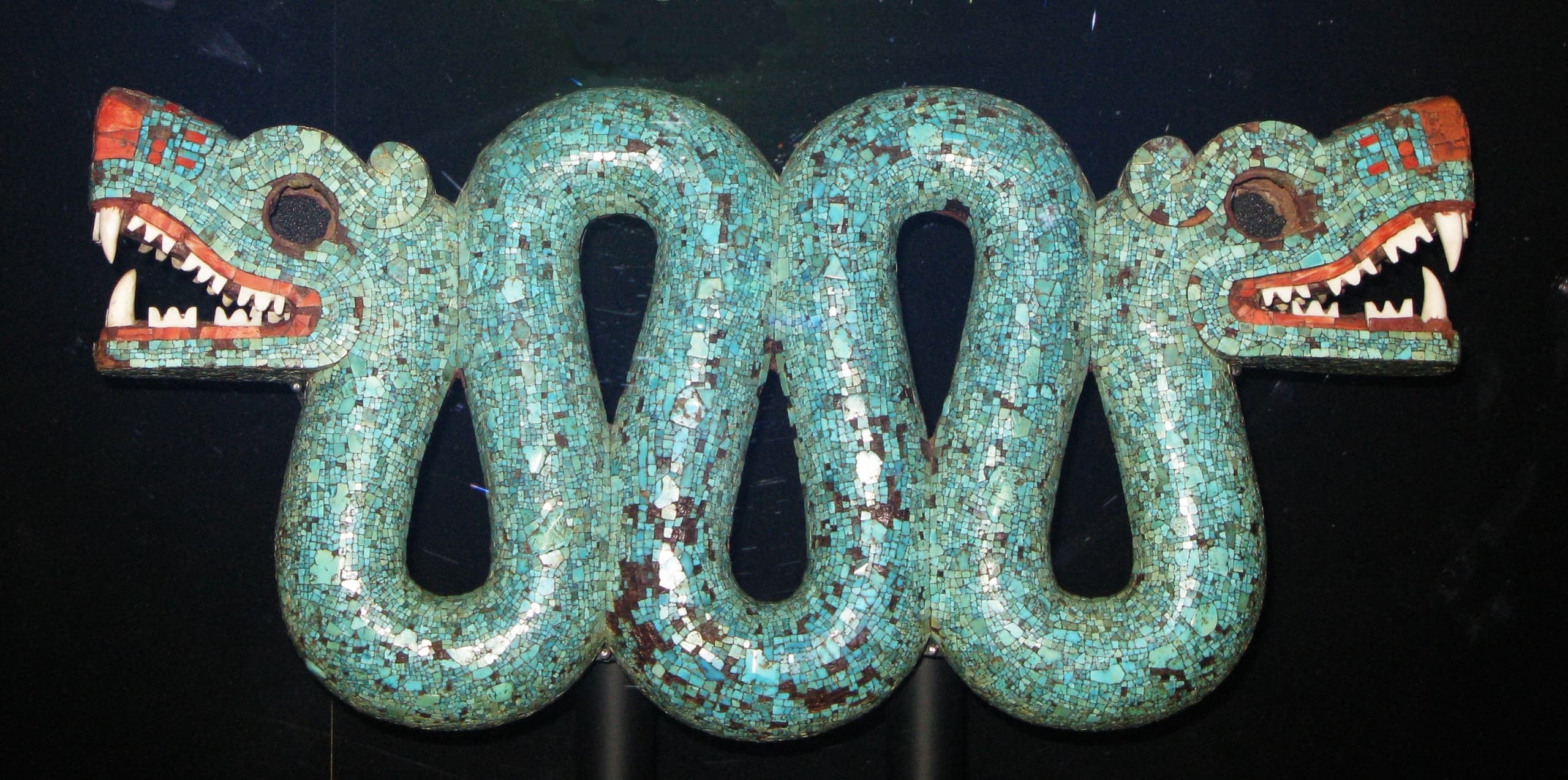
A wooden snake covered entirely in turquoise mosaic, with two heads and one tongue. Nobody recorded what ceremony it belonged to, or who wore it.
At a glance
- Material
- Spanish cedar, turquoise, pine resin, seashell
- Height
- 20.5 cm
- Collection
- British Museum, Am1894,-.634
Look closer
Two heads, one tongue
The serpent curves into a shallow wave, and a head emerges at each end. The mouths gape, lined with white shell for teeth, and a single red tongue forks between them. The symmetry is not quite perfect: the curve is gentle, not a circle, and the heads face slightly outward rather than directly opposing one another. The effect is a creature frozen mid-motion, turning back on itself.
Turquoise tesserae
The surface is covered in small, shaped pieces of turquoise — tesserae, in mosaic terms — fitted closely together and fixed with pine resin to a base carved from Spanish cedar. The turquoise varies in colour, from pale blue-green to deeper blue, creating subtle bands and variations across the body. Pieces of spiny oyster shell and conch shell provide contrast: white for the teeth, red for the tongue and details around the nostrils.
The hollow underneath
The underside is not decorated. The wooden base is carved but left plain, and the cavity is deep enough that the object is much lighter than solid wood of the same size would be. This has led to the suggestion that it was worn — perhaps on the chest, suspended or fastened somehow — rather than simply displayed on a flat surface. But no fastening holes or attachment points survive, and no contemporary description records how it was used.
The story
The object is a serpent with two heads, carved from Spanish cedar and covered almost entirely in turquoise mosaic. It measures just over twenty centimetres tall, curves gently, and weighs less than you would expect because the wooden core is hollowed out. Each head has an open mouth lined with white shell teeth, and a single red shell tongue emerges from the centre, forked so that each head appears to possess it. The eyes are marked, the nostrils detailed, and the turquoise pieces are cut and fitted with care, held in place by pine resin.
The mosaic technique — small shaped pieces of stone applied to a wooden form — was used widely in the Mexica world for ceremonial objects, masks, and ornaments. Turquoise itself was valued, and the colour carried symbolic weight, though the specific associations are harder to reconstruct than is sometimes claimed. Serpents appear throughout Mexica art and cosmology, often with multiple heads or intertwined bodies, and they are linked to various deities and forces. But this object has no surviving label, no recorded findspot, and no contemporary European description that identifies it by name or function.
What is recorded is that it reached Europe early. It was probably sent or taken within a generation of contact between the Mexica world and Spanish forces in the early sixteenth century. A number of Mexica objects entered European collections in this period, sometimes as diplomatic gifts, sometimes as plunder, sometimes through trade or indirect routes that left no paper trail. By the time collectors and institutions began cataloguing such things systematically, the circumstances of acquisition were already unclear.
The hollowed base and the lack of decoration on the underside have suggested to some scholars that the serpent was worn, perhaps as a pectoral — an ornament worn on the chest. The curve would sit naturally against the body, and the heads would project symmetrically. But no attachment mechanism survives, and the hypothesis rests on the form and weight rather than on any recorded use. It might equally have been displayed flat, or held, or mounted in a way that has left no trace.
The double-headed form itself is not unique in Mexica art, but this object is among the surviving examples of the mosaic technique applied to a serpent of this size and symmetry. Turquoise mosaic was labour-intensive: each piece had to be shaped, the wooden core carefully prepared, the resin mixed and applied while workable, the tesserae pressed into place before it set. The result is a surface that catches light unevenly, the colour shifting as the viewer moves, the joins between pieces almost invisible until you look closely.
Why it mattered then
Turquoise mosaic objects in the Mexica world were not everyday things. The materials were valued, the technique was specialised, and the labour was considerable. Objects like this were made for ceremonial contexts, for display or use by elites, or as offerings. Serpents carried symbolic weight — they appear in creation narratives, in depictions of deities, in architectural ornament — but the meanings were multiple and context-dependent, not fixed symbols with single referents. The double-headed form may have had specific associations, but without a recorded provenance or a surviving text that describes this object, those associations remain speculative. What is clear is that the object was made with skill and care, that it required resources and time, and that it was the kind of thing that might be given as a diplomatic gift or taken as a trophy when the Mexica world and Spanish forces came into contact in the early sixteenth century. Objects like this entered European collections in that period, and they were noted — though often without the detail that would allow us to trace individual pieces back to specific moments or places.
Why it matters now
The object survives as evidence of a technique and a visual language that were disrupted by conquest and conversion. Turquoise mosaic continued to be made after contact, but the contexts shifted, the symbolic systems were suppressed or transformed, and much of the knowledge about how these objects were used and understood was lost or went unrecorded. What remains is the thing itself: the carved wood, the cut turquoise, the shell details, the workmanship. It is a reminder that the Mexica world had its own materials, its own aesthetics, its own ways of marking importance and making meaning — and that those systems were as complex and as specific as any in Europe at the same moment. The fact that we do not know exactly what ceremony this serpent belonged to, or who wore it, or what it was called, is itself part of the history. The gaps in the record are not accidents; they are the shape of what was lost when one world met another and the meeting was violent.
The surprising detail
The object has no recorded findspot and no early European description that identifies it specifically. It appears in the British Museum's collection in the late nineteenth century, but the route it took to get there is not documented. This is not unusual for Mexica objects in European collections: many entered as curiosities, were passed between collectors, and were catalogued long after the circumstances of their acquisition were forgotten or considered unimportant. The result is that we can say a great deal about how it was made and what it is made of, but very little about where it was found, who made it, or what it was called by the people who made it.
How it got here
The object reached Europe in the early modern period, probably within decades of contact between the Mexica world and Spanish forces in the early sixteenth century. It entered the British Museum's collection in 1894, but the route it took before that is not documented. The museum's records do not identify where it was found, who owned it before it was acquired, or how it left the region where it was made. This lack of documentation is common for Mexica objects in European collections, many of which were collected, traded, or taken as plunder in circumstances that were not recorded or were considered unimportant at the time. There is ongoing discussion about the repatriation of cultural objects from this period, and the absence of a clear provenance is part of that conversation.
Remember this
A serpent with two heads and one tongue, covered in turquoise mosaic. The technique and materials are recorded; the name and purpose are not.
Test yourself
Why does the hollowed underside suggest the serpent might have been worn, and why is that suggestion not certain?
The hollow makes the object much lighter than it would be if carved from solid wood, and the curve would sit naturally against a body, with the two heads projecting symmetrically outward. The underside is undecorated, which is consistent with it being hidden against the wearer. But no attachment holes, fastening points, or suspension loops survive, and no contemporary account describes it being worn. The form is compatible with use as a pectoral, but it is also compatible with display on a flat surface or mounting in some other way that left no physical trace. The hypothesis rests on the object's shape and weight, not on recorded evidence of use.
Go deeper
- Double-headed serpent · Wikipedia
- Double-headed serpent — Wikidata · Wikidata
- The Double-Headed Serpent — collection record · britishmuseum.org
Image: Geni, CC BY-SA 4.0. Licence: CC BY-SA 4.0. Source.