III · THE WORK · ART HISTORY
The Great Enclosure at Great Zimbabwe
▶ Listen · narrated
A stone enclosure in south-eastern Africa, built by ancestors of the Shona people in the 13th and 14th centuries — and then attributed by colonial archaeologists to almost anyone else.
At a glance
- Culture
- Ancestors of the Shona people
- Date
- 13th–14th centuries
- Material
- Granite, laid without mortar
- Wall height
- 11 metres
- UNESCO status
- World Heritage Site
Look closer
Coursed granite laid without mortar
The walls are built from granite blocks shaped to fit tightly together, laid in horizontal courses without any binding material. Each stone was selected and dressed so that its weight and the friction between stones hold the structure in place. The technique is called dry-stone construction. The walls of the Great Enclosure reach eleven metres in height — roughly the height of a three-storey building — and taper slightly as they rise, which helps distribute the load. The precision required to keep such a wall standing for seven centuries, through seasonal expansion and contraction, is considerable.
The chevron frieze along the upper course
Near the top of the outer wall, a band of stones is set in a zigzag pattern, creating a decorative frieze that runs horizontally around part of the enclosure. The chevron motif is formed by angling the stones in alternating directions within the same course. It is one of the few places where the builders introduced ornament into what is otherwise a functional structure. The frieze has no structural purpose; it marks a deliberate aesthetic choice, and suggests that the enclosure was intended to be seen and read as architecture, not merely as a boundary.
The narrow parallel passage
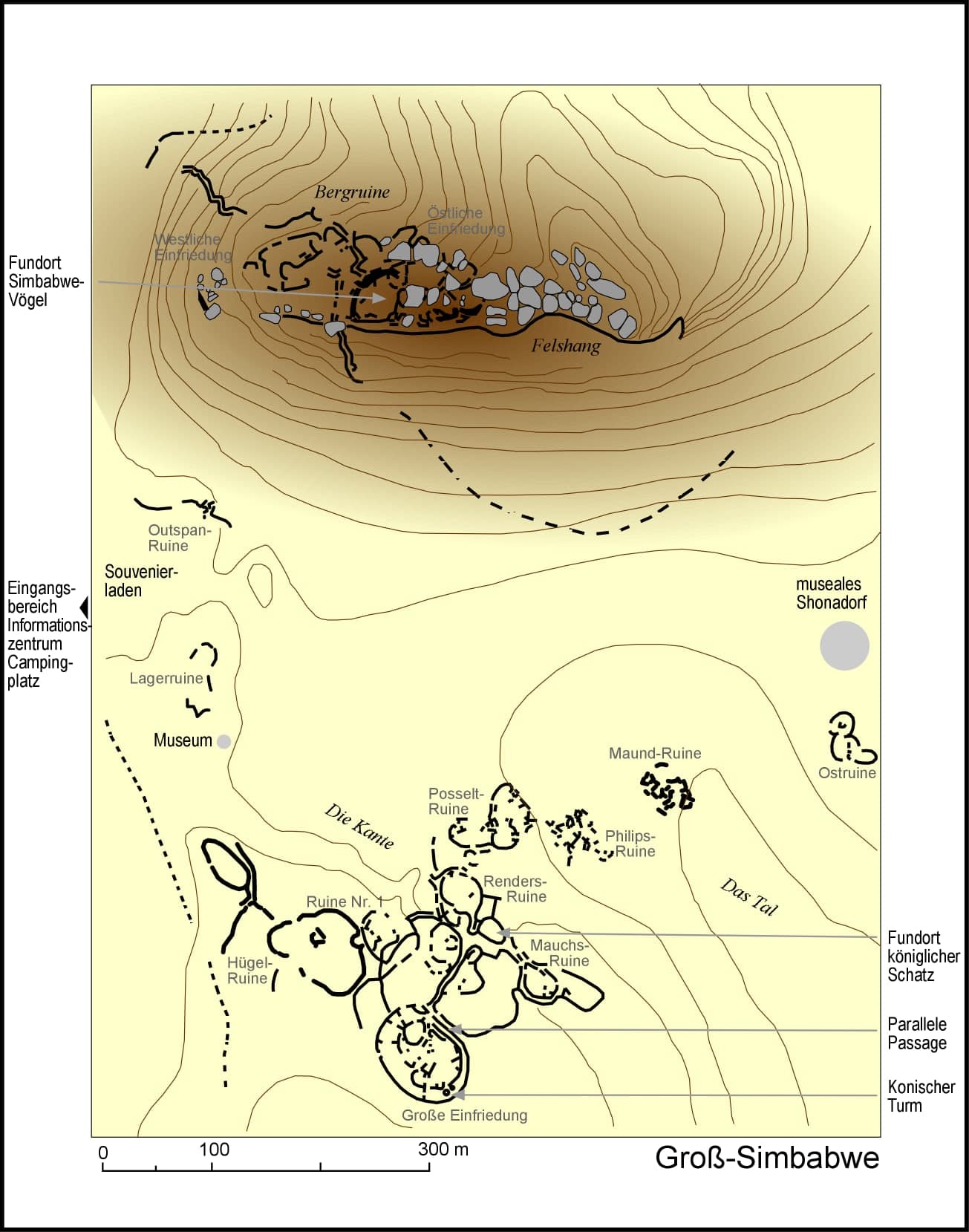
Between the outer wall and an inner wall, a long, narrow passage runs in a curve, so tight in places that only one person can pass at a time. The walls on either side rise above head height, creating a controlled, almost claustrophobic route. Scholars disagree on its function. Some interpret it as a processional path, where movement would have been slowed and directed, perhaps for ritual purposes. Others see it as a way to separate different areas within the enclosure, controlling access to spaces that may have been reserved for particular groups or activities. The passage does not lead directly to any obvious entrance or exit; it curves and redirects.
The story
Great Zimbabwe is the name given to a stone city in the south-eastern hills of what is now the country of Zimbabwe, near the modern town of Masvingo. The site was settled from around the year 1000, and by the 13th century it served as the capital of the Kingdom of Great Zimbabwe. Construction of the major stone structures began in the 11th century and continued until the 15th. The city was abandoned in the 16th or 17th century. The reasons for abandonment are not fully understood; suggestions include resource depletion, shifts in trade routes, and political changes, but the evidence does not settle the matter.
The site covers an area of 7.22 square kilometres. Population estimates vary. Earlier studies suggested a peak of around 20,000 people. A more recent study, using archaeological, ethnographic and historical evidence combined with statistical modelling, suggests the population did not exceed 10,000. The kingdom centred on Great Zimbabwe likely covered 50,000 square kilometres. The city was built by ancestors of the Shona people, who are currently located in Zimbabwe and nearby countries.
The site is composed of three main complexes: the Hill Complex, the Valley Complex, and the Great Enclosure, all constructed at different times. There is disagreement among scholars about the functions of these complexes. Some interpret them as residences for royals and elites at different periods. Others infer that they had separate, specialised functions. The Great Enclosure, with its eleven-metre-high dry-stone walls, was built during the 13th and 14th centuries. It likely served as the royal residence, with spaces demarcated for public rituals. The walls were constructed without mortar — each granite block was shaped and fitted so that the structure is held together by the weight and friction of the stones themselves.
Great Zimbabwe is part of a wider tradition. The word "great" distinguishes this site from many smaller ruins, known as "zimbabwes" or "houses of stone", spread across the Zimbabwe Highveld. More than 400 sites with monumental, mortarless walls have been identified across Southern Africa, including Bumbusi in Zimbabwe and Manyikeni in Mozambique. Great Zimbabwe is recognised as a World Heritage Site by UNESCO.
European visits to the site were recorded by the late 19th century, with investigations starting in 1871. Between the 1890s and 1920s, Great Zimbabwe and surrounding sites were looted by European antiquarians. Some later studies of the monument were controversial, because the white government of Rhodesia pressured archaeologists to deny its construction by black Africans. Consensus that the site was of African origin was not reached until the 1950s. Since independence, Great Zimbabwe has been adopted as a national monument by the Zimbabwean government, and the modern state was named after it.
Why it mattered then
The scale and permanence of the stone construction at Great Zimbabwe marked a significant concentration of political and economic power in the region during the 13th and 14th centuries. The kingdom controlled trade routes, and the city served as a centre for the distribution of goods including gold, ivory and cattle. The stone enclosures — particularly the Great Enclosure — appear to have been spaces where royal authority was displayed and reinforced through architecture. The height and thickness of the walls, the controlled access through narrow passages, and the decorative elements like the chevron frieze all suggest that the structures were designed to be read as symbols of power and permanence. The labour required to quarry, dress and lay the granite blocks, and the coordination needed to build walls that have stood for seven centuries, indicate a society with the resources and organisation to undertake sustained, large-scale projects. The city was not isolated; it was part of a broader network of stone-building traditions across Southern Africa.
Why it matters now
The historiography of Great Zimbabwe is as significant as the ruins themselves. For much of the 20th century, the site was used as a test case in arguments about African history and capability. European investigators, unwilling to accept that black Africans had built such structures, attributed them to Phoenicians, Arabs, or a lost white civilisation. The white government of Rhodesia, which ruled the territory until independence, actively suppressed archaeological findings that confirmed African authorship. This was not a matter of scholarly caution; it was ideological censorship in the service of colonial rule. The eventual acceptance of the site's African origin, by the 1950s, came through the work of archaeologists who insisted on evidence over prejudice, but the damage had been done. Great Zimbabwe became a symbol of the ways colonial powers rewrote history to justify their presence. Since independence, the site has been reclaimed as a national symbol, and the modern state of Zimbabwe took its name from it. The ruins are now a point of pride and a reminder that the distortion of the past is never neutral. The long refusal to acknowledge who built Great Zimbabwe is part of the site's meaning, and cannot be separated from it.
The surprising detail
Great Zimbabwe and the surrounding sites were looted by European antiquarians between the 1890s and 1920s. Objects were removed, walls were dismantled to search for treasure, and stratigraphic layers — the careful record of how material accumulates over time, which is essential for archaeological interpretation — were destroyed. The looting was not casual; it was systematic, and it was conducted by people who presented themselves as scholars. The loss of context means that many questions about the site — what was made there, what was imported, how spaces were used — are now harder to answer than they would have been if the site had been left undisturbed. The damage was compounded by the fact that some of the removed objects were dispersed into private collections and museums, where they were catalogued without reference to their original location. The historiography of Great Zimbabwe is not just about what was written; it is also about what was taken.
What is disputed
Population estimates for Great Zimbabwe vary significantly, from around 10,000 to 20,000 at peak. The functions of the three main complexes — Hill, Valley, and Great Enclosure — are debated, with some scholars interpreting them as residences for different periods or groups, and others suggesting separate, specialised uses. The reasons for the city's abandonment in the 16th or 17th century are not settled; proposals include resource depletion, trade route shifts, and political change, but the evidence does not favour one explanation decisively.
Remember this
Great Zimbabwe's walls were built without mortar by ancestors of the Shona people in the 13th and 14th centuries — a fact that took until the 1950s to become consensus.
Test yourself
Why does the fact that the walls at Great Zimbabwe were built without mortar make the structure more, not less, impressive as an engineering achievement?
Because a mortared wall is held together by the adhesive strength of the binding material, which can compensate for irregularities in the stones. A dry-stone wall has no such compensation. Each block must be shaped and positioned so that its weight, its fit with neighbouring stones, and the friction between surfaces are sufficient to hold it in place. For a wall eleven metres high, the cumulative load is considerable, and any instability in the lower courses will eventually cause collapse. The wall must also withstand seasonal expansion and contraction of the stone, ground movement, and weathering, all without any material to bind the joints. The fact that the walls at Great Zimbabwe have stood for seven centuries indicates a high level of skill in selecting, shaping and placing the stones, and a sophisticated understanding of how weight and friction can be used to create a stable structure. The absence of mortar is not a limitation the builders worked around; it is the technique they chose, and they made it work at a scale that required precision and planning.
Go deeper
Image: Thomas Wozniak, CC BY 3.0. Licence: CC BY 3.0. Source.