I · THE OBJECT · BRITISH MUSEUM
The Benin Bronzes
▶ Listen · narrated
A guild of metalworkers cast plaques for a king's palace. An expedition took them. Museums across three continents hold them, and the argument continues.
At a glance
- Material
- Copper-based alloy, mostly brass of variable composition
- Technique
- Lost-wax casting
- Origin
- Kingdom of Benin, now Edo State, Nigeria
- Date range
- Fourteenth to eighteenth century
- Current locations
- British Museum, Ethnological Museum Berlin, Museum of Fine Arts Boston, Nigerian National Museum Lagos
Look closer
Lost-wax casting in brass
The plaques were made using lost-wax casting, a technique in which the artist models the design in wax, encases it in clay, then heats the assembly until the wax melts and runs out. Molten metal pours into the void left behind. When the clay breaks away, the casting emerges with fine detail intact — and the wax original is destroyed, making each piece unrepeatable. The metal is brass, a copper-based alloy, not bronze as the popular name suggests. The composition varies from piece to piece.
Plaques called Ama
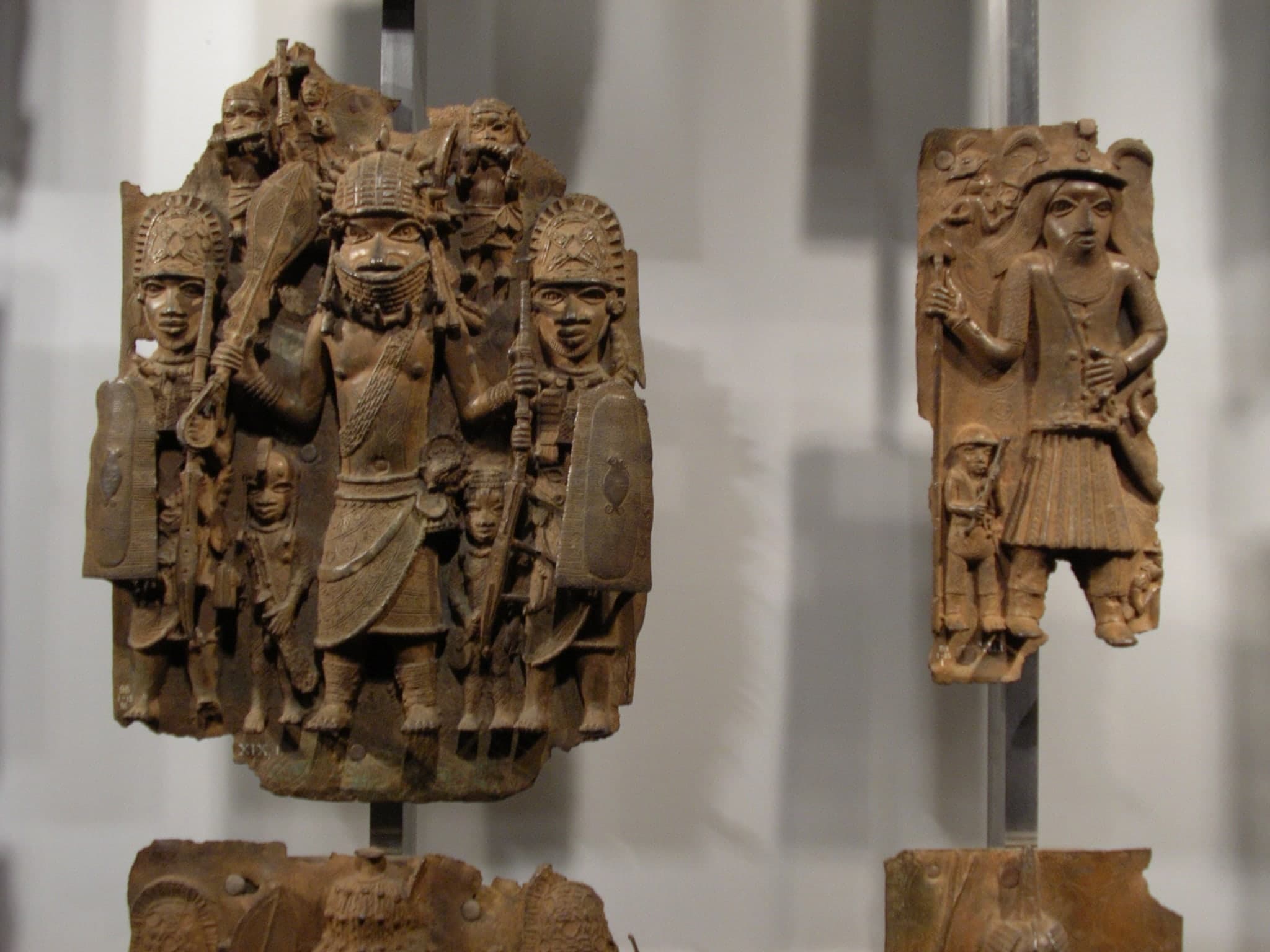
In the Edo language, the metal plaques are called Ama. They depicted scenes or represented themes in the history of the kingdom, and they decorated the royal palace. The collection includes not only plaques but also portrait heads, jewellery, and smaller sculptures. Some pieces date to the fourteenth century; the bulk were made in the fifteenth and sixteenth centuries. Two periods — the reigns of Esigie and Eresoyen — are described as times when the workmanship reached particularly high quality, though the exact dates of Esigie's reign are not recorded and Eresoyen ruled from 1735 to 1750.
A guild tradition in Igun Street
The plaques and sculptures were produced by the Guild of Benin Bronze Casters, now located in Igun Street, also known as Igun-Eronmwon Quarters. This was a specialist guild working for the court. The bronze sculpture tradition in Benin is thought to have derived from or been influenced by the metalworking tradition of the nearby Kingdom of Ife. Benin began trading with the Portuguese in the late fifteenth century, exchanging ivory, pepper, and slaves, and incorporated manillas — brass ingots in the form of bracelets, bought from the Portuguese — as a metal source. The brass in those manillas is now thought to come from the Rhineland region of Germany, not The Netherlands as previously suggested.
The story
The Benin Bronzes are a group of several thousand metal plaques and sculptures that decorated the royal palace of the Kingdom of Benin, in what is now Edo State, Nigeria. Despite the name, most are made of brass — a copper-based alloy — rather than bronze, and the composition varies across the collection. There are also pieces made of mixtures of bronze and brass, and of wood, ceramic, and ivory.
The objects were created by artists of the Edo people, working within the Guild of Benin Bronze Casters. The guild is now located in Igun Street, also known as Igun-Eronmwon Quarters. The plaques, called Ama in Edo, depict scenes or represent themes in the history of the kingdom. The collection also includes portrait heads, jewellery, and smaller pieces.
The tradition stretches back to the fourteenth century, though the bulk of the collection dates to the fifteenth and sixteenth centuries. Scholars describe two periods when the metalwork reached particularly high quality: the reign of Esigie, whose dates are given only as flourishing around 1550, and the reign of Eresoyen, from 1735 to 1750. The Benin bronze sculpture tradition is thought to have derived from or been influenced by the older metalworking tradition of the nearby Kingdom of Ife in southwest Nigeria.
The technique used to make the metal pieces was lost-wax casting. The artist models the design in wax, encases it in clay, and heats the assembly until the wax melts and runs out through channels. Molten brass pours into the cavity left behind. When the clay mould is broken away, the casting emerges with fine surface detail intact. The wax original is destroyed in the process, so each piece is made only once.
When the Portuguese began trading with Benin in the late fifteenth century, the kingdom incorporated a new metal source into its sculpture: manillas, brass ingots shaped like bracelets, which were bought from the Portuguese. The brass in those manillas was previously thought to come from The Netherlands, but is now believed to come from the Rhineland region of Germany. The Kingdom of Benin had been working in metal long before contact with the Portuguese, and earlier scholars who suggested that Benin learned metallurgy from European traders were mistaken.
Why it mattered then
The plaques and sculptures were made for the royal palace of the Kingdom of Benin, a state that was a hub of civilisation in the region long before European contact. The objects were not made for trade or export; they were part of the visual and political language of the court. The plaques depicted scenes from the kingdom's history and were fixed to the palace walls, making the building itself a record in metal. The guild system that produced them was a specialist institution. Membership and training were controlled, and the work was done for royal patronage. The incorporation of manillas — brass ingots traded from Europe — into the metal supply shows that the guild adapted new resources into an existing tradition, rather than learning the craft from outsiders. The two periods identified as high points in workmanship, under Esigie and Eresoyen, suggest that quality fluctuated with patronage and that particular rulers invested in the guild's output.
Why it matters now
Most of the plaques and other objects were taken by British forces during the Benin Expedition of 1897, as British control was being consolidated in Southern Nigeria. British sources positioned the expedition as retaliation for a massacre of an unarmed party of British envoys and a large number of their African bearers in January 1897. Some scholars, such as Dan Hicks, argue that the expedition was part of a broader series of premeditated attacks, framed as retaliatory or punitive, to further European imperialistic and economic interests in Africa. Following the expedition, two hundred pieces were taken to the British Museum in London, and the rest were distributed to other European museums. Today, large numbers are held by the British Museum, with other notable collections in Germany and the United States. Some pieces are held by the Nigerian National Museum in Lagos. The question of where the objects belong has become a central case in arguments over restitution of cultural property taken during colonial rule. Calls for their return have come from the Nigerian government, from Edo representatives, and from scholars and activists in multiple countries. Some institutions have begun returning pieces or are in discussions about doing so, but the process is uneven and contested. The objects remain physically scattered across three continents, while the guild that made them still exists in Igun Street.
The surprising detail
Scholars in the late nineteenth century, including O. M. Dalton and Charles Hercules Read, concluded erroneously that Benin learned metallurgy from Portuguese traders. The assumption was that African metalworking at this level of skill must have had a European source. The Kingdom of Benin had been working in bronze and brass long before the Portuguese arrived, and the sculpture tradition is thought to have links to the older Kingdom of Ife. The mistake was not a small one: it misread a tradition centuries deep as a recent import, and the correction took decades.
How it got here
Most of the plaques and sculptures were taken by British forces during the Benin Expedition of 1897. British sources described the expedition as retaliation for a massacre of British envoys and their African bearers in January 1897. Some scholars, including Dan Hicks, argue that the expedition was part of a broader series of attacks designed to advance European imperial and economic interests in Africa, and that the retaliatory framing was a justification rather than a cause. Following the expedition, two hundred pieces went to the British Museum and the rest were distributed to museums in Europe and the United States. Calls for restitution have come from the Nigerian government, from representatives of the Edo people, and from scholars and activists internationally. Some institutions have begun returning objects or are in discussions about doing so, but the process remains uneven and contested. The British Museum holds a large portion of the collection, as do museums in Germany and the United States, while some pieces are held by the Nigerian National Museum in Lagos.
Remember this
A guild cast brass plaques for a palace. British forces took them in 1897. They are now held across three continents, and the argument over their return continues.
Test yourself
The popular name for these objects is the Benin Bronzes, but most are made of brass, not bronze. Why does that distinction matter beyond getting the metal right?
Because the metals come from different sources and tell different stories about trade and material supply. Bronze is an alloy of copper and tin; brass is copper and zinc. Benin's use of brass, particularly brass from manillas traded by the Portuguese, shows the kingdom adapting imported metal into an existing casting tradition. If the plaques were bronze, the sourcing story would be different — tin and copper deposits are not in the same places as zinc, and the trade routes would have run differently. The misnaming also reflects the early scholars' errors: calling them bronzes without checking the composition was part of the same carelessness that led some to assume Benin had learned metalworking from Europeans. Getting the metal right means getting the history right.
Go deeper
Image: English-speaking Wikipedia user Warofdreams. Licence: CC BY-SA 3.0. Source.