III · THE WORK · ART HISTORY
David's Oath of the Horatii
▶ Listen · narrated
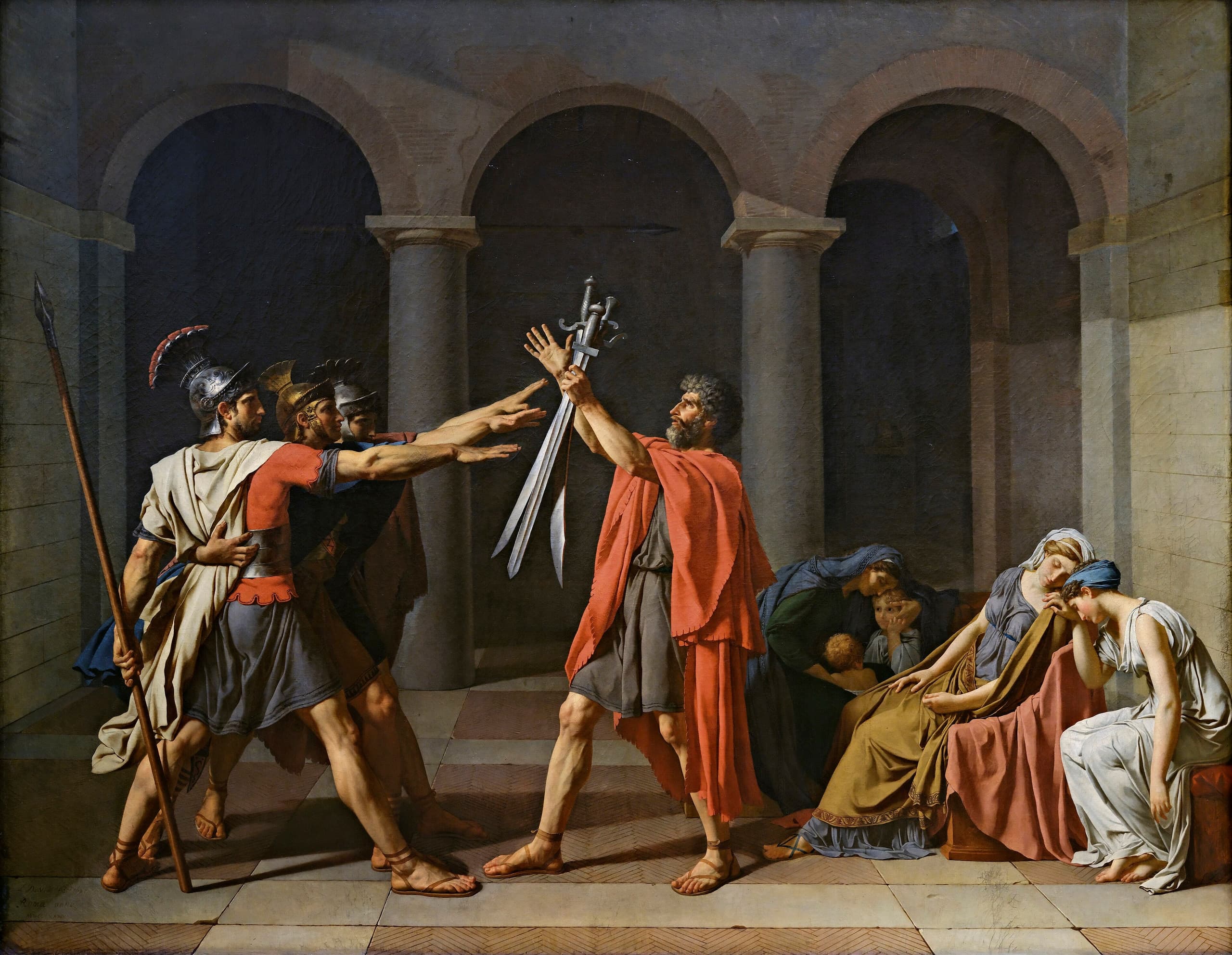
David painted a legend about choosing the state over the family, and made the choice visible in the composition itself: male figures as verticals, female figures as curves.
At a glance
- Artist
- Jacques-Louis David
- Date
- 1784–1785
- Medium
- Oil on canvas
- Dimensions
- 330 × 425 centimetres
- Collection
- Louvre, Room 702
- Movement
- Neoclassicism
Look closer
Three arms converging on the swords
The three brothers raise their right arms in identical gestures, hands stretched towards the hilts their father holds out. The arms form three parallel lines that meet at a single point. The brothers stand with their weight forward, legs braced, bodies angled towards the centre. David has made the oath a geometric event: three separate figures unified by a single vector. The father's outstretched arms hold three swords bundled together, the blades forming a fan. The hands do not quite touch the hilts yet. The gesture is frozen at the moment of commitment, before contact.
The women rendered in curves, not angles
On the right, three women and two small children collapse into each other. Where the men are verticals, the women are curves: bent backs, draped fabric, heads tilted or bowed. One woman sits, another leans against her, a third cradles the children. The group reads as a single mass of soft, continuous forms. No rigid limbs, no extended arms, no upward gestures. The contrast is structural, not incidental. David has used posture to separate two kinds of response to the same event: the men face it, the women fold away from it.
One arch per figure group
Three arches divide the background into three zones. The left arch frames the three brothers. The centre arch frames the father holding the swords. The right arch frames the women. The architecture does not merely sit behind the figures; it organises them into separate chambers. Each group occupies its own spatial compartment. The arches are round, Roman, and severe. They create a rhythm of repeated verticals that reinforces the upright postures of the men and makes the collapsed postures of the women more conspicuous by contrast. The floor is bare stone. The walls are plain. Nothing competes with the figures.
The story
David painted a moment that does not appear in the Roman sources. The legend of the Horatii and Curiatii is recorded by Livy and Dionysius: two cities, Rome and Alba Longa, agree to settle a war by sending three brothers from each side to fight. From Rome, the Horatii. From Alba Longa, the Curiatii. The story tells what happened in the fight and what happened after, but it does not describe an oath ceremony beforehand. David invented that.
What he invented was a scene built from geometric clarity. Three brothers on the left, standing. Their father in the centre, holding three swords. Three women and two children on the right, seated or leaning. The men are verticals: straight legs, straight arms, straight backs. The women are curves: bent, draped, folded into each other. The floor is bare. The background is three Roman arches, one per group. The light is even and cold. Every element is placed to make the composition readable as a diagram of choice.
The brothers stretch their right arms towards the swords. Their hands do not touch the hilts yet; the gesture is suspended at the moment of commitment. Their legs are braced, weight forward. They are identical in posture but not in face or dress. The father stands with his arms extended, holding the three swords bundled together, blades fanning outward. He is older, bearded, draped in red. His stance is frontal and symmetrical. He is the axis of the scene.
On the right, the women respond differently. One woman sits on a low bench, another leans against her, a third bends over two small children. They are Camilla, a sister of the Horatii, and others whose relationships the painting does not specify. Camilla is betrothed to one of the Curiatii, so whichever side wins, she will lose someone. The legend records that the surviving Horatius brother killed her for weeping over her dead betrothed. David has painted her at the earlier moment, when the outcome is not yet known but the loss is already certain.
The composition is a structure of oppositions: male and female, vertical and curved, commitment and grief, public duty and private attachment. The brothers face the swords. The women face away. The architecture divides them into separate spaces under separate arches, but they share the same room and the same event. David has made the moral argument of the story — that the state comes before the family — into a spatial argument. The painting does not ask you to agree with that hierarchy; it asks you to see it as a hierarchy, rendered in posture and geometry.
The painting was made in Rome, where David had travelled, and was exhibited in Paris in 1785. It was received as a statement of Neoclassical principles: clarity, austerity, subjects drawn from ancient history, and a rejection of the decorative manner that had preceded it. The style is called Neoclassicism because it looked back to Greek and Roman art for its formal language, but the content was contemporary. A painting about choosing the state over personal loyalty, exhibited in Paris five years before the Revolution, was read as a painting about virtue, sacrifice, and civic duty in the present tense.
Why it mattered then
David painted the Oath in 1784 and 1785, and exhibited it in Paris in 1785. It was received as a manifesto. The style — hard edges, clear light, shallow space, Roman subject — was understood as a rejection of the decorative manner that had dominated French painting earlier in the century. Where that earlier style favoured soft forms, pastel colours, and subjects drawn from mythology or aristocratic leisure, David offered geometry, austerity, and a story about men dying for the state. The painting does not record a historical moment; it invents one in order to make a moral claim visible. The subject is duty, sacrifice, and the precedence of public obligation over private feeling. Those themes were legible to an audience in Paris in 1785 as arguments about the present, not the past. The painting was read as a statement about virtue, and virtue was a political term. Five years later, the Revolution would make that reading explicit. David himself became a deputy in the Convention and voted for the execution of the king. The Oath was not a cause of the Revolution, but it was part of the same vocabulary: a language of republican severity, drawn from Roman sources, used to argue that the old forms were exhausted.
Why it matters now
The Oath of the Horatii is still looked at because it is a clear example of how composition can be an argument. David did not paint three brothers and three women and leave it to the viewer to notice a contrast. He built the contrast into every formal decision: vertical versus curve, extension versus collapse, facing towards versus turning away. The painting is didactic by design. It wants you to see the structure, not discover it. That clarity makes it useful for understanding how Neoclassicism worked as a style and as a political language. The painting is not subtle. It does not hint. It states. The geometry is the message: order, hierarchy, discipline, sacrifice. Those values were mobilised in the Revolution, and they have been mobilised since, in different contexts and with different consequences. The painting does not tell you whether to endorse those values, but it shows you what they look like when rendered as a visual system. It also remains a problem. The women are painted as the opposite of the men: soft where the men are hard, passive where the men are active, grieving where the men are resolute. That opposition is structural, not incidental. The painting needs the women to collapse in order for the men to stand upright. The moral claim — that duty to the state outweighs personal attachment — is gendered in the composition itself. Camilla's grief is painted as the thing the brothers must reject in order to be virtuous. The painting makes that rejection visible, and it does not apologise for it.
The surprising detail
The moment David painted does not appear in the ancient sources. Livy and Dionysius describe the fight between the Horatii and the Curiatii, and they describe what happened afterwards, but neither records an oath ceremony beforehand. David invented the scene in order to paint a moment of choice rather than a moment of action. The oath itself — three brothers raising their arms towards three swords held by their father — is his composition, not a Roman tradition. The painting is a history painting in the sense that it takes its subject from history, but the subject it takes is one David made up.
What is disputed
The identities of the two women beside Camilla are not specified in the sources, and the painting does not label them. They are sometimes described as the wife and mother of the Horatii, but that is interpretation, not documented fact.
Remember this
David invented the oath ceremony to paint commitment as geometry: three verticals reaching towards a single point, and three curves turning away.
Test yourself
Why does David paint the women as curves and the men as verticals, rather than simply showing them in different activities?
Because the painting is not illustrating a difference in activity; it is illustrating a difference in moral posture, and David has made that difference structural. The men are painted as figures who face the event and commit to it. The women are painted as figures who turn away from it and collapse under it. If David had simply shown the men standing and the women sitting, the contrast would be incidental. By making the men into verticals — straight legs, straight arms, straight backs — and the women into curves — bent, draped, folded — he makes the contrast into a formal principle that organises the entire composition. The geometry is not decoration; it is the argument. The painting claims that duty and grief are opposites, and it makes that claim visible in the shapes of the bodies themselves.
Go deeper
Image: Jacques-Louis David, Public domain. Licence: Public domain. Source.