I · THE OBJECT · BRITISH MUSEUM
The Bimaran Casket
▶ Listen · narrated
For centuries, Buddhist art avoided depicting the Buddha directly. This gold casket from Afghanistan captures the moment that changed, in a visual language shaped by Mediterranean sculpture.
At a glance
- Culture
- Gandharan
- Material
- Gold
- Findspot
- Stupa No. 2 at Bimaran, near Jalalabad, eastern Afghanistan
- Contents
- Buddhist relics and Indo-Scythian coins
Look closer
Figures in arched niches
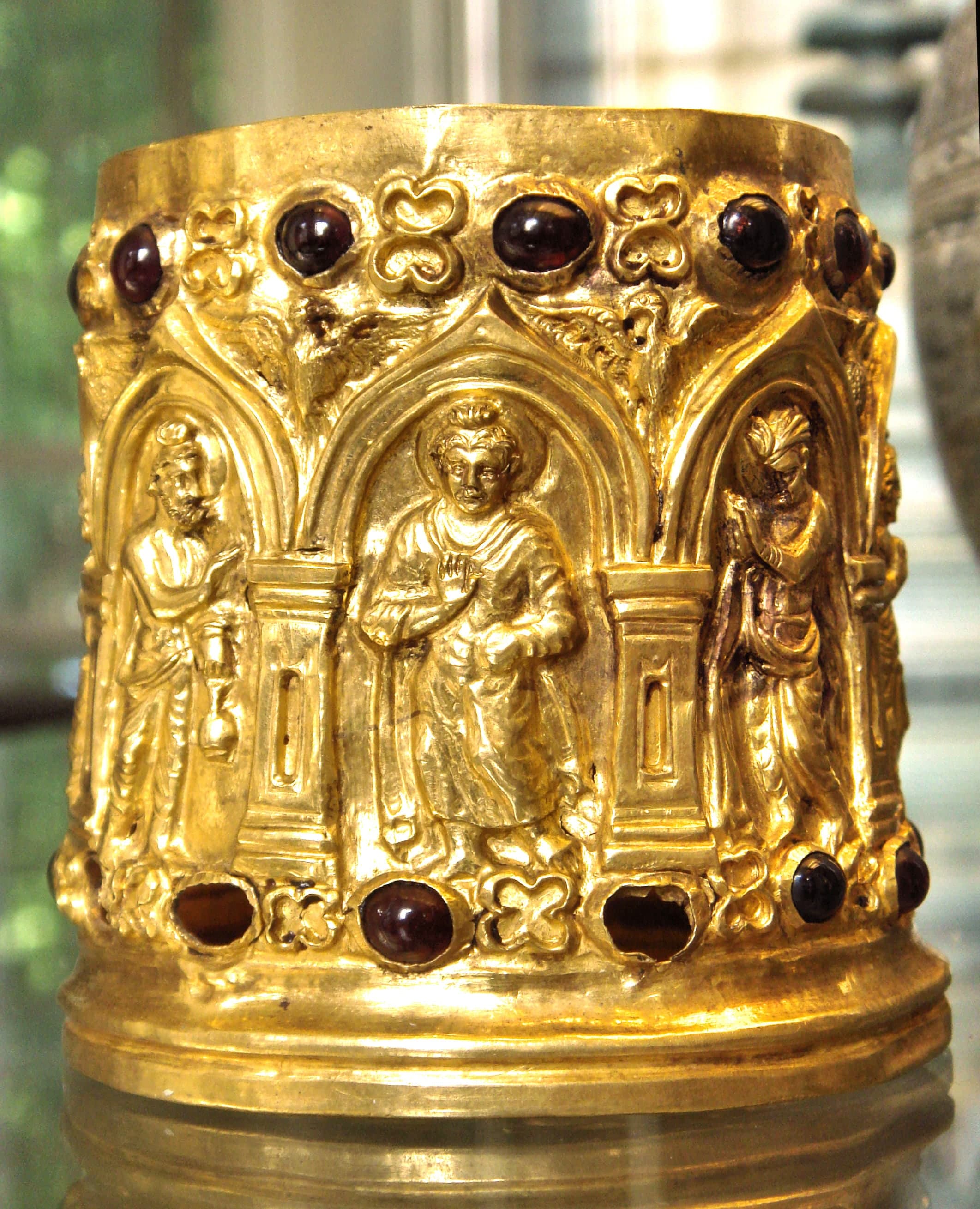
The casket's outer surface is worked in repoussé — the goldsmith hammered the design from the reverse, pushing the metal outward to create raised figures. The decoration shows standing figures within arched frames. The figures wear draped robes that fall in folds resembling cloth rendered in Greek and Roman sculpture. The treatment of fabric, the contrapposto stance, and the architectural framing all draw on visual conventions developed in the Mediterranean and carried eastward.
A human Buddha
One of the figures is identified as the Buddha, shown as a man rather than represented by symbols such as an empty throne, a footprint, or a wheel. The figure stands upright, robed, with one hand raised. For centuries before this, Buddhist art had depicted the Buddha's presence indirectly. The shift to showing him in human form is documented in Gandharan art, where sculptors working in a region influenced by Greek artistic traditions began rendering the Buddha as a physical person. This casket is among the objects that record that change.
Coins and dating uncertainty
Inside the casket were coins, along with bone fragments understood to be relics. The coins are Indo-Scythian — minted by rulers in the region during a period of shifting control. They were initially attributed to the reign of Azes II, then reassigned to Azes I. More recent research suggests they were probably minted by the kings Kharahostes and Mujatria, who issued posthumous coins in the name of Azes. The reliquary is typically dated to the first century CE based on artistic style, though some sources instead date it to the second century.
The story
The casket was removed from Stupa No. 2 at Bimaran, near Jalalabad in eastern Afghanistan. A stupa is a dome-shaped structure built to house Buddhist relics — fragments of bone or ash associated with the Buddha or with revered teachers. Stupas were pilgrimage sites, and placing a reliquary inside one was an act of devotion and commemoration. The Bimaran casket is small, made of gold, and cylindrical. It held bone fragments and coins.
The decoration on the casket shows figures standing within arched niches. The figures are worked in repoussé, a technique in which the goldsmith hammers the design from the back, pushing the metal forward to create raised forms. The style of the figures — the way the robes fall, the way the bodies stand — resembles sculptural conventions developed in the Greek world and carried eastward in the wake of Alexander's campaigns and the Hellenistic kingdoms that followed. Gandhara, the cultural region where this casket was made, lay at a crossroads. It was a place where Buddhist religious practice met artistic traditions shaped by Greek sculpture.
One of the figures on the casket is identified as the Buddha. He is shown as a man: standing, robed, with one hand raised. This matters because for centuries Buddhist art had avoided depicting the Buddha in human form. Instead, his presence was indicated by symbols — an empty throne, a pair of footprints, a wheel, a tree. The reasons for this are not entirely clear from surviving texts, but the practice was widespread and consistent. At some point, in Gandhara, that changed. Sculptors began to show the Buddha as a person, and they did so using the visual language of Greek and Roman figural art: the draped robe, the contrapposto stance, the individualised face.
The casket also contained coins. They are Indo-Scythian, minted by rulers in the region during a period of shifting control. The coins were originally attributed to the reign of Azes II, later reassigned to Azes I, and more recent research suggests they were probably minted by the kings Kharahostes and Mujatria, who issued posthumous coins in the name of Azes. The coins provide a terminus post quem — the casket cannot be older than the coins inside it — but the dating remains uncertain. The reliquary is typically dated to the first century CE based on artistic style, though some sources instead date it to the second century. Without inscriptions naming a patron or a dedicatory date, the casket's age rests on comparative judgments about style and on the contested dating of the coins.
Why it mattered then
The casket was made to hold relics — physical fragments believed to be remains of the Buddha or of revered teachers. Relics were objects of devotion, and housing them in precious materials expressed both reverence and the status of the donor or community. Gold was costly, durable, and symbolically appropriate for something sacred. Placing the reliquary inside a stupa made it part of a pilgrimage site, a focus for ritual circumambulation and offerings. The decision to show the Buddha in human form, rather than through symbols, represents a significant shift in how religious communities visualised their teacher. The reasons for the change are not recorded in surviving texts, but the practice spread. Gandhara was a region where Greek artistic conventions — brought by settlers, soldiers, and craftsmen in the centuries after Alexander — were available to artists working for Buddhist patrons. The result was a visual tradition that combined Greek sculptural techniques with Buddhist iconography. The casket is one object within that broader development.
Why it matters now
The casket records a moment when an artistic convention changed. The shift from aniconic to figural representation of the Buddha is one of the major developments in Buddhist art, and Gandharan works like this casket document that change. The object also shows how artistic styles move and adapt. The conventions used to depict the figures — the treatment of drapery, the stance, the architectural framing — were developed in the Mediterranean world and travelled eastward, where they were taken up by artists working in a different religious and cultural context. The casket also raises questions about how we date objects. The coins inside have been reassigned more than once as scholars have revised the chronology of Indo-Scythian rulers. The stylistic dating is also uncertain, with some sources placing the casket in the first century and others in the second. The object sits within a range rather than at a fixed point, and the uncertainty is a reminder that dating ancient objects often rests on judgments that can shift as evidence is reconsidered.
The surprising detail
The coins inside the casket have been reassigned multiple times. They were originally attributed to the reign of Azes II, then reassigned to Azes I, and more recent research suggests they were probably minted by the kings Kharahostes and Mujatria, who issued posthumous coins in the name of Azes. Each reassignment changes the terminus post quem — the earliest possible date for the casket — and the uncertainty reflects the difficulty of establishing a firm chronology for Indo-Scythian rulers. The casket's date, in turn, depends partly on these coins, so the revisions ripple outward.
What is disputed
The dating of the casket is uncertain. It is typically assigned to the first century CE based on artistic style, though some sources instead date it to the second century. The coins inside were originally attributed to the reign of Azes II, then reassigned to Azes I, and more recent research suggests they were probably minted by the kings Kharahostes and Mujatria. The reassignments affect the terminus post quem — the earliest possible date for the casket — and scholarly consensus has shifted more than once.
Remember this
A gold reliquary from a stupa in Afghanistan, showing the Buddha in human form using Greek sculptural conventions — and dated uncertainly to the first or second century CE.
Test yourself
The casket shows the Buddha as a man, using conventions from Greek sculpture. Why does that combination — Buddhist subject, Greek style — tell us something about Gandhara that a purely Greek or purely Buddhist object would not?
Because it shows that artistic styles and religious practices do not move as sealed packages. Gandhara was a region where Greek artistic conventions, brought eastward in the wake of Alexander's campaigns and the Hellenistic kingdoms, were available to artists working for Buddhist patrons. The casket shows those conventions being used to solve a new problem: how to depict the Buddha in human form when earlier Buddhist art had avoided doing so. The result is neither a Greek object nor a purely local one, but something that draws on both traditions. It is evidence of a crossroads, where artists adapted tools from one visual tradition to serve the needs of another.
Go deeper
Image: World Imaging, CC BY-SA 3.0. Licence: CC BY-SA 3.0. Source.