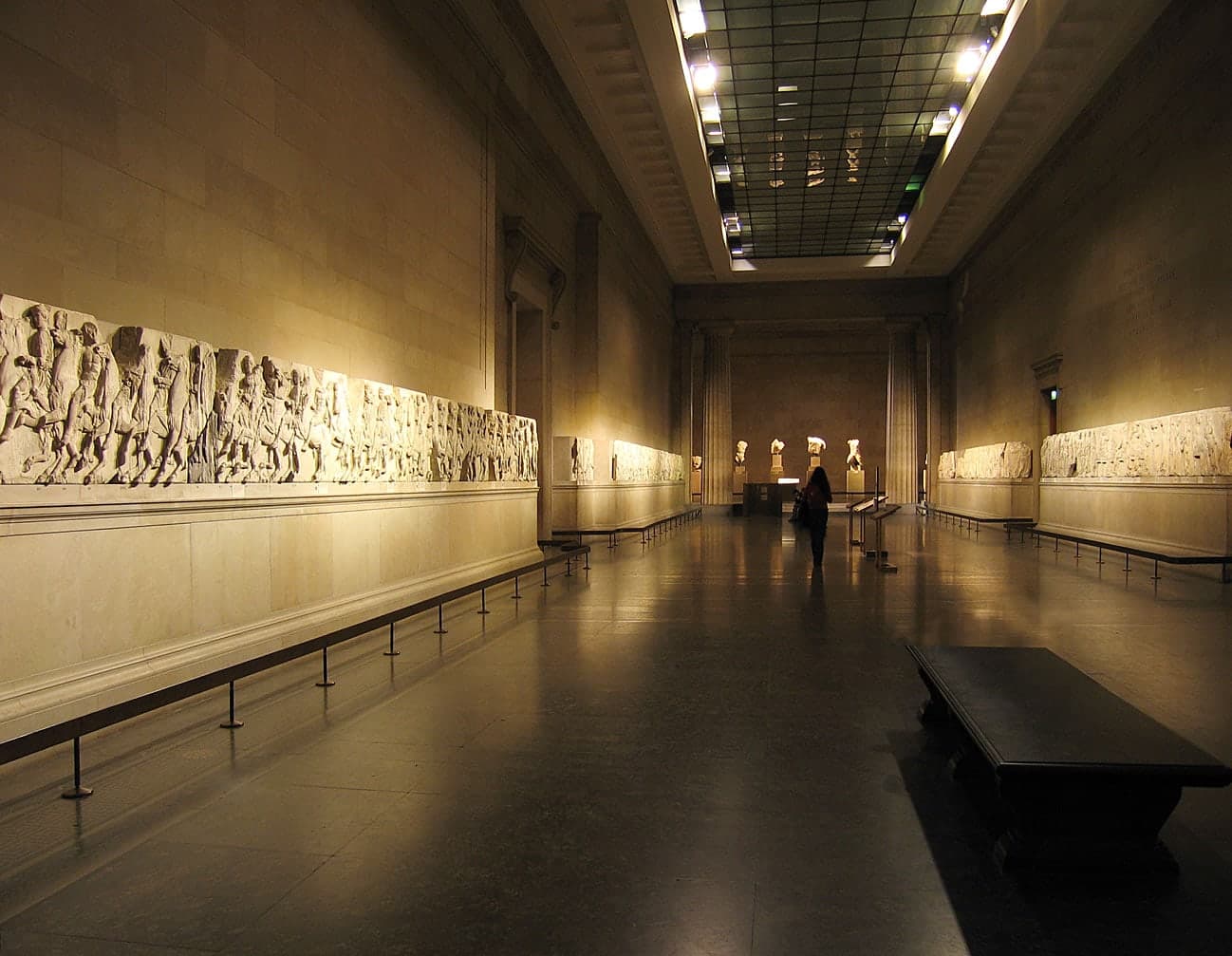
I · THE OBJECT · BRITISH MUSEUM
The Parthenon Sculptures
▶ Listen · narrated
These are the carvings that taught Europe what Greek sculpture looked like, and the objects two nations have argued over for two hundred years without resolution.
At a glance
- Date
- 440 BC
- Material
- Pentelic marble
- Creator
- Phidias
- Origin
- Parthenon and other structures, Acropolis of Athens
- Removal
- 1801–1812
Look closer
Wet drapery that maps the body beneath
The fabric on many of the figures clings as though soaked, gathering in fine folds that reveal the form underneath. This is carved stone behaving like wet linen. The technique lets the sculptor show a clothed body in motion without losing the anatomy: you can read the twist of a torso, the bend of a knee, the weight shifting from one leg to another, all through cloth that looks windblown and weightless. It is a way of having both the dignity of dress and the information of the nude.
Horses with visible effort
The horses in the frieze sections are not idealised into stillness. Their heads turn, their necks arch, veins stand out on their faces, and their mouths pull against the bit. Some rear, some toss their manes. The carving captures the specific tension of a controlled animal, not a decorative motif. Even in relief — where the stone projects only a few centimetres from the background — the musculature is distinct enough that you can see which muscles are contracting.
Figures carved for a position no viewer could occupy
These sculptures originally sat high on the Parthenon: the frieze ran along the outer wall of the inner chamber, above the columns, and the pediments crowned the triangular gables at either end. Much of the detail now visible at eye level in the museum would have been difficult or impossible to see from the ground. The backs of pediment figures are finished even though they faced the wall. Scholars debate whether this was for the gods, for completeness as a principle, or because the carving was done before installation.
The story
The Parthenon was built on the Acropolis of Athens in the fifth century BC, a temple to Athena. Phidias directed its sculptural programme. That programme included a frieze running around the inner building, metopes — rectangular panels — on the outer colonnade, and pediment sculptures filling the triangular gables at each end. The material was Pentelic marble, quarried from a mountain northeast of Athens. The carving was relief sculpture: figures and scenes cut into or projecting from the stone surface.
By the early nineteenth century, Greece was under Ottoman rule and the Parthenon had been used as a mosque, a fortress, and a gunpowder store. Venetian artillery ignited stored powder and blew out the centre of the building. When Thomas Bruce, 7th Earl of Elgin, arrived as British ambassador to Ottoman Greece, the temple was a ruin with sculpture scattered on the ground and still attached to the structure.
From 1801 to 1812, agents working for Elgin removed about half the surviving sculpture, along with pieces from other Acropolis buildings: the Erechtheion, the Temple of Athena Nike, and the Propylaia. Elgin stated that he had permission from Ottoman officials who controlled Athens at the time. The legality of that permission has been disputed. The sculptures were shipped to Britain. Elgin's intention was to establish a private museum.
In Britain, the removal provoked disagreement. Some supported the acquisition; others, including Lord Byron, likened it to vandalism or looting. A parliamentary inquiry in 1816 concluded that Elgin had acquired the marbles legally. That same year, Elgin sold the collection to the British government, and it passed into the trusteeship of the British Museum.
In 1983, the Greek government formally requested the return of the sculptures and referred the matter to UNESCO. The British government and the British Museum declined UNESCO's offer to mediate. In 2021, UNESCO called on the British government to resolve the issue at the intergovernmental level. Discussions between British and Greek officials continue.
Why it mattered then
The Parthenon sculptures were part of a building programme that reshaped the Acropolis after Athens emerged victorious from earlier conflicts. The Parthenon itself was not simply a temple but a treasury, a political symbol, and a demonstration of what Athenian wealth and ambition could produce in stone. Phidias, who oversaw the work, was already known for large-scale religious sculpture, and the Parthenon gave him a surface measured in hundreds of metres. The frieze is thought to depict a procession, though which one is debated. The metopes show mythological combat: gods against giants, Greeks against Amazons, Lapiths against centaurs. The pediments held free-standing figures illustrating the birth of Athena and her contest with Poseidon for the city. Together, the programme presented Athens as divinely favoured, martial, and cultured. The sculptures were not decoration added to a completed building; they were integral to what the Parthenon was for.
Why it matters now
The sculptures remain a reference point for the study of Classical Greek art. Their presence in the British Museum has made them accessible to a broad international audience for two centuries, and they have shaped how Greek sculpture is taught and understood outside Greece. The style of carving, particularly the treatment of drapery and anatomy, influenced European sculpture from the moment the marbles reached London. But their significance now is inseparable from the argument over where they belong. Greece has maintained that the sculptures were removed without legitimate consent, that they are of exceptional cultural importance to the Greek nation, and that their meaning is incomplete when separated from the Parthenon and the other sculptures that remain in Athens. The Acropolis Museum displays the surviving Parthenon sculptures in Greece in a gallery aligned with the temple itself, with gaps left for the pieces held elsewhere. The British Museum and the British government have argued that the sculptures were obtained legally under the law at the time, that returning them would set a precedent that could destabilise the collections of museums holding objects from many cultures, and that the British Museum offers a context in which the Parthenon sculptures can be seen alongside works from other ancient civilisations, complementing the perspective available in Athens. The argument involves law, ethics, colonialism, and what a museum is for. It has not been resolved.
The surprising detail
The sculptures were not always treated as untouchable treasures. When they arrived in London, they were stored in a temporary shed, and later in a house Elgin had bought. Early viewers could walk among them, and some of the surfaces show wear from handling. After the British Museum acquired them, casts were made and sold widely, which meant that European art schools and museums had plaster copies decades before photography was common. Those casts taught generations of artists what Greek sculpture looked like, even though they were copies of works that had themselves been removed from their original setting.
What is disputed
The legality of the removal is contested. Elgin stated that he had written permission from Ottoman officials, but the original document has not been found. What survives is an Italian translation of an Ottoman order, and scholars disagree on whether it authorised removal or only access and the taking of moulds and drawings. A British parliamentary inquiry in 1816 concluded that Elgin acted legally, but that conclusion is not accepted by Greece or by all historians.
How it got here
The sculptures were removed from the Acropolis of Athens between 1801 and 1812 by agents of Thomas Bruce, 7th Earl of Elgin, who stated he had permission from Ottoman authorities. They were sold to the British government in 1816 and transferred to the British Museum. Greece formally requested their return in 1983 and referred the matter to UNESCO. The British Museum and the British government maintain that the sculptures were legally acquired and that the museum holds them in trust for the world. Greece argues that they were removed without legitimate consent, that they are inseparable from Greek cultural heritage, and that they should be reunited with the remaining Parthenon sculptures in Athens. UNESCO has called for the dispute to be resolved at the intergovernmental level. Discussions continue, without resolution.
Remember this
Sculpture carved for a temple on the Acropolis, removed to Britain in the early nineteenth century, and claimed by Greece ever since — a dispute that has not been resolved.
Test yourself
Why does the British Museum argue that holding the Parthenon sculptures alongside objects from other cultures strengthens their meaning, while Greece argues the opposite — that separation weakens it?
The two positions rest on different ideas of what context means. The British Museum's argument is that seeing Greek sculpture near Egyptian, Assyrian, Roman, and other works lets a visitor understand Classical Greece as part of a wider ancient world, shaped by and shaping its neighbours — a comparative context. Greece's argument is that the sculptures were made for a specific building, to be seen in relation to that building and to each other, and that their meaning is tied to the place they were made for and the history of the people who made them — a context of origin and intention. Both are kinds of context. The disagreement is over which kind matters more, and who gets to decide.
Go deeper
Image: CC BY-SA 2.0. Licence: CC BY-SA 2.0. Source.