I · THE OBJECT · BRITISH MUSEUM
The Sutton Hoo Helmet
▶ Listen · narrated
It lay in the ground as a ship full of treasure for thirteen centuries, then spent another three decades in pieces before anyone saw a face in the fragments.
At a glance
- Inventory number
- 1939,1010.93
- Material
- Iron, bronze, tin, gold
- Discovery
- 1939, Sutton Hoo, Mound 1
- Culture
- Anglo-Saxon
Look closer
A face made of birds and dragons
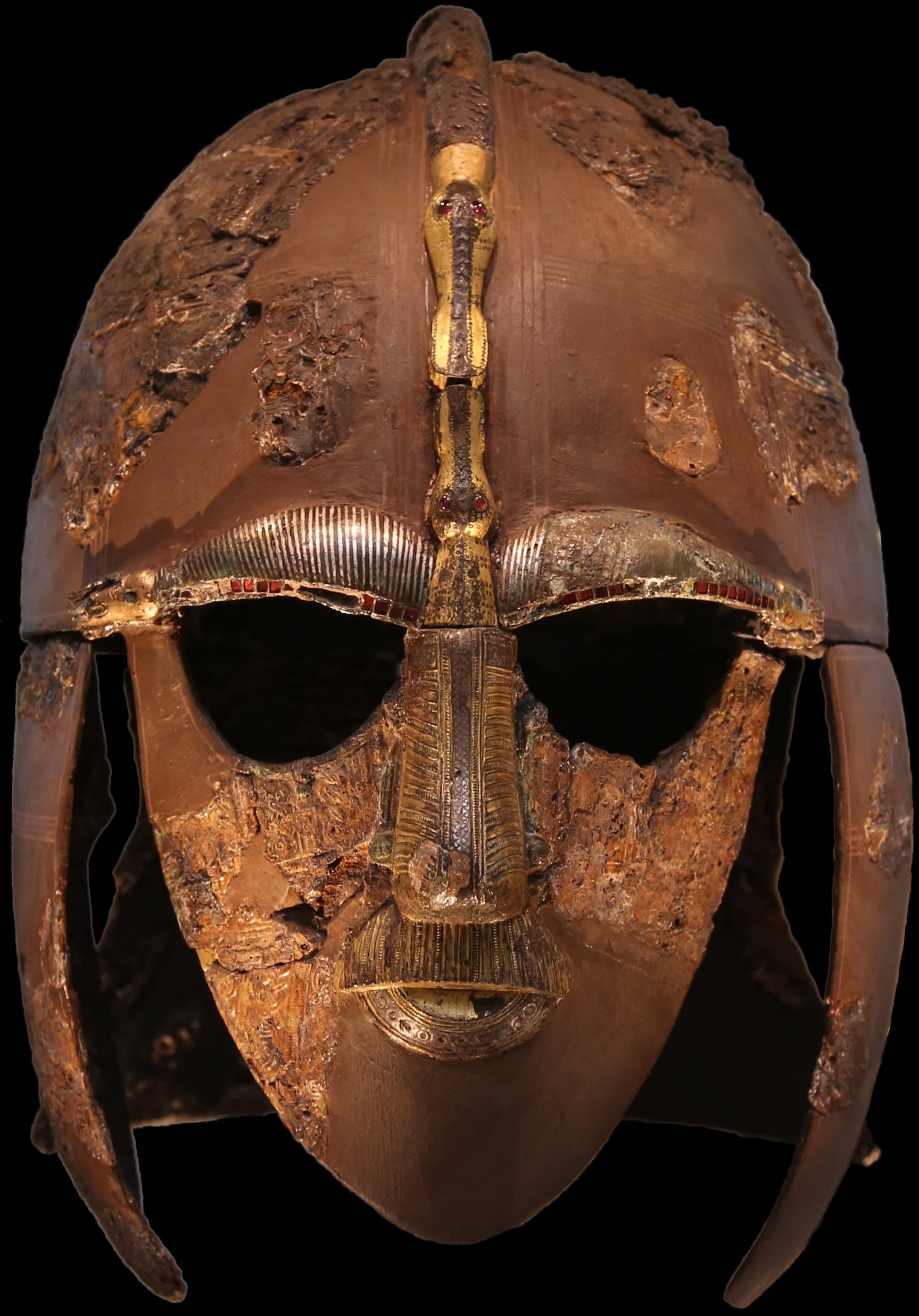
The visage is built from interlocking animal forms. The eyebrows, nose and moustache create the image of a man's face, but those same lines also form a dragon's head joined to outstretched wings. What reads as facial features from one angle becomes a soaring creature from another. The design rewards slow looking: the bronze and gold inlay work together to make the viewer see two images at once, a human face and a dragon in flight, neither fully separable from the other.
Fragments, then a helmet, then fragments again
The helmet was excavated as hundreds of rusted fragments in 1939. It was reconstructed in 1945–46, put on display, and then taken apart again. A second reconstruction followed in 1970–71, and that is the form it takes now. The gap between the two builds reflects changing ideas about how the pieces fit together — what looked correct in the 1940s did not survive closer scrutiny. The helmet you see today is an interpretation, one that may yet be revised if new evidence or methods suggest a different assembly.
Armour and ornament at once
The helmet was both a functional piece of armour and a decorative piece of metalwork. The iron provided protection; the bronze, tin and gold provided display. The elaborate decoration may have given it a secondary function akin to a crown — something worn not just in battle but in ceremony, where being seen mattered as much as being shielded. The line between the two uses is not always clear, and the object itself does not resolve the question.
The story
The helmet was found during the 1939 excavation of a ship-burial at Sutton Hoo, in Mound 1. It came out of the ground not as a helmet but as hundreds of rusted fragments, corroded almost beyond recognition. The iron had decayed, the joins had failed, and what had once been a fitted piece of armour was now a scatter of metal pieces and soil.
A reconstruction took place in 1945–46. The fragments were assembled into a helmet and put on display. But that version did not hold. By the late 1960s it was clear that the initial reconstruction had made errors — pieces had been placed incorrectly, and the overall form was wrong. The helmet was taken apart again, and a second reconstruction was carried out in 1970–71. That is the object you see now.
The visage is the most striking feature. Eyebrows, a nose and a moustache create the image of a man's face, but those same lines also form a dragon's head joined to outstretched wings. The design is deliberate: the viewer is meant to see both at once, a human face and a soaring dragon, neither fully separable from the other. The effect depends on the bronze and gold inlay, which picks out the lines and makes the dual image legible.
The helmet was both a functional piece of armour and a decorative piece of metalwork. The iron provided protection in combat; the bronze, tin and gold provided display in ceremony. The elaborate decoration may have given it a secondary function akin to a crown, something worn not just to deflect blows but to signal status and authority. Whether it saw use in battle or was made primarily for ritual is not recorded.
The ship-burial itself is thought to date to around 620–625, and the burial is widely associated with a king of East Anglia, though the identification is not certain. What is certain is that the burial was elaborate, that it included a ship, and that the helmet was among the objects placed inside. The find has been called the British Tutankhamen, and the helmet has become a symbol of the Early Middle Ages and of Anglo-Saxon England more broadly.
Why it mattered then
The helmet was made to do two things at once: protect the wearer and display their status. The iron shell would have deflected blows in combat, but the bronze, tin and gold inlay served no defensive purpose. They were there to be seen, and the elaborate decoration — the dragon-and-bird face, the intertwined animal forms — would have marked the wearer as someone of high rank, someone who could afford metalwork this intricate and materials this costly. The dual function may explain why the decoration is so elaborate. If the helmet was worn in ceremony as well as in battle, it needed to work as both armour and ornament, as both a practical object and a symbol of authority. The dragon-and-bird face would have been legible to anyone who saw it, a visual claim to power and possibly to supernatural protection. The helmet may have functioned akin to a crown, worn to signal status in contexts where a crown itself would not have been appropriate.
Why it matters now
The helmet has become a symbol of Anglo-Saxon England, and of the Early Middle Ages more broadly. It appears in textbooks, exhibitions and popular histories as the face of the period, the object that stands in for a culture that left few images of itself. Part of that symbolic weight comes from the find itself — the ship-burial at Sutton Hoo was one of the richest archaeological discoveries in Britain, and the helmet was among the most striking objects in it. But part of it also comes from the reconstruction. The helmet you see now is not the helmet as it was buried; it is an interpretation, assembled from fragments in 1970–71 after an earlier reconstruction was found to be incorrect. That interpretive work is part of what makes the object powerful: it is both an ancient artefact and a modern creation, something that has been actively remade in order to be understood. The helmet is a reminder that archaeology is not just about finding things but about deciding what they mean and how they fit together, and that those decisions can change as methods and evidence improve.
The surprising detail
The helmet and the other artefacts from the Sutton Hoo ship-burial were determined to be the property of Edith Pretty, the owner of the land on which they were found. She donated them to the British Museum. That donation was not inevitable — she could have kept them, or sold them — and the fact that the helmet is on public display now is the result of a decision she made, not a legal requirement. The excavation took place in 1939, as war began, and the timing shaped what happened next: the finds were packed away for safety during the conflict, and the reconstruction of the helmet did not take place until 1945–46, after the war ended.
How it got here
The helmet and the other artefacts from the Sutton Hoo ship-burial were determined to be the property of Edith Pretty, the owner of the land on which they were found. She donated them to the British Museum, where the helmet is now on permanent display in Room 41.
Remember this
Excavated as hundreds of fragments, reconstructed twice, and now the face of a period that left few images of itself.
Test yourself
Why does the helmet's elaborate decoration suggest it may have had a secondary function akin to a crown?
Because the bronze, tin and gold inlay served no defensive purpose — they were there to be seen, not to deflect blows. The intricate dragon-and-bird face and the costly materials would have marked the wearer as someone of high rank, someone who could afford metalwork this elaborate. If the helmet was worn in ceremony as well as in battle, the decoration would have functioned as a visual claim to authority, making it both a piece of armour and a symbol of status. The line between the two uses is not always clear, and the object itself does not resolve the question, but the level of ornament suggests it was made to impress as much as to protect.
Go deeper
Image: user:Geni, Public domain. Licence: Public domain. Source.