III · THE WORK · ART HISTORY
Van Eyck's Arnolfini Portrait
▶ Listen · narrated
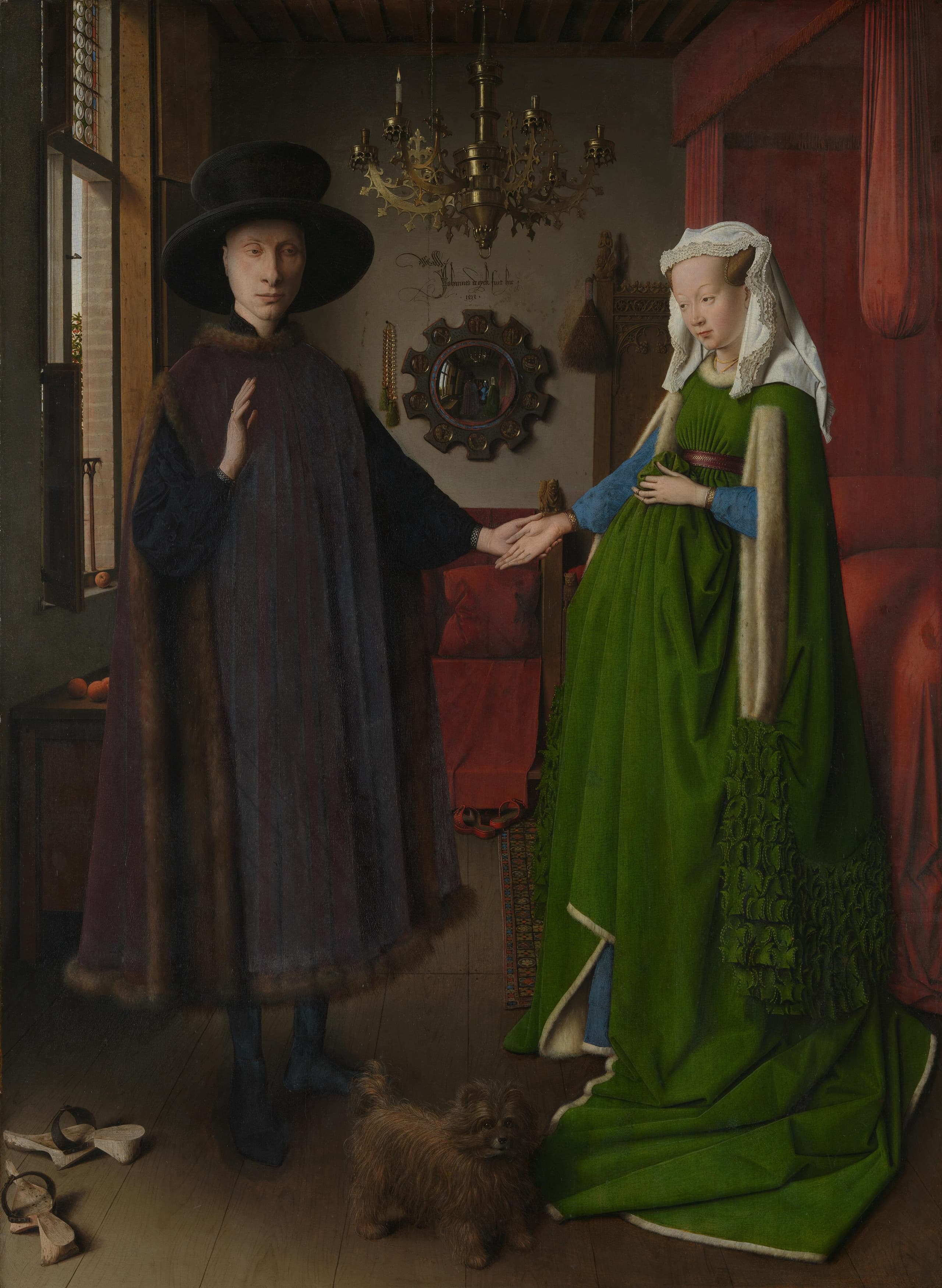
A man and woman stand in a dim interior. Behind them, a convex mirror reflects the room, two witnesses in the doorway, and a signature: Jan van Eyck was here.
At a glance
- Artist
- Jan van Eyck
- Date
- 1434
- Material
- Oil paint on oak panel
- Dimensions
- 82.2 × 60 cm
- Collection
- National Gallery, London (Room 52)
Look closer
The convex mirror
A small circular mirror hangs on the back wall, its frame decorated with tiny scenes. The convex surface reflects the entire room in miniature: the couple seen from behind, the window, the bed, and two figures standing in the doorway where the viewer stands. The mirror does what the painting cannot — it shows you the space you occupy and the people who are witnessing this scene. Van Eyck has used it to expand the picture beyond its frame, to assert that this room continues in all directions, and to place two additional figures in a composition that appears to contain only two.
The signature
Above the mirror, in careful Latin script, the wall reads 'Johannes de eyck fuit hic' — Jan van Eyck was here. The phrasing is unusual. It is not 'made this' or 'painted this', but 'was here', as though the artist is recording his physical presence in the room rather than his authorship of an image. Below the inscription is the date, 1434. The wording has been read by some scholars as the language of a legal witness, the kind of statement that accompanies a signature on a document. Whether that interpretation holds or not, the inscription makes the painting a record of an event, not merely a likeness.
The single candle
A brass chandelier hangs from the ceiling, its six branches visible. Five are empty. One holds a lit candle, burning in full daylight with the window open on the left. The flame is painted with enough precision that you can see the wick. Why light a candle when the room is already bright? The detail has been debated. Some have argued it carries symbolic weight, others that it is simply what was there. What is certain is that van Eyck chose to paint it, and to paint it with the same attention he gave to the mirror, the dog, and the folds of fabric — as though its presence mattered.
The story
The painting shows two figures standing in a domestic interior. The man, dressed in a dark robe trimmed with fur, raises his right hand. The woman, in a green gown with a long train, extends her right hand toward his left. Between them, a small dog stands on the floorboards. Behind them, a bed with red hangings occupies much of the right side of the room. A window on the left admits daylight. On the back wall, a convex mirror reflects the room and two additional figures.
The painting is dated 1434 and signed with an inscription that reads 'Johannes de eyck fuit hic' — Jan van Eyck was here. The wording is not the standard formula for an artist's signature. It has been interpreted by some scholars, including Erwin Panofsky, as the language of a witness statement, suggesting that the painting records a marriage ceremony or a marriage contract. Others have disputed this reading, noting that the details of the scene do not align neatly with documented marriage customs of the period. The identities of the figures have also been debated. The painting has traditionally been called the Arnolfini Portrait, and the man is often identified as the Italian merchant Giovanni di Nicolao Arnolfini, who lived in Bruges. The woman is presumed to be his wife. But these identifications rest on circumstantial evidence, and the painting itself offers no names.
What is not in dispute is the technique. Van Eyck painted this panel in oil, applying thin translucent layers — glazes — one over another to build up colour and tone. Oil paint dries more slowly than tempera, the medium that had been standard for panel painting. The slower drying time allowed van Eyck to blend colours while the paint was still wet, a technique known as wet-in-wet or alla prima, achieving smooth transitions between light and shadow. It also allowed him to work at a scale of detail that tempera made difficult. The beads hanging beside the mirror are painted bead by bead, each with its own highlight. The bristles of the dog's coat are distinct. The oranges on the windowsill and chest are rendered with enough texture that you can see the pores in the skin.
The painting captures not only the appearance of surfaces but the behaviour of light. The window on the left is the source of illumination, and van Eyck has traced its effect across the room: the way it glances off the brass chandelier, the way it diffuses through the red bed-hangings, the way it reflects in the mirror. Some have suggested he used a magnifying glass to paint the smallest details, though this is not documented. What is clear is that he was observing the physical world with a degree of attention that had not been recorded in painting before — or at least, no earlier painting survives that demonstrates it at this level.
The mirror is the most discussed element. It shows the couple from behind, the room in miniature, and two figures in the doorway. One wears red, the other blue. They are too small to identify, but their presence is deliberate. The mirror asserts that the space of the painting extends beyond its edges, that the room is complete, that the viewer is standing where those two figures stand. Combined with the inscription — 'Jan van Eyck was here' — the mirror has been read as evidence that the painting records an event at which the artist was present, not merely a sitting for a portrait. Whether that event was a marriage, a betrothal, or something else is not settled.
The painting was acquired by the National Gallery in London in 1842. It has remained there since, and it is now in Room 52, which is dedicated to Early Netherlandish painting from 1420 to 1480. The oak panel measures 82.2 centimetres high by 60 centimetres wide. It is, along with the Ghent Altarpiece by Jan van Eyck and his brother Hubert, among the earliest surviving panel paintings executed in oils to have achieved wide recognition.
Why it mattered then
Oil paint was not new in 1434, but its use for panel painting was not yet standard. Tempera — pigment mixed with egg yolk — had been the dominant medium for portable paintings. Oil allowed for effects that tempera made difficult: smoother transitions between light and dark, richer saturation of colour, and finer detail because the paint stayed workable longer. Van Eyck's technique of building up thin glazes, layer over layer, produced surfaces that seemed to glow from within. The painting demonstrated what the medium could do, and it did so at a moment when painters were beginning to explore it seriously. The subject of the painting — a merchant and his companion in a domestic interior — was also a choice that carried weight. This was not a religious scene, not a ruler, not an allegory. It was two people in a room, painted with the same intensity of attention that had been reserved for saints and kings. The inscription on the wall, written as though the artist were signing a legal document, suggested that the painting was not merely a likeness but a record, something that carried authority. Whether it was understood that way by its original audience is not documented, but the care with which the details were rendered — the mirror, the chandelier, the dog, the oranges — suggests that the painting was meant to be examined closely, that its precision was part of its purpose.
Why it matters now
The painting remains a test case for how much a picture can be asked to prove. Scholars have read the mirror, the candle, the dog, the joined hands, the shoes on the floor, and the oranges on the sill as evidence for specific meanings — marriage, fidelity, wealth, domesticity, sacrament. Some of these readings rest on documented symbolism from the period; others are more speculative. The painting has been described as a marriage contract, a memorial, a celebration of mercantile prosperity, and a demonstration of artistic skill. None of these interpretations has displaced the others, and the painting continues to generate arguments. What is not disputed is the level of observation. Van Eyck recorded the way light moves through a room, the way surfaces reflect and absorb it, the way textures differ — wood, fabric, metal, glass, fur, skin. The painting is a record of looking, and it asks the viewer to look with the same attention. The mirror, the inscription, and the two reflected figures make the viewer's position part of the composition. You are not outside the scene; you are standing in the doorway, and the painting knows it. That structure — the assertion that the viewer is implicated, that the space of the painting extends into the space of the viewer — has influenced how artists think about what a picture can do. The painting is studied not only for what it shows but for how it constructs the relationship between the image and the person looking at it.
The surprising detail
The painting was bought by the National Gallery in 1842, but its earlier history is not fully documented. It is not known who commissioned it, or for whom it was made. The traditional identification of the man as Giovanni di Nicolao Arnolfini rests on circumstantial evidence and has been questioned. Some scholars have argued that the woman is not Arnolfini's wife but someone else, or that the painting does not record a marriage at all. The interpretation of the mirror and the inscription as evidence of a marriage ceremony, proposed by Erwin Panofsky, has been influential but is not universally accepted. The painting has been called by several different titles over the centuries, reflecting the uncertainty about its subject. What remains is the signed date, the material facts of the panel, and the image itself — a man, a woman, a dog, a mirror, and two witnesses whose identities are not recorded.
What is disputed
The identities of the figures are not certain. The painting is traditionally called the Arnolfini Portrait, and the man is often identified as Giovanni di Nicolao Arnolfini, an Italian merchant who lived in Bruges, but this identification rests on circumstantial evidence. The interpretation of the painting as a record of a marriage ceremony or contract, proposed by Erwin Panofsky, has been influential but remains disputed. Other scholars have argued that the details do not align with documented marriage customs, or that the scene depicts something else entirely. The painting offers no names, and its earlier provenance before 1842 is not fully documented.
Remember this
Van Eyck signed this painting as though he were a witness to an event, not merely the maker of an image — and left a mirror to prove he was there.
Test yourself
The convex mirror shows two figures in the doorway. Why does their presence change the way the painting works, even if we do not know who they are?
Because the mirror asserts that the space in front of the painting is not neutral viewing space but part of the scene itself. Without the mirror, we would be outside observers of a room. With it, the painting claims that where we stand — the doorway — is occupied, that the room continues in our direction, and that the event being depicted has witnesses. The two figures are too small to identify, but their presence converts the viewer from a spectator into someone standing in a specific location within the fiction of the painting. That structure — the extension of the pictorial space into the viewer's space — is what makes the painting more than a double portrait. It becomes a record of an event that includes the act of witnessing, and it places the viewer in the position of a witness, whether or not we know what we are witnessing.
Go deeper
Image: Jan van Eyck, Public domain. Licence: Public domain. Source.