III · THE WORK · ART HISTORY
Amor Vincit Omnia
▶ Listen · narrated
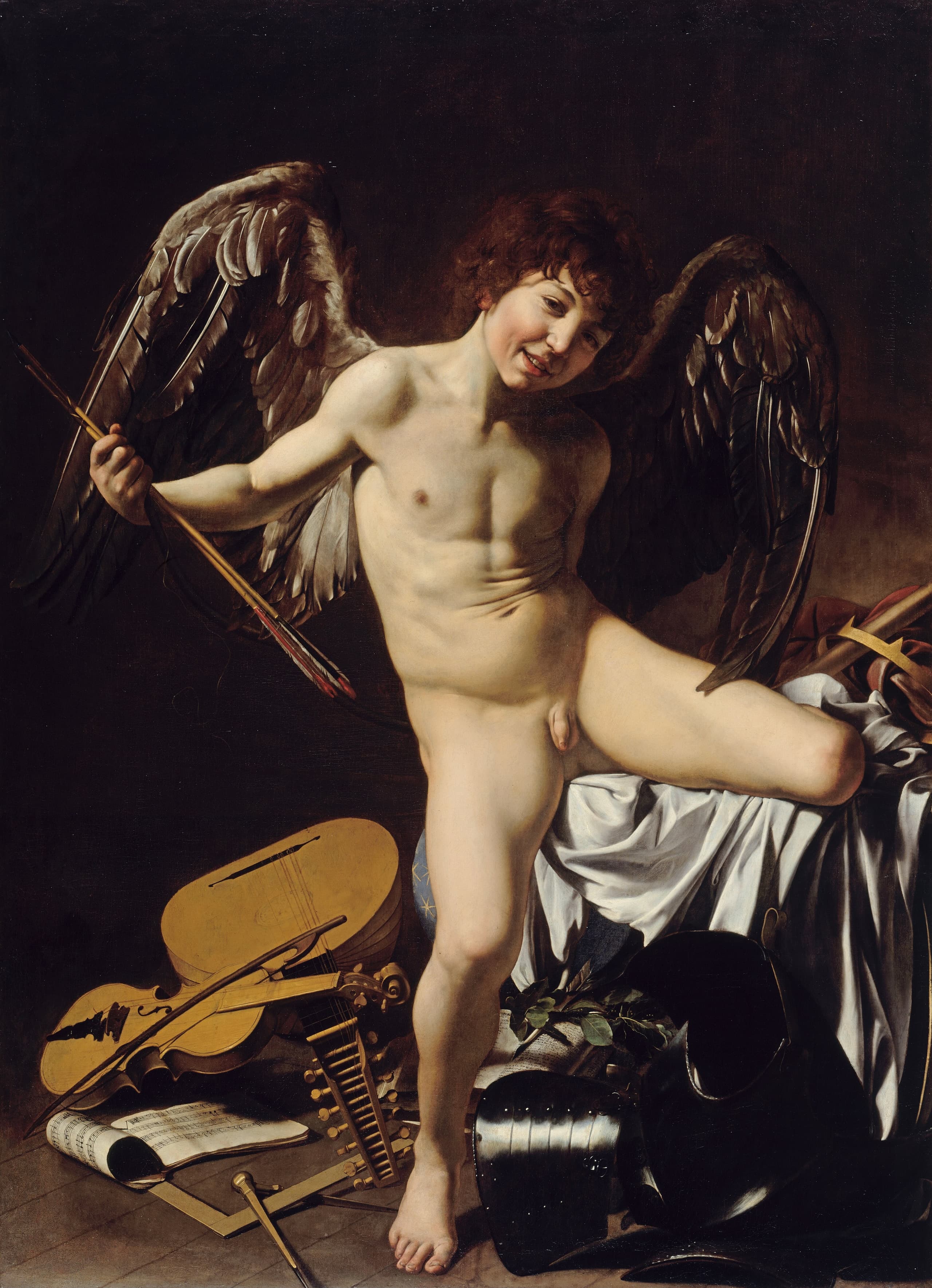
A nearly life-size boy with dark wings stands on a sheet of music, surrounded by the scattered props of adult ambition. The painting gives you the objects but not the key.
At a glance
- Artist
- Caravaggio
- Date
- 1601
- Medium
- Oil on canvas
- Dimensions
- 156.5 × 113.3 cm
- Collection
- Gemäldegalerie Berlin
Look closer
The figure's pose
The boy is painted at nearly life scale, his body twisted so that his weight rests on his left leg while his right crosses over it. His left arm is raised, his right lowered, and the diagonal they make runs counter to the diagonal of his legs. The pose is uncomfortable if you try to hold it — a demonstration of physical control rather than rest. His wings are dark, closer to the wings of a bird than the white feathered conventions often given to Cupid. The light comes from the upper left, carving the musculature in sharp contrast.
The objects beneath him
The floor is covered with things: a lute, a violin and bow, a square and compass, a manuscript with musical notation, pieces of armour including a breastplate, a crown, a laurel branch. They are piled and overlapping, as though swept into a heap. The boy's right foot rests on the sheet music. The objects are rendered with the same attention to surface and texture as the figure — the wood grain of the lute, the sheen on the metal, the crumpled paper — but they are subordinate in the composition, literally beneath him.
The expression
The boy is smiling. It is not the distant smile of an idealised god but a specific expression, caught as though mid-laugh. His mouth is open slightly, his eyes engaged with something outside the frame. The face is painted from a live model, and it reads as a portrait of a particular person rather than a type. That specificity — a real boy's face on a mythological body — is part of what made the painting contentious.
The story
The painting is called Amor Vincit Omnia, Latin for love conquers all. The phrase comes from a line in Virgil, and by the time Caravaggio painted this it was already a well-worn motto, the kind of thing that appeared on marriage chests and commemorative medals. What Caravaggio did with it was take the sentiment literally and make it physical.
The boy is Cupid, the Roman god of desire, but he is not the chubby infant of Valentine cards. He is an adolescent, painted from life, with anatomical precision and nothing idealised about him. His body is lit in chiaroscuro — the technique of building form through strong contrasts of light and shadow — so that he emerges from a dark ground as a sculptural presence. The wings are dark and realistic, the kind a bird might have. He is grinning, and the grin is not decorative. It is the expression of someone who has won.
What he has won over is represented by the objects scattered beneath his feet. They include instruments of music, tools of geometry and astronomy, symbols of military power and civic authority, and a laurel branch, the ancient emblem of poetic achievement. Scholars have read the pile as a catalogue of human endeavour: the arts, the sciences, war, governance, glory. The manuscript is musical notation, readable as a specific piece. The armour is a breastplate and other fragments. The lute and violin are painted with enough detail that you can see the grain of the wood and the tension in the strings.
The painting was made in 1601 and entered the Giustiniani Collection, where it remained before eventually moving to the Gemäldegalerie Berlin. Records suggest it was kept behind a curtain, revealed only to select viewers. Whether that was because of its subject matter or simply to protect the surface is not certain, but the curtain became part of the painting's reputation.
The composition is unusual in that it gives almost equal weight to the figure and the still life. The objects are not background or attribute; they are co-subjects, painted with the same intensity as the body. That doubling of attention — the god and the things he conquers treated as equally real — is part of what makes the picture work as an argument rather than just an image.
What the argument is, exactly, has been interpreted in different ways. The most straightforward reading is that love — meaning erotic desire — defeats all other human pursuits. A more specific reading is that it was a statement of priorities within a collection that also contained works celebrating those other pursuits. Some have read it as a critique, a suggestion that desire makes fools of the learned and the powerful. Others have read it as a celebration, a claim that love is the most vital force. The painting does not resolve the question. It shows you the victor and the defeated, and leaves the moral judgment to you.
Why it mattered then
Caravaggio painted this during the period when he was working for a small group of Roman patrons who collected his work and, to some extent, protected him. The painting entered the Giustiniani Collection, held by a family with enough wealth and standing to commission what they wanted and enough sophistication to want something that was not conventional. The painting was made at a moment when the genre of mythological painting was well established, but Caravaggio's approach to it was not. The tradition was to idealise, to elevate the subject into a realm of perfection that was visibly not the everyday world. Caravaggio did the opposite. He painted Cupid as a real boy, lit as though he were standing in a specific room with a specific window. That choice was deliberate, and it was noticed. The painting was recognised as technically accomplished and also as provocative, both in its realism and in the fact that the model was painted nude, without the mediating distance of idealisation. The decision to keep it behind a curtain may have been a way of managing that provocation, treating it as a work to be encountered deliberately rather than casually. It also made the painting an event, something revealed rather than simply seen, which would have heightened its impact.
Why it matters now
The painting remains compelling because it takes a familiar idea — love conquers all — and makes it strange by rendering it as a physical fact. The boy is not a symbol hovering in an abstract space; he is a body, standing on things, grinning at you. That specificity, the refusal to let the allegory stay allegorical, is what makes the picture uncomfortable and memorable. It also matters as an example of how chiaroscuro can be used not just to create drama but to make an argument. The light does not fall evenly; it picks out the boy and leaves the objects in relative shadow, which tells you where the power is. The composition is a hierarchy made visible. And it remains a test case for how we look at paintings that use real bodies to represent ideas. The model was a person, painted with attention to individual detail, but the painting is not a portrait of that person. It is a use of that person's body to say something else. That doubling — the real and the symbolic occupying the same surface — is part of what the painting is about, and it has not stopped being a live question.
The surprising detail
The painting was part of the Giustiniani Collection, and records indicate it was displayed behind a curtain. Whether this was to protect the painting, to control who saw it, or to heighten the drama of viewing it is not documented with certainty, but the curtain became part of the work's reputation and the way it was talked about.
Remember this
Caravaggio painted love as a real boy standing on the symbols of everything else, and left the moral of the pile for the viewer to decide.
Test yourself
The objects under Cupid's feet are often described as symbols of human achievement, but the painting does not label them or arrange them in any obvious hierarchy. Why does that lack of order matter to what the painting might mean?
Because a neat arrangement would suggest a clear ranking of what love defeats, turning the painting into a diagram with a single reading. The pile, by contrast, is ambiguous. It could be the aftermath of a victory, the spoils swept aside. It could be a collection of things love makes irrelevant, or things love interrupts, or things love co-exists with but dominates. The disorder leaves room for the viewer to decide whether this is triumph, critique, or something more complicated. It also makes the picture less didactic and more like an image of a real moment — a boy standing in a room where things have been scattered — which is consistent with Caravaggio's method of painting mythological subjects as though they were happening in front of him.
Go deeper
Image: Caravaggio, Public domain. Licence: Public domain. Source.