III · THE WORK · ART HISTORY
The Abbey in the Oakwood
▶ Listen · narrated
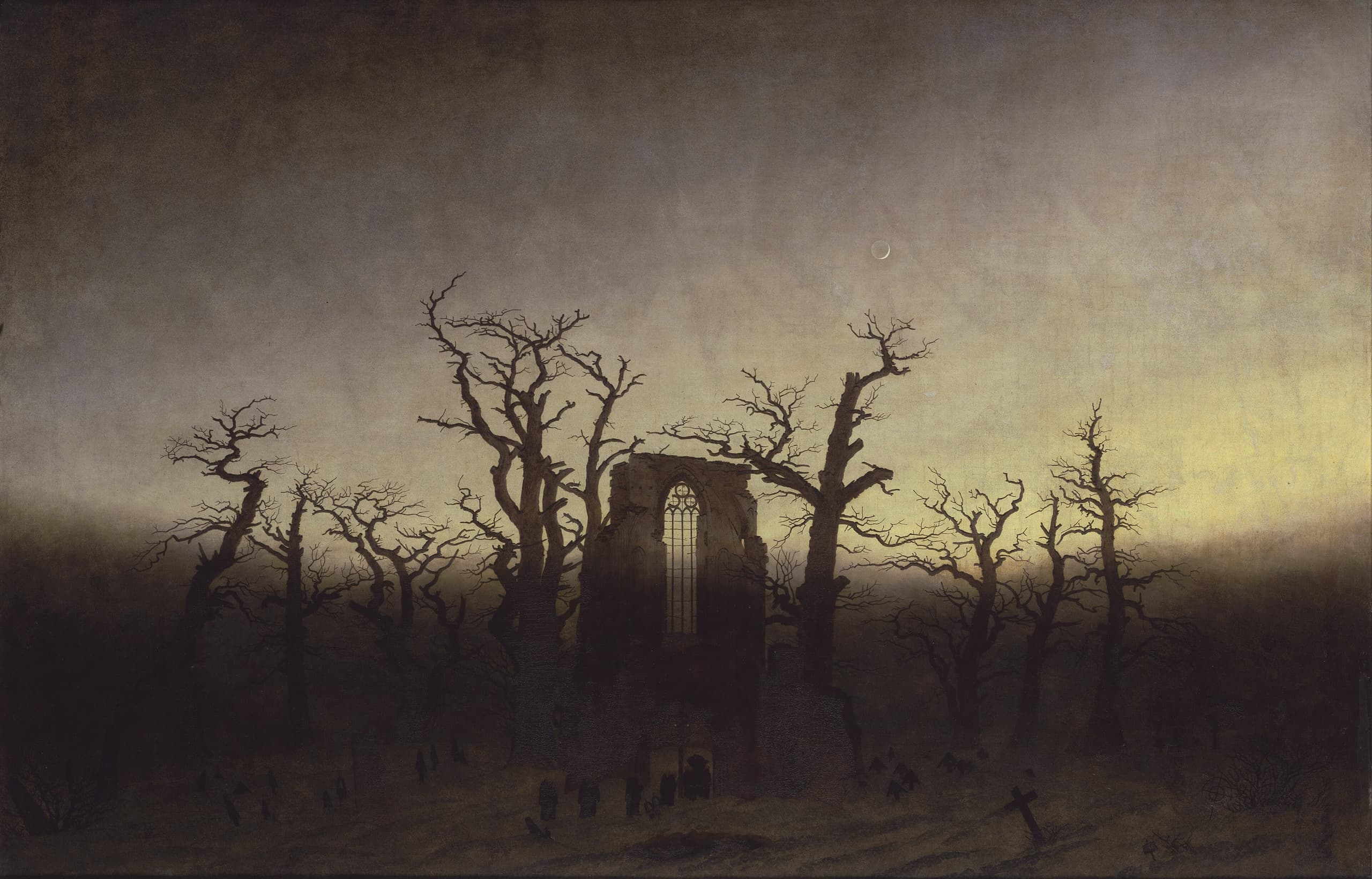
A line of monks carries a coffin through snow toward a ruin that no longer has a roof. Friedrich made the trees as deliberate as architecture, and just as still.
At a glance
- Artist
- Caspar David Friedrich
- Date
- 1809
- Medium
- Oil paint on canvas
- Dimensions
- 110.4 × 171 cm
- Collection
- Alte Nationalgalerie, Berlin
Look closer
The procession you almost miss
A line of monks in dark robes moves through the snow from the left edge toward the abbey ruin. They are carrying a coffin, and a cross leads them. The figures are painted small and dark against the white ground, deliberately scaled so that the landscape dwarfs them. If you look at the painting from across a room, the procession can disappear entirely into the composition — the trees and the ruin read first, and the human event they frame reads second, if at all.
The trees as a structure
The oak trees are leafless, their branches spreading in silhouette against a pale sky. Friedrich has arranged them with the kind of symmetry you would expect from columns in a nave, not from a natural forest. They flank the central ruin and the path the monks are walking, and their trunks and limbs are painted with enough detail that you can see which branches are dead wood and which are merely bare. The trees are not background: they are built into the composition as deliberately as the Gothic arch.
The ruin that frames the sky
The remains of the abbey stand at the centre of the painting. The Gothic window is intact enough that its tracery is legible, but the walls around it are broken and the roof is gone. Through the window you see the same pale sky that appears above the trees, so the ruin works as a frame within the frame. What is left of the building is just enough to read as a church, and just broken enough that it no longer shelters anything.
The story
Friedrich painted The Abbey in the Oakwood in 1809, working in oil on canvas. The painting shows a winter scene: a graveyard, a line of bare oak trees, and the ruins of a Gothic monastery. A procession of monks in dark robes is carrying a coffin through the snow toward the broken arch of the abbey. A cross leads them. The figures are small, and the landscape is large.
The composition is organised around symmetry. The abbey ruin stands at the centre, its window a vertical accent in the middle of the canvas. The oak trees are arranged to either side, their branches spreading outward and upward in a way that echoes the shape of a vaulted ceiling. The procession moves along a path that leads the eye from the left edge toward the ruin. Everything is aligned: the trees, the path, the window, the movement of the figures.
The painting was shown in 1810 at the Prussian Academy of Arts exhibition in Berlin, hung together with another Friedrich painting called The Monk by the Sea. Friedrich asked that The Abbey in the Oakwood be placed beneath The Monk by the Sea, so the two pictures would be seen as a pair. After the exhibition, both paintings were bought by Frederick Wilhelm III for his collection. They are now in the Alte Nationalgalerie in Berlin, where they hang side by side.
The palette is restricted. The sky is a pale greyish tone, the snow is white, and the trees and figures are dark — browns and blacks. The light is even and cold, the kind of light that comes on an overcast winter afternoon when the sun is low and there are no shadows. The mood the painting creates is one of stillness and waiting, as though the scene is suspended between the end of the day and the arrival of night.
This painting is one of more than two dozen works by Friedrich that include cemeteries or graves. The subject — a burial, a ruin, the end of the day, the dead season — is consistent with a broader interest in mortality and the passage of time that appears throughout his work. The Gothic ruin, the procession, and the graveyard are all conventional symbols of death in European painting, but Friedrich has arranged them in a composition that is less about narrative and more about structure. The painting does not tell a story so much as it presents a space where a story has already finished.
Why it mattered then
The painting was made in 1809, during a period when Friedrich was working in Dresden and beginning to establish a reputation for landscape painting that used natural forms — trees, rocks, fog, ruins — to carry emotional and symbolic weight. The Gothic ruin in The Abbey in the Oakwood would have been read by Friedrich's contemporaries as a reference to a medieval Christian past, and the procession as a ritual of death and continuity. The combination of a Christian subject with a landscape that feels vast and indifferent was not a common one in German painting at the time, and the reception of the work was mixed. Some viewers found the painting moving; others found it unsettling or too stark. The decision by Frederick Wilhelm III to buy both The Abbey in the Oakwood and The Monk by the Sea after the 1810 exhibition was significant. It brought Friedrich's work into the Prussian royal collection and gave him a measure of official recognition. The pairing of the two paintings — one showing a monk alone on a beach, the other showing a procession toward a ruin — suggests that they were understood as meditations on solitude, mortality, and the relationship between the human figure and the natural world. That reading was available in 1810, and it has remained available since.
Why it matters now
The Abbey in the Oakwood is now studied as an example of how Friedrich used landscape to construct meaning rather than simply to record a place. The painting does not depict a specific monastery or a specific forest; it assembles elements — the ruin, the trees, the procession — into a composition that is as much architecture as it is observation. The symmetry, the restricted palette, and the deliberate scaling of the human figures against the landscape are all choices that shape how the painting is read, and they are choices that can be examined and taught. The painting also remains visually striking. The bare trees, the broken arch, and the small dark figures moving through snow create an image that is both clear and strange. It is a winter scene, but it does not feel like a record of winter weather. It feels like a constructed space, a stage set for an event that is both specific — a burial — and general — an image of ending. That doubling, between the particular and the symbolic, is what keeps the painting in use as a teaching object and as a reference point for later artists working with landscape and mood.
The surprising detail
Friedrich asked that The Abbey in the Oakwood be hung beneath The Monk by the Sea when the two paintings were shown together in 1810. That request suggests he thought of them as a pair, with a vertical relationship rather than a side-by-side one. Today the paintings hang next to each other in the Alte Nationalgalerie, not one above the other. The original arrangement is recorded, but it is not the one visitors see now. Whether the change matters — whether the paintings read differently when they are horizontal rather than vertical — is a question the museum has not publicly answered, but the fact that Friedrich specified the arrangement means he thought it did.
Remember this
Friedrich built the composition like a stage set: the trees frame the ruin, the ruin frames the sky, and the procession moves through the centre, small enough to almost disappear.
Test yourself
The painting includes more than two dozen trees, a ruin, and a procession, but Friedrich has organised them with strong symmetry. Why might a painter choose symmetry for a scene that is meant to evoke a natural landscape and a solemn ritual, rather than using a more irregular or naturalistic arrangement?
Symmetry imposes order on the scene, and that order changes how the subject is read. A symmetrical composition feels deliberate, even ceremonial, which reinforces the mood of ritual and solemnity that the procession already carries. It also makes the landscape feel less like a record of a particular place and more like a constructed space — a setting that has been arranged for symbolic effect rather than observed from nature. The trees, when they are spaced and balanced like columns, stop behaving like trees in a forest and start behaving like architecture, which ties them visually to the Gothic ruin at the centre. The effect is that the natural and the built elements of the painting work together as a single structure, and the viewer reads the scene as a composed image rather than as a glimpse of a real event. That makes the painting feel more like an idea about death and time than like a depiction of a specific burial.
Go deeper
Image: Caspar David Friedrich, Public domain. Licence: Public domain. Source.