I · THE OBJECT · BRITISH MUSEUM
Lion of Knidos
▶ Listen · narrated
This lion sat near a port in south-west Asia Minor for two thousand years. Then it was moved halfway across a continent and became one face of a museum.
At a glance
- Date
- 200 BC (scholarly consensus; some debate)
- Material
- Marble
- Discovery
- Found at Knidos, 1858
- Current location
- British Museum, Queen Elizabeth II Great Court
Look closer
Scale and posture
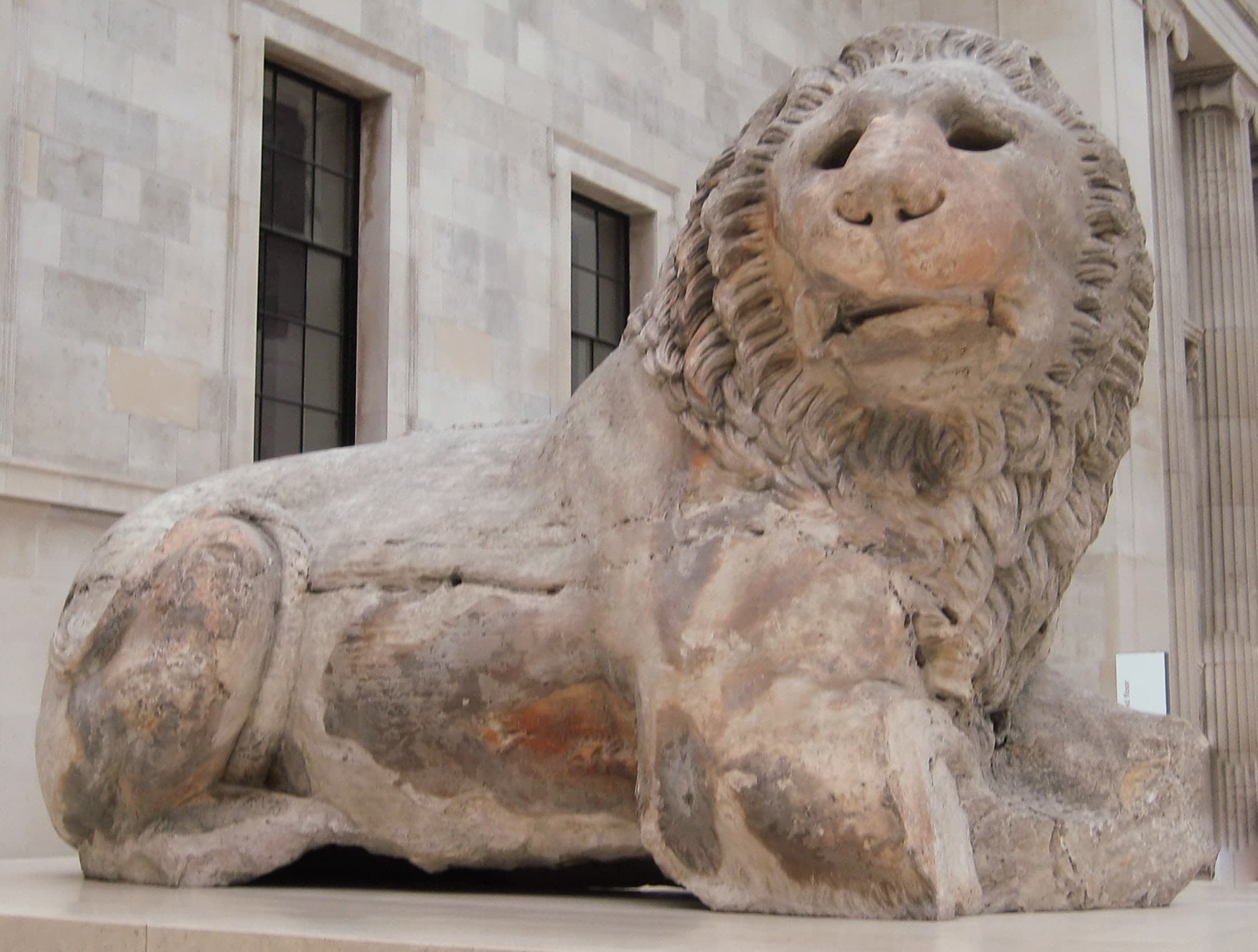
The lion is carved larger than life, seated on its haunches with front legs extended. The musculature is defined but not exaggerated — the sculptor worked within the conventions of Hellenistic animal sculpture, where anatomical accuracy mattered but monumentality mattered more. The pose is alert rather than aggressive: the head is raised, the mouth closed.
Surface and weathering
The marble surface shows the effects of long exposure. Details that would have been crisp when carved — the definition around the eyes, the texture of the mane — have softened. This is consistent with a sculpture that stood outdoors near a harbour for centuries. The weathering is not uniform, suggesting the statue may have been repositioned or partially sheltered at some point in its history.
No surviving inscription
Many monumental sculptures from Knidos carried dedicatory inscriptions, either on the base or the body of the work. This lion has none that survives. Whether it never had one, or whether an inscribed base was separated from the sculpture before or during its discovery, is not recorded. That absence means the specific purpose of the monument — whether funerary, commemorative, or protective — remains uncertain.
The story
The lion was found at Knidos in 1858. Knidos was a Greek city on a peninsula in what is now south-west Turkey, a port that controlled trade routes between the Aegean and the eastern Mediterranean. The city was rebuilt on a new site in the mid-fourth century BC and flourished under Hellenistic rule — the period after the conquests of Alexander, when Greek culture and political structures spread across a geography far wider than Greece itself.
Hellenistic cities built in marble. They marked their harbours, their sanctuaries, their public squares with sculpture that announced wealth and cultural ambition. Lions were a common form: they guarded tombs, flanked temple steps, stood at harbour entrances. The symbolism was flexible — lions could signify courage, protection, or simply the presence of power. A city like Knidos, which minted coins and traded across the Mediterranean, used monumental sculpture as both decoration and declaration.
The date assigned to this lion is 200 BC, though scholarly opinion on Hellenistic sculpture is often hedged because the style conventions of the period were long-lived and widely copied. A lion carved in 200 BC and one carved fifty years later might look nearly identical. What is generally agreed is that the sculpture belongs to the second century BC, a period when Knidos was prosperous and still building.
When British archaeologists saw the lion in 1858, it was taken to London. By 1859 it had been accessioned into the British Museum's collection, where it has remained. Since 2000, it has been displayed on a plinth in the Queen Elizabeth II Great Court, the museum's covered central courtyard. The sculpture is now one of the most visible objects in the building — encountered by visitors before they reach the galleries, positioned under a glass roof that admits natural light.
The circumstances of the find are not detailed in the surviving record. The discovery location is given as Knidos, but whether the lion was found in situ, reused in later construction, or already displaced when the archaeologists arrived is not specified. Many ancient sculptures were moved, buried, broken up for building material, or repositioned long before modern archaeology arrived. What is known is that the lion left Knidos in the mid-nineteenth century and has not returned.
Why it mattered then
A marble lion erected near a harbour in the second century BC was a statement about the city that paid for it. Knidos was a trading port, and trade required infrastructure — not just docks and warehouses, but the symbolic architecture that signalled stability and civic pride. Monumental sculpture was part of that infrastructure. It told arriving merchants and visiting diplomats that this was a city with resources, a city that could afford to quarry marble, hire sculptors, and erect permanent monuments in public space. Lions specifically carried associations that a Hellenistic audience would have recognised. They appeared in myth, in royal iconography, in the sculpture of sanctuaries and tombs. A lion at a harbour entrance or near a public building was a familiar sight, and familiarity was part of the point. Hellenistic cities competed with one another, but they also imitated one another. A city that built like other prosperous cities was a city that belonged to a network of prosperous cities. The lion at Knidos was part of that visual language — a signal that this port operated within the conventions of the Greek-speaking Mediterranean world.
Why it matters now
The lion matters now partly because of where it is. It sits in the central court of a museum in London, far from the harbour it was carved for. That displacement is not incidental to its current meaning. The sculpture is part of a collection formed during a period when European institutions acquired ancient objects on a scale that emptied sites and filled storerooms. The British Museum's holdings from the Greek world are among the most contested objects in any public collection. The question of where ancient sculptures belong is not settled. Some argue that objects removed in the nineteenth century should remain in the institutions that have cared for them and made them accessible to a global audience. Others argue that removal was itself an act of dispossession, and that return is both a legal and an ethical obligation. The lion is part of that argument, though it has not been the focus of repatriation campaigns in the way some other sculptures from Greek sites have. What the lion also does, in its current setting, is mark a shift in how museums present their collections. For much of the twentieth century, ancient sculpture was displayed in galleries organised by culture and period. The lion's placement in the Great Court since 2000 — visible, central, encountered before the visitor has chosen a route — reflects a different curatorial logic. It is there to be seen by everyone, whether or not they intend to visit the Greek and Roman galleries. That visibility is deliberate. It makes the sculpture a landmark within the building, and it makes the question of its presence in London harder to ignore.
The surprising detail
The lion now stands on a plinth in a covered courtyard under a glass roof, but for much of its time in the British Museum it would have been displayed differently. Museum practice in the nineteenth and early twentieth centuries did not isolate objects behind barriers the way contemporary galleries do. Sculptures were often placed on the floor or on low plinths, within reach. Photographs from the period show visitors standing close to ancient statuary, and there are accounts of objects being touched, leaned on, even climbed. The lion would have been accessible in a way that is difficult to imagine now, when almost every object in a major museum is behind glass, rope, or a sightline enforced by gallery attendants.
What is disputed
The date of 200 BC represents a scholarly consensus, but there is debate. Hellenistic sculptural styles were long-lived and widely imitated, and lions in particular followed conventions that changed slowly. Some scholars place the sculpture earlier or later within the second century BC. The original setting is also unknown: the lion was found at Knidos, but whether it stood at the harbour, near a sanctuary, or in a funerary context is not recorded.
How it got here
The lion was taken from Knidos by British archaeologists in 1858 and accessioned into the British Museum's collection in 1859. It has remained in London since. The removal occurred during a period when European institutions acquired ancient objects from sites across the Mediterranean, often with the permission of local or colonial authorities but without the consent frameworks that govern archaeological work today. The British Museum's position is that objects in its collection are held in trust for a global public and that their presence in London makes them accessible to an international audience. Critics of that position argue that the sculpture belongs in Turkey, where Knidos is located, and that its removal was an act of colonial appropriation. The lion has not been the focus of formal repatriation requests in the way some other objects in the collection have, but it is part of the broader debate over the provenance and ownership of ancient sculpture in European museums.
Remember this
A monumental lion carved for a Hellenistic port, taken to London in the nineteenth century, and now displayed in a way that makes its displacement visible.
Test yourself
Why does the absence of an inscription make it harder to interpret the lion's original function?
Because Hellenistic monumental sculpture often carried dedicatory inscriptions that named the patron, the occasion, or the deity being honoured. Without an inscription, the lion could be funerary, commemorative, protective, or simply decorative — all were common uses for monumental lions in Hellenistic cities, and the forms were similar. The pose and style do not resolve the ambiguity. An inscribed base, if one existed and was separated from the sculpture, would have answered the question. Its absence leaves the specific purpose uncertain, even though the general type — a marble lion in a prosperous port city — is well understood.