III · THE WORK · ART HISTORY
Madonna of the Goldfinch
▶ Listen · narrated
Raphael arranged three figures into a pyramid so stable that when the panel shattered centuries later, restorers could put it back together.
At a glance
- Artist
- Raphael
- Date
- 1505
- Medium
- Oil paint on panel
- Dimensions
- 107 × 77 centimetres
- Collection
- Uffizi Gallery
Look closer
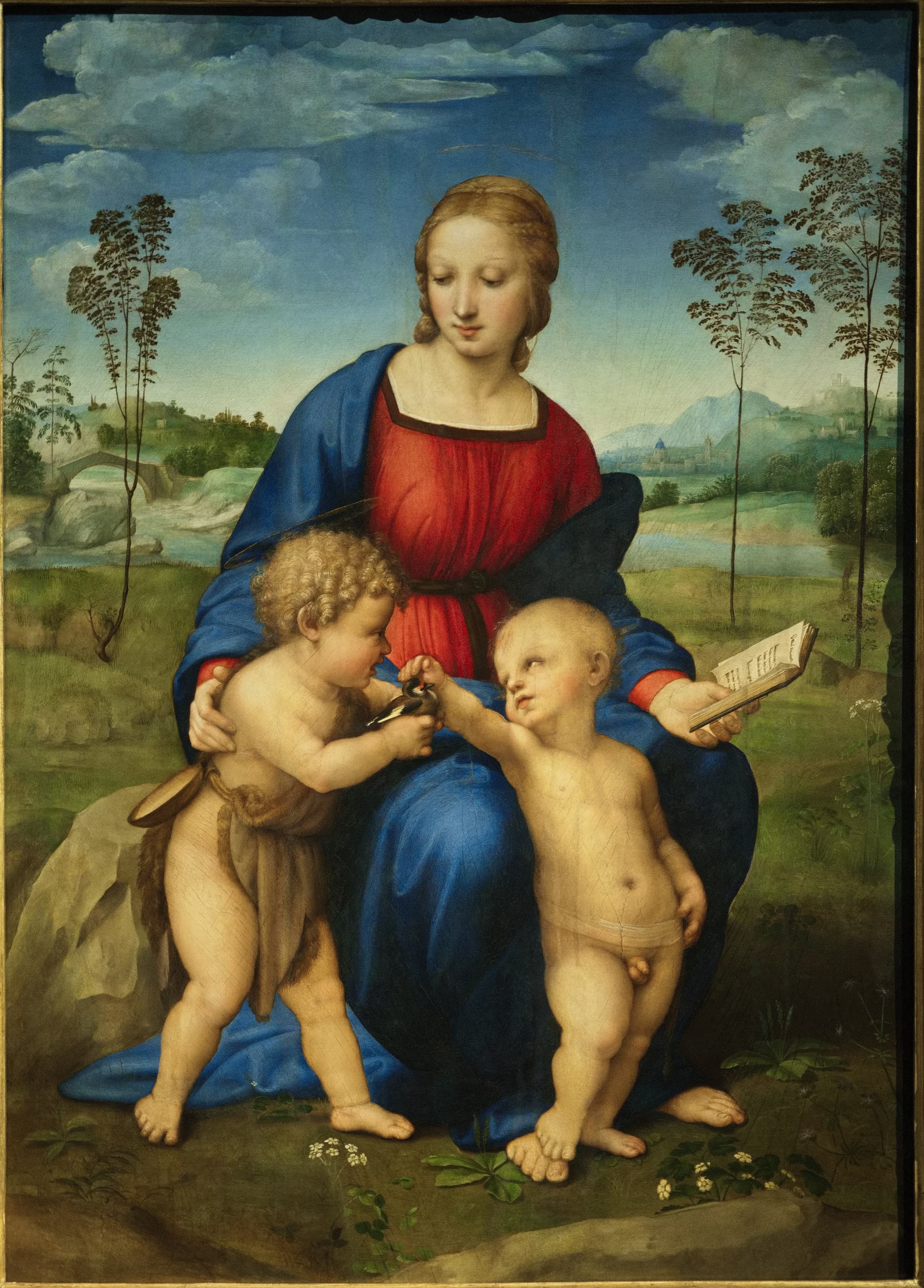
The pyramidal composition
The three figures form a triangle. The woman's head is the apex; the two children, seated on the ground, anchor the base. This geometric arrangement was a deliberate choice. It creates visual stability — your eye moves in a loop from face to face without leaving the group — and it gives equal weight to both children despite their different roles. The shape also echoes compositions Raphael would have seen in Florence, where he was working when he painted this panel.
The goldfinch itself
The bird is a European goldfinch, identifiable by the red face and yellow wing bars. One child holds it gently while the other reaches to touch it. In religious painting of this period, the goldfinch carried specific meaning: it was said to eat thistles and thorns, and so became associated with Christ's Passion — the suffering that would come. The bird is small, painted with attention to its markings, and it is the only object the children are handling. It is what the painting is named for.
The landscape behind
The background is not a flat gold ground but an open landscape: low hills, a winding path, trees, a pale sky. This locates the holy figures in a version of the natural world rather than in a symbolic space. The light is even and clear. The landscape recedes in layers, each paler than the one before it, a technique called atmospheric perspective — the air itself dims distant things. It is not a specific place, but it is a carefully constructed one.
The story
Raphael painted the Madonna of the Goldfinch in 1505, in oil on a wooden panel. The painting shows a woman seated outdoors, with the infant Christ and his young cousin. One child holds a small goldfinch; the other reaches toward it. The woman rests one hand on a book in her lap and steadies Christ with the other. All three figures are connected by touch or gaze.
The composition is built on a triangle. The woman's face is at the apex; the two children, seated on the ground, form the base. This geometric arrangement was not unique to Raphael — it appears in other paintings made in Florence in the same years — but he used it with particular clarity here. The shape holds the group together visually and gives the picture a sense of calm and balance.
The goldfinch is the painting's central object. In the religious imagery of the period, the bird was associated with Christ's future suffering, because it was believed to feed on thorns. The inclusion of the bird turns what might be a simple group portrait into a meditation on what is to come. One child, who would later recognise Christ and announce his ministry, holds the bird; Christ reaches for it. The woman watches. The moment is quiet, but it is not without meaning.
The painting was made on a wooden panel, 107 centimetres high and 77 wide. The surface is oil paint, which allowed Raphael to build up layers of colour and to blend tones smoothly. The faces are soft-edged; the fabrics have weight and fall. Behind the figures is a landscape: hills, trees, a path, a sky. It is not a specific place, but it is rendered with attention to how distance works — the farthest hills are palest, the air itself dimming them.
Centuries after it was painted, the panel was damaged. It broke into seventeen pieces. A ten-year restoration process, completed in 2008, reassembled it. During that decade, a copy stood in its place at the Uffizi. The painting is now back in the gallery, and the breaks are visible if you look closely, fine lines running through the surface. The structure Raphael built — the pyramid, the linked figures, the bird at the centre — survived the shattering.
Why it mattered then
In 1505, Raphael was working in Florence, where he would have seen recent paintings that used similar compositions — figures arranged in stable geometric groups, set against landscapes. The pyramidal structure was part of a broader shift in how religious subjects were painted: less hieratic, more naturalistic, with holy figures placed in settings that resembled the visible world. The painting was made for a private patron. It was not an altarpiece for public worship but a devotional image for a household. The size — just over a metre tall — and the intimacy of the scene suggest it was meant to be seen up close, in a domestic space. The subject, a woman and child with the infant cousin, was a common one, but the way Raphael handled it — the softness of the faces, the attention to the children's gestures, the legible symbolism of the bird — made it accessible without being simple.
Why it matters now
The Madonna of the Goldfinch is now at the Uffizi Gallery, where it has been for centuries, though it has also been housed at other locations including Palazzo Nasi, Villa Medicea of Poggio a Caiano, and Poppi Castle. It remains an example of how Raphael organised a composition: the way he used geometry to create stability, the way he connected figures through gesture and gaze, the way he embedded meaning in an object as small as a bird. The restoration completed in 2008 returned the painting to view after a decade of work. The breaks in the panel are still there, visible as fine lines across the surface. They do not obscure the image, but they are part of its history now. The painting is what Raphael made in 1505, and it is also what survived being shattered and what restorers were able to put back together. Both facts matter.
The surprising detail
The painting broke into seventeen pieces. The damage happened centuries after Raphael painted it, and the restoration that followed took ten years to complete. During that decade, ending in 2008, the Uffizi displayed an antique copy in the painting's usual place, so that visitors would not find an empty wall. When the restored original returned, the breaks were not hidden. They remain visible as fine lines across the surface, a record of what the panel survived.
Remember this
Raphael built a composition so stable that even when the panel shattered, the structure held well enough to be reassembled.
Test yourself
Why would a painter in 1505 choose to arrange three figures into a pyramid, rather than in a line or a looser group?
A pyramidal composition creates visual stability. The broad base anchors the group, and the apex draws the eye upward, then back down through the connected figures. This structure keeps the viewer's attention inside the painting rather than leading it off the edge. It also distributes weight evenly — no single figure dominates by position alone. In a religious painting meant for private devotion, this kind of balance makes the scene feel contained and contemplative rather than dynamic or narrative. The geometry is not invisible; it is part of what makes the image feel ordered and calm. Raphael was working in Florence at a time when other painters were using similar structures, so the choice was both personal and part of a broader shift toward compositions built on clear geometric principles.
Go deeper
Image: Armin Kleiner. Licence: CC BY-SA 4.0. Source.