I · THE OBJECT · BRITISH MUSEUM
Isabella Brant
▶ Listen · narrated
A drawing made as a study became a model passed between painters, then revealed a hidden sketch when conservators lifted it from its backing in 1964.
At a glance
- Date
- 1621
- Artist
- Peter Paul Rubens
- Technique
- Trois crayons (three chalks) on brown wash paper
- Dimensions
- 16.9 × 15.8 cm
- Museum number
- 1893,0731.21
Look closer
Three chalks, three tones
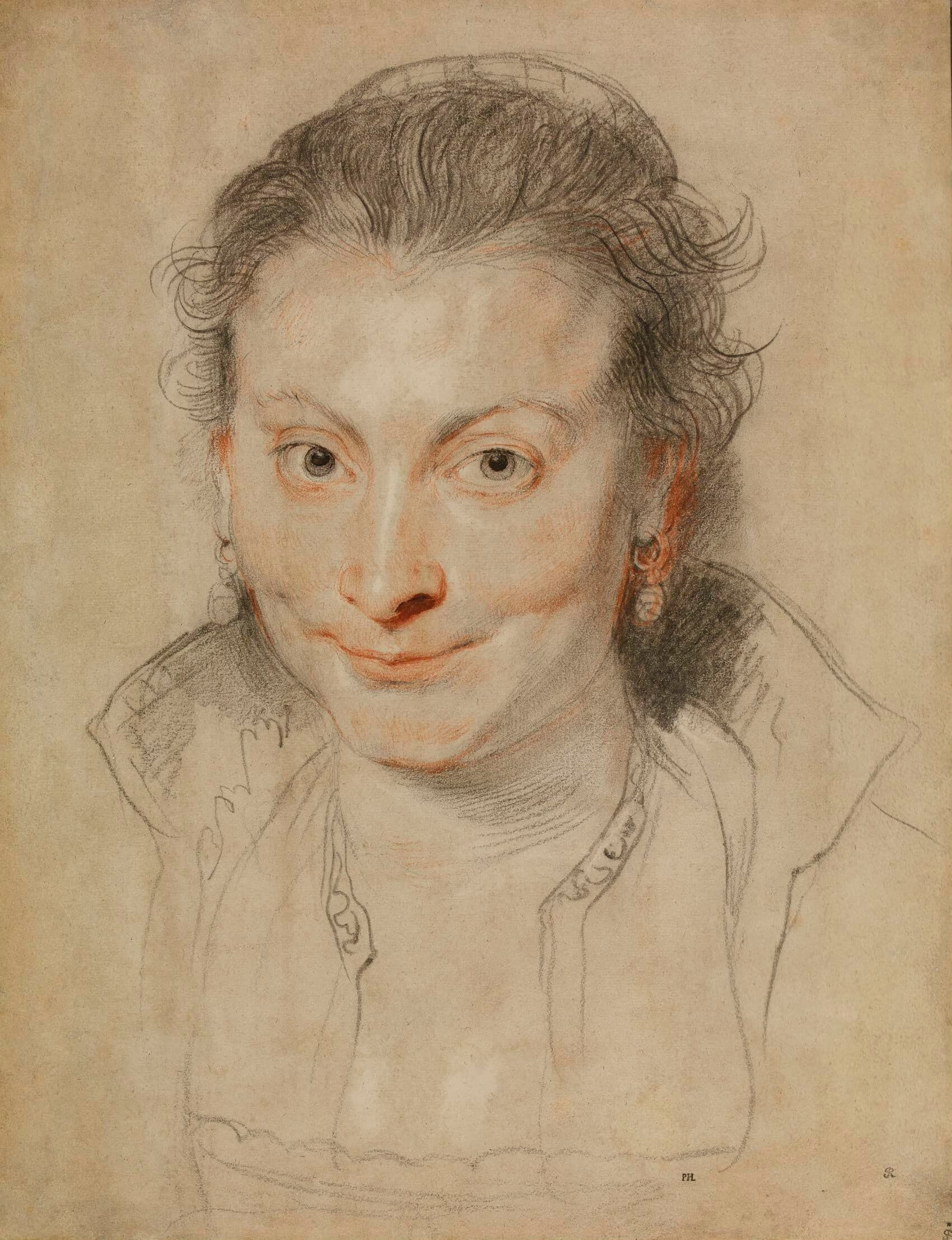
The technique is called trois crayons — three crayons. Rubens used black chalk for the darkest lines and shadows, red chalk for the mid-tones and the warmth of skin, and white chalk to catch the light on Isabella's face, collar and sleeve. The paper itself is brown, so it acts as a fourth tone between the applied colours. This method lets a draughtsman model form quickly without building up layers of a single colour, and it was a common studio practice for portrait studies intended as reference for paintings.
A drawing made to be copied
This sheet was not made as a finished work. It served as a template for oil paintings. Three are recorded: one painted by Rubens' pupil Anthony van Dyck in 1621, now in Washington; a second painted by Rubens himself between 1620 and 1625, now in Cleveland; and a third also by Rubens in 1625, now in Florence. The drawing gave all three a consistent likeness, a workshop resource that could be consulted when Isabella was not sitting. The immediacy of the chalk portrait — the sense of a face caught quickly — was translated into more formal painted compositions.
The hidden sketch on the reverse
In 1964, conservators removed the drawing from its old backing during re-mounting work. On the reverse side they found a rough sketch, also in red and black chalk. It is thought to show Rubens himself with his second wife Hélène Fourment and a child. The sketch had been hidden since the sheet was mounted, which may have happened after Rubens' death when the drawing entered a collector's hands. Why Rubens used the back of Isabella's portrait for this sketch is not recorded, but paper was a reusable surface in the studio.
The story
Peter Paul Rubens drew this portrait of his wife Isabella Brant in Antwerp around 1621. Isabella was born in 1591 and died in 1626, five years after this drawing was made. She modelled for some of Rubens' portraits until her death.
The technique is trois crayons, meaning three chalks. Rubens worked on brown paper, using black chalk for the deepest shadows and outlines, red chalk for the warmer tones of the face and hair, and white chalk to pick out highlights on the forehead, cheek, and the lace of her collar. The brown paper acts as a middle tone, so the artist does not have to fill in every area — the paper itself reads as skin, fabric, or background depending on what surrounds it. The method is fast and produces a lifelike sense of volume and light, which is why it was widely used for preparatory portraits in Flemish and Italian studios.
This drawing was not made to stand alone. It was a studio resource, a reference sheet that could be consulted when painting Isabella's likeness in oil. Three paintings based on it are recorded. One was made in 1621 by Anthony van Dyck, who was Rubens' pupil at the time. Van Dyck painted it as a gift for Rubens, and that portrait is now in Washington. Rubens himself painted two further versions: one between 1620 and 1625, now in Cleveland, and another in 1625, now in Florence. Each painting translates the chalk study into a more finished composition, but all three preserve the same face, the same tilt of the head, the same arrangement of the collar.
After Rubens died in 1640, the drawing passed through the hands of five known collectors. The British Museum acquired it in 1893. For more than seventy years it was mounted and displayed with only the portrait side visible. Then in 1964, during routine conservation work, the sheet was lifted from its backing. On the reverse side, conservators found a second sketch, also in red and black chalk. The sketch is rougher and less finished, and it is thought to show Rubens with his second wife Hélène Fourment and a child. The drawing had been face-down and hidden since it was mounted, which likely happened after Rubens' death.
Why Rubens used the back of Isabella's portrait for a later sketch is not explained in any surviving document. Paper was expensive, and artists routinely reused sheets, but the choice to draw over the reverse of this particular portrait may have been practical or may have carried some private significance. The evidence does not settle it.
Why it mattered then
In Rubens' studio, this drawing was a working document. It fixed Isabella's features in a portable, reusable form that could be referred to when she was not available to sit. Paintings took weeks or months, and sitters could not always attend for the full duration, so a detailed chalk study let the artist or his assistants continue work in her absence. The practice was standard in large workshops where multiple hands contributed to a single commission, and where the master's role was often to design the composition and paint the most important passages — the face, the hands — while pupils filled in drapery, background, and less critical areas. A reference drawing like this one kept the likeness consistent across paintings and across painters. It also meant that a patron commissioning a portrait of Isabella did not need her physical presence in the studio at all; the drawing could stand in for her.
Why it matters now
The drawing matters now in part because it documents a studio practice that was essential to how large workshops functioned, but which leaves little direct evidence. Preparatory drawings were not made to be kept or displayed; they were tools, and many were discarded or painted over. This one survived because it entered a collector's hands after Rubens' death and was treated as a finished work. It also matters because it carries two portraits, not one. The sketch on the reverse, hidden for three centuries, shows how artists reused materials and how a sheet of paper could hold layers of a life in a way that was never intended to be read as a sequence but which becomes one when the sheet is turned over. The drawing is now behind glass, but for much of its time in the British Museum it was not. Visitors could touch it, and photographs from the period show hands resting on the frame. It was only glazed in the second half of the twentieth century.
The surprising detail
The drawing noted for its immediacy and attractiveness became the basis for three oil paintings by two different artists. Van Dyck painted his version as a gift to Rubens. The sheet itself was handled and touched by museum visitors for more than a century and a half before it was placed behind glass in the second half of the twentieth century.
What is disputed
The sketch on the reverse is described as showing Rubens with Hélène Fourment and a child, but this identification is not certain. The figures are roughly drawn and no contemporary label or documentation confirms who they represent. The assumption rests on the fact that Rubens married Fourment and that the chalk technique matches his hand, but the evidence is circumstantial.
Remember this
A working drawing made to be copied, not displayed — and it hid a second portrait on its back for three hundred years.
Test yourself
Why would a workshop drawing like this one have been more useful to Rubens and his pupils than a painted portrait of Isabella?
Because a drawing on paper could be handled and consulted without risk, while a wet or drying oil painting could not. A chalk study was also faster to produce than a painted portrait, so it could be made in a single sitting and then serve as reference for multiple paintings over months or years. In a busy workshop where several paintings might be in progress at once, a portable reference that fixed the sitter's likeness meant the artist did not need the sitter present for every stage of every commission. The drawing was a tool, not an end in itself, which is why so few survive — they were used until they wore out or were no longer needed.
Go deeper
Image: Peter Paul Rubens, Public domain. Licence: Public domain. Source.