III · THE WORK · ART HISTORY
Masaccio's Holy Trinity
▶ Listen · narrated
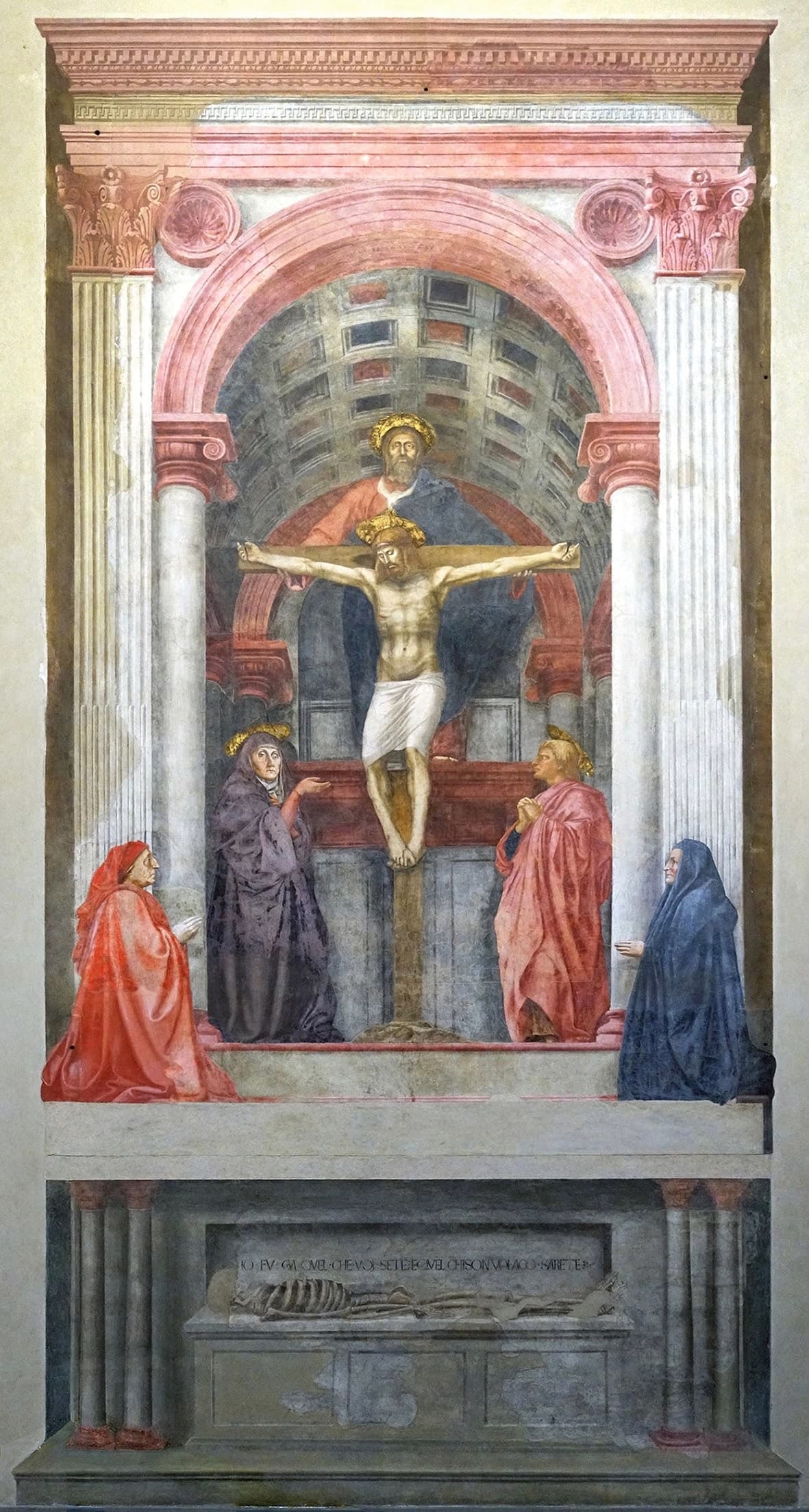
A coffered vault recedes to a single point with such conviction that visitors to Santa Maria Novella still approach the wall to check whether the chapel is real or painted.
At a glance
- Artist
- Masaccio
- Date
- 1420
- Medium
- Fresco
- Dimensions
- 667 × 317 cm
- Collection
- Basilica of Santa Maria Novella, Florence
Look closer
The coffered barrel vault receding to one point
The ceiling is divided into square coffers — recessed panels — that diminish in size as they recede. Every line that runs into depth converges on a single point just below the base of the cross. This is linear perspective applied with mathematical consistency: the illusion is constructed so that all the architecture obeys the same geometric rule. The effect is that the vault appears to tunnel back into the wall, creating a space that reads as three-dimensional.
Donors kneeling outside the fictive architecture
Two figures kneel in prayer at the front edge of the composition, outside the painted chapel. They are shown at the scale of living people, positioned as though they occupy the real space of the church rather than the fictive space behind them. The man and woman are understood to be the patrons who commissioned the fresco, placed in the eternal act of devotion. Their position — in front of the architecture rather than inside it — marks the boundary between the viewer's world and the painted one.
The tomb and skeleton at the base
Below the main scene, at eye level for a standing viewer, a skeleton lies on a sarcophagus. Above it runs an inscription: IO FU GIA QUEL CHE VOI SETE E QUEL CHIO SONO VOI ANCO SARETE — I was once what you are, and what I am you will also be. The tomb is painted as though it projects forward from the wall, a ledge in the viewer's space. The skeleton is the hinge: the perspective above shows the divine, made present through geometry; the memento mori below tells you why the geometry matters. The illusion of space is in the service of preparing for death.
The story
The fresco is painted on the wall of the Dominican church of Santa Maria Novella in Florence. It shows the crucified Christ supported by a standing figure above, with a dove between them — a representation of sacred mystery. Two standing figures flank the cross, within a barrel-vaulted chapel that recedes in perspective. Two donors kneel at the front, outside the architecture. Below everything, a skeleton lies in a tomb with an inscription warning the viewer of mortality.
What makes the painting notable is the architecture. The coffered vault, the fluted columns, the entablature — all of it is constructed according to a single vanishing point, located just below the base of the cross. Every orthogonal — every line running into depth — converges there. The result is a coherent illusion of three-dimensional space on a flat wall. The chapel does not exist. It is geometry made visible in pigment on wet plaster.
Linear perspective — the system in which parallel lines converge to a point — was a preoccupation in Florence in the early fifteenth century. The architect Brunelleschi is credited with formulating the geometric rules, though no written treatise by him survives. Masaccio's fresco demonstrates the system applied at monumental scale. The painting does not merely use perspective; it makes perspective the subject. The architecture is there to be seen as architecture, to assert that a flat surface can be made to behave like a window into constructed space.
The fresco measures 667 centimetres high by 317 wide. It was painted in 1420, during the period when Masaccio was working in Florence. The exact circumstances of the commission are not fully recorded, but the presence of the two kneeling donors indicates private patronage. The figures are painted at life scale, which means the viewer stands in spatial relation to them as though they were present in the church.
Below the main composition, the tomb and skeleton occupy a different pictorial zone. The sarcophagus is painted as though it projects forward from the wall, placing the skeleton in the viewer's space rather than in the fictive chapel above. The inscription is a standard memento mori formula, a reminder that death is the destination. The perspective above and the tomb below are linked: the illusion of space is not an end in itself but a means of making the sacred vivid, and the vivid sacred is presented alongside the fact of mortality.
Why it mattered then
In Florence in 1420, the application of geometric perspective to painting was new enough to be a demonstration. The system allowed painters to construct space that obeyed consistent rules, space that could be measured and replicated. For a religious fresco, this had a theological dimension: the illusion of depth made the divine scene present in a new way, as though the wall had been cut away to reveal a chapel that existed in the same physical order as the church itself. The architecture is not decorative. It is there to be legible as architecture, to show that the painter commands the same spatial language as the architect. The fresco was painted for a Dominican church, and the Dominicans were a preaching order. The clarity of the composition — the frontal presentation of the sacred figures, the symmetry, the single vanishing point aligned with the cross — serves a didactic function. The painting teaches through visibility. The perspective makes the sacred scene readable as a coherent space, and the tomb below makes the moral explicit: the illusion is in the service of preparing the soul.
Why it matters now
The fresco is studied because it demonstrates a system of representation that became widespread in European painting over the following centuries. Linear perspective offered a method for depicting space that obeyed geometric rules. Masaccio's fresco is among the surviving works that show the system applied with consistency at the moment it was being formulated. The painting is a record of a shift in how space could be constructed on a flat surface. The tomb and skeleton are also a reminder that the perspective was not an end in itself. The geometry is there to make the divine scene vivid, and the vivid scene is placed above a memento mori. The illusion of space and the fact of death are held together in the same composition. The fresco does not separate its technical achievement from its moral purpose.
The surprising detail
The fresco was covered over in the sixteenth century when a stone altar was built in front of it, and it remained hidden for centuries. It was rediscovered in the nineteenth century when the altar was removed. During the rediscovery, the skeleton and tomb at the base were found on a different part of the wall, separated from the main composition. The fresco had been cut and moved at some point, and the tomb section had been relocated. It was only when both parts were uncovered that the full composition — perspective above, memento mori below — could be understood as a single work.
What is disputed
The exact date of the fresco is given as 1420 in the verified facts, but some sources place it later in the 1420s. The circumstances of the commission and the identity of the donors are not fully documented. The fresco was moved at some point in its history, and the skeleton section was separated from the main composition, so the original installation is a matter of reconstruction.
Remember this
A chapel that does not exist, painted with such geometric consistency that it asserts the reality of the space it depicts — and a skeleton below to tell you why the illusion matters.
Test yourself
Why does the fresco place the two donors outside the architecture of the painted chapel, rather than inside it with the other standing figures?
Because the donors occupy a different status in the composition. The standing figures within the chapel are sacred presences within the eternal divine space represented by the architecture. The donors are mortal patrons, shown in the act of devotion but not admitted into the sacred zone. Placing them outside the architecture, at the threshold, marks the boundary between the human and the divine. They kneel in the viewer's world, looking into the space they cannot enter. The perspective constructs a hierarchy: the geometry creates a coherent space, and the placement of figures within or outside that space signals their relation to the sacred. The donors are perpetually approaching, not arrived.
Go deeper
Image: Masaccio, Public domain. Licence: Public domain. Source.