I · THE OBJECT · BRITISH MUSEUM
Dürer's Rhinoceros
▶ Listen · narrated
An artist working from a written description can get the large shape right and every detail wrong — and if the print is good enough, the mistakes travel.
At a glance
- Creator
- Albrecht Dürer
- Date
- 1515
- Material
- Laid paper
- Technique
- Woodcut process
- Dimensions
- 23.5 × 29.8 cm
Look closer
Plates and rivets that are not there
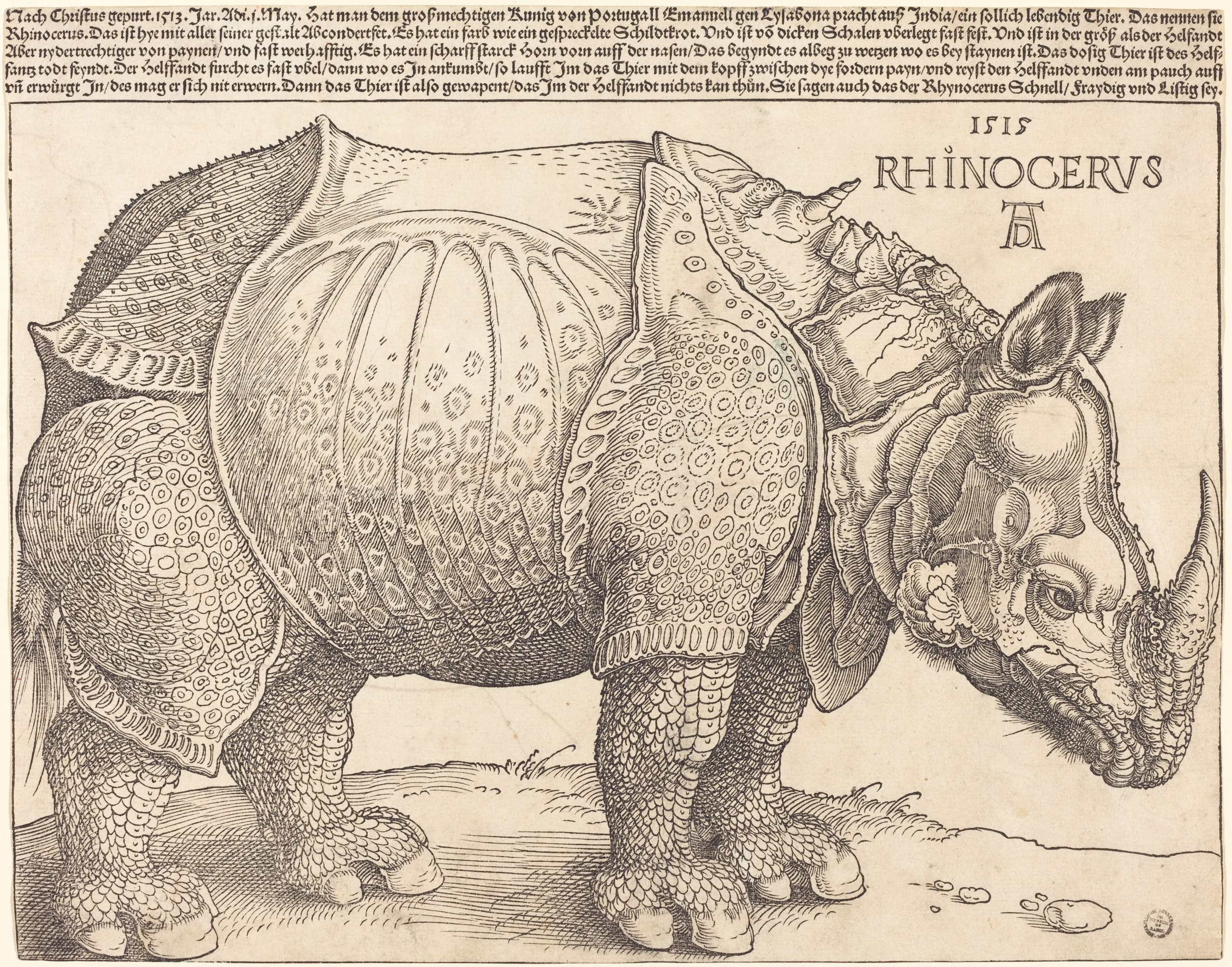
The body is covered in what look like separate sheets of armour, with a gorget — a throat guard — at the neck and a solid breastplate across the chest. Along the seams you can see what appear to be rivets, as though the animal had been assembled in a workshop. An Indian rhinoceros does have deep folds in its skin, and from a distance those folds can suggest armour, but there are no hard plates, no separate pieces, and certainly no rivets. Dürer has turned creases into engineering.
A small twisted horn on the back
Just behind the shoulder, a second horn projects upward, smaller than the one on the nose and twisted like a narwhal tusk. No rhinoceros has this. The feature may have come from a misunderstood phrase in the written description Dürer was working from, or from a sketch that marked a fold of skin in a way he read as a separate structure. Once carved into the woodblock, it was copied into every print pulled from it, and then copied again by artists who worked from Dürer's image rather than from life.
Scaly legs and saw-edged haunches
The legs are covered in overlapping scales like a reptile's, and the rear quarters have a serrated edge, as though the animal's hide had been cut with pinking shears. Both details are inventions. They may reflect a general sixteenth-century expectation that exotic animals would be strange in a particular way — armoured, segmented, toothed — or they may simply be Dürer's solution to the problem of rendering an unfamiliar texture in wood. Either way, they became canonical. For generations, a rhinoceros was supposed to look like this.
The story
In 1515, a rhinoceros arrived in Lisbon. It had been brought from India as a gift. Albrecht Dürer, working in Nuremberg, did not see it. He had access to a written description and a brief sketch, both anonymous, and from those he carved a woodcut.
The process matters. A woodcut is made by cutting away the areas that will print white, leaving the lines and shapes in relief. The block is then inked and pressed onto paper. Every print pulled from the block is identical, and the block can be used many times. This makes the woodcut a powerful instrument for distributing an image — but it also means that any error in the carving is reproduced exactly, again and again, in every impression.
Dürer's rhinoceros is not accurate. The animal is covered in hard plates that look like sheets of armour, with what appear to be rivets along the seams. There is a small twisted horn on its back. The legs are scaly, the rear quarters saw-edged. None of these features exist on a real rhinoceros, though the deep folds in the skin of an Indian rhinoceros can suggest armour from a distance.
The woodcut became very popular. It was copied many times over the following three centuries, in prints, in books, in paintings, in sculpture. It was treated as a reliable representation of what a rhinoceros looked like. The animal Dürer had drawn from a description became the animal that Europe expected to see.
This continued until the middle of the eighteenth century, when another rhinoceros arrived in Europe and was exhibited widely. More realistic drawings and paintings were made from direct observation, and those gradually replaced Dürer's image. But for more than two hundred years, if you wanted to know what a rhinoceros looked like, you looked at Dürer's woodcut — and you saw an animal that had never existed.
Why it mattered then
The woodcut was made in 1515, the same year the rhinoceros arrived in Lisbon. The animal was sent onward as a gift, but it died in a shipwreck off the coast of Italy. Another live rhinoceros was not seen in Europe until 1577. For more than sixty years, Dürer's print was widely available, and it was based on second-hand information. This mattered because the woodcut process allowed the image to be reproduced and distributed efficiently. Prints could be pulled from the block and sold, or sent to other cities, or bound into books. The image travelled widely. It reached audiences who would never see a rhinoceros in life, and for those audiences, Dürer's version was authoritative. It came from a respected artist, it was detailed and confident, and there was no competing image to check it against. The result was that a mistake, once carved into wood, became a standard. Other artists copied Dürer's rhinoceros because it was the reference they had. The plates, the rivets, the extra horn — all of these were reproduced, not because anyone had seen them, but because Dürer had drawn them and the drawing had been printed.
Why it matters now
The woodcut is a parable about copying descriptions. Dürer worked from a written account and a sketch, neither of which he could verify. He filled in the details himself, using his own judgment about what an exotic animal ought to look like. The result was plausible enough to be accepted, and the woodcut process ensured that it was accepted widely. This is a problem that has not gone away. Images are still copied, and errors are still reproduced. The difference now is speed and scale. A mistake can be embedded in a dataset, or repeated in a template, or recommended by an algorithm, and it can reach a global audience before anyone has checked it against the thing it claims to represent. Dürer's rhinoceros also raises a question about what we mean by accuracy. The woodcut is not a faithful representation of the animal's anatomy, but it is a faithful representation of the information Dürer had, and of the assumptions he brought to the task. It is accurate as a record of what a sixteenth-century artist, working in Nuremberg, believed a rhinoceros looked like based on a letter from Lisbon. That is not the same as being accurate as a picture of a rhinoceros, but it is not without value. The image tells us something about the limits of knowledge in 1515, and about the confidence with which those limits were ignored.
The surprising detail
The woodcut was still being treated as a reliable image well into the eighteenth century, long after more accurate descriptions and drawings were available. It was when a live rhinoceros was exhibited widely in Europe in the 1740s and 1750s that artists began to work from direct observation in significant numbers. Even then, Dürer's version did not disappear immediately. The image had been copied so many times, and had appeared in so many books, that it had a kind of institutional momentum. People expected a rhinoceros to look like Dürer's rhinoceros, and some continued to draw it that way even after they had seen the real thing.
What is disputed
The date of the woodcut is given as both 1512 and 1515 in different records. The rhinoceros arrived in Lisbon in 1515, so the later date is more consistent with the account that Dürer worked from a description of that animal. The earlier date may refer to a preliminary drawing or may be an error in cataloguing.
Remember this
A confident image, widely copied, can define a thing more powerfully than a correct description — especially when the thing itself is out of reach.
Test yourself
Why did Dürer's inaccurate rhinoceros remain the standard European image of the animal for so long, even after more accurate descriptions became available?
Because the woodcut process allowed the image to be reproduced and distributed efficiently, and because there was no competing image with comparable reach for decades. Dürer's print was detailed, confident, and came from a respected artist. It was copied into books and other prints, and each copy reinforced the authority of the original. By the time a live rhinoceros was exhibited widely in Europe in the 1740s and 1750s, Dürer's version had been in circulation for more than two centuries. It had become the reference image, and references are slow to change. The lesson is about distribution as much as accuracy: the image that travels furthest is not always the one that is correct, but the one that is most easily copied.