I · THE OBJECT · BRITISH MUSEUM
The Oxus Treasure
▶ Listen · narrated
This is what remains of a hoard that was larger, found somewhere less certain, and dispersed before anyone wrote down what had been there.
At a glance
- Date
- 550–330 BC
- Discovery
- About 1880, by the Oxus river
- Material
- Gold and silver
- Surviving pieces
- About 180 metalwork objects, around 200 coins
Look closer
A chariot model in miniature
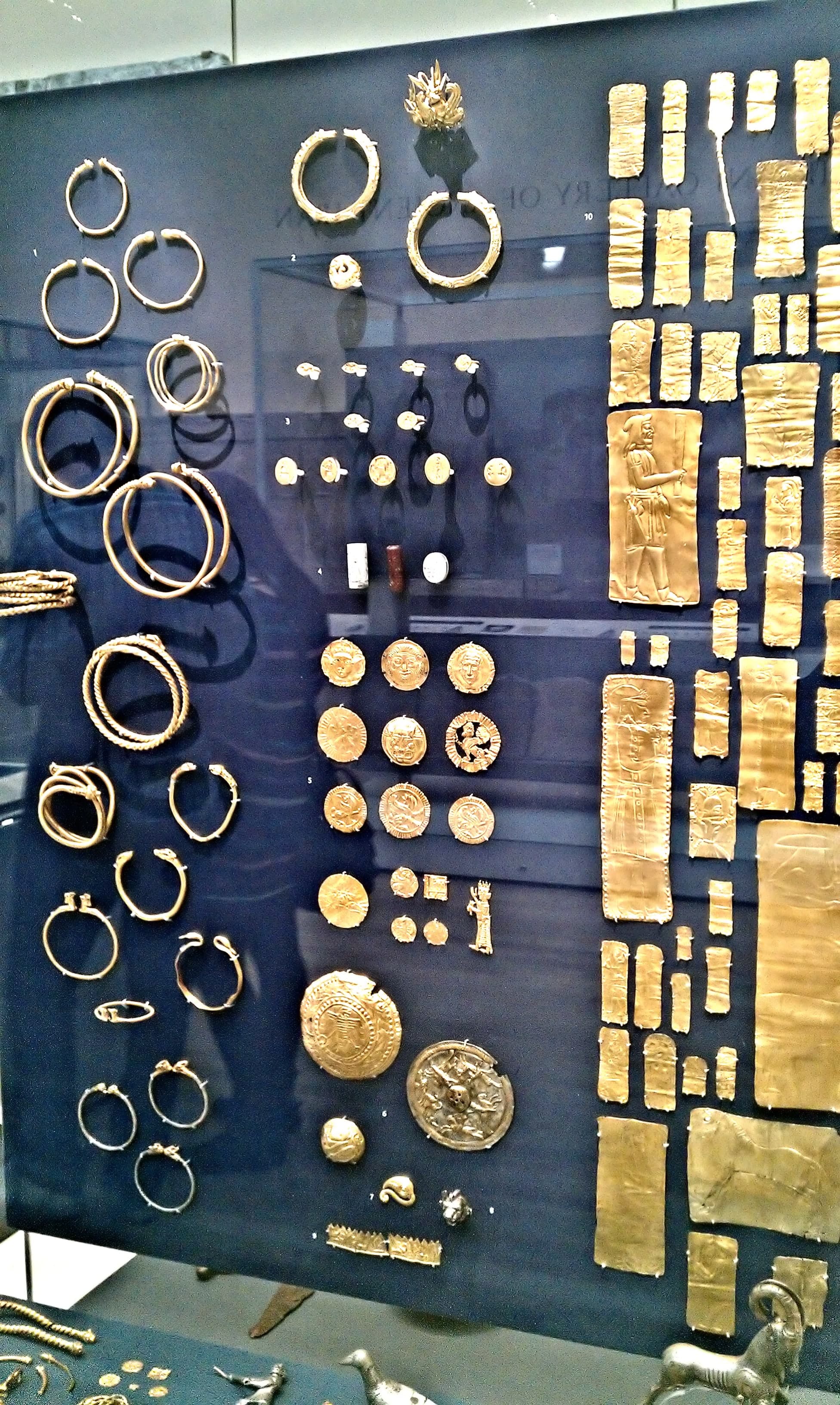
One of the surviving pieces is a small gold chariot, complete with a driver and four horses. The wheels turn. The craftsmanship is fine enough that the reins are visible as separate strands, and the horses' musculature is modelled. Objects like this may have been votive offerings — gifts left at a temple — rather than functional items. The range of quality across the hoard is wide: some pieces show the precision expected at court, while others, particularly the flat votive plaques, are crudely executed, perhaps by the people who donated them.
Griffin-headed bracelets
A pair of bracelets ends in griffin heads, the beaks hooked and the eyes inlaid. The British Museum holds one; the other is on loan from the Victoria and Albert Museum. The two are displayed together. Bracelets of this kind appear in Achaemenid reliefs worn by figures at court, so these may have been high-status ornaments before they were deposited. Whether they were worn in life or made specifically as offerings is not recorded.
What the early reports mentioned
Contemporary accounts of the find describe types of metalwork that are not among the pieces now in museums. They also suggest the hoard originally contained around fifteen hundred coins, far more than the two hundred now associated with it. Many pieces were likely melted down for bullion before scholars could record them. What survives is a fraction of what was found, and what was found may itself be a fraction of what was deposited.
The story
The Oxus treasure is a collection of gold and silver objects from the Achaemenid Persian period, recovered near the Oxus river around 1880. About 180 pieces of metalwork survive, along with around 200 coins. The exact location of the find and the date of discovery remain unclear. The site is often proposed as being near Kobadiyan, but the evidence for this is not definitive.
Early reports suggest the hoard was much larger. Accounts from the period mention around fifteen hundred coins and describe categories of object that are not present in the surviving material. It is likely that many pieces were melted down for their metal before they could be recorded or acquired by institutions. What remains, then, is a sample of unknown size from a find of unknown extent.
The metalwork is believed to date from the sixth to fourth centuries BC. The coins show a wider range, with some thought to belong to the treasure dating from around 200 BC. This spread suggests the hoard was not buried all at once, but accumulated over time. The most plausible explanation is that it belonged to a temple, where offerings were deposited across generations. How it came to be buried or abandoned is not known.
The objects themselves vary greatly in quality. Many of the gold votive plaques — flat pieces, often stamped with figures or inscriptions — are crudely made. Some may have been produced by the donors themselves, people who could afford the gold but not the services of a specialist goldsmith. Other pieces, including the chariot model and the griffin-headed bracelets, are finely worked, with detail that suggests they were made for or by the court.
The British Museum now holds nearly all the surviving metalwork, displayed in Room 52. One of the pair of griffin bracelets is on loan from the Victoria and Albert Museum. Many items were bequeathed to the nation by Augustus Wollaston Franks. The coins are more widely dispersed and harder to connect firmly to the treasure. A group believed to come from the hoard is held by the Hermitage Museum, and other collections have examples.
Why it mattered then
The range of objects in the hoard — from crude plaques to court-quality goldwork — suggests a temple that accepted offerings from people of different means. Votive deposits were a way of marking gratitude, seeking favour, or fulfilling a vow, and temples in the Achaemenid world accumulated wealth in this manner over centuries. The presence of coins spanning several centuries supports the idea of long-term accumulation rather than a single burial event. The craftsmanship of the finer pieces reflects the reach and resources of the Achaemenid court. Griffin-headed bracelets of the kind found in the hoard appear on reliefs at Persepolis, worn by figures in procession. Whether the bracelets in the treasure were worn first and then offered, or made specifically as temple gifts, is not recorded. Either way, they show that temple deposits could include objects of the kind associated with royal or elite display. The hoard is evidence of a production system that worked in precious metal on a large scale. Achaemenid goldwork was once plentiful, but very little survives. Most was melted down in antiquity, either for coinage or for reuse. The Oxus treasure, even in its reduced state, preserves a range of forms and techniques that would otherwise be known only from descriptions or depictions in stone.
Why it matters now
The treasure is a rare survival of Achaemenid metalwork in precious materials. Most gold and silver from the period was recycled long ago, so the objects that remain are a small sample of what was once made. The hoard shows the range of work produced under Achaemenid rule, from pieces made with the precision expected at court to offerings made by people with fewer resources but the same impulse to give. The murky recovery story is also instructive. The exact site is uncertain, the original size of the hoard is unknown, and many pieces were lost to melting before anyone could record them. This is not unusual for nineteenth-century finds, but it means the evidence is incomplete in ways that cannot now be repaired. The lesson applies beyond this hoard: when the context of a find is not documented at the time, it is lost permanently, and with it much of what the objects might have revealed. The dispersal of the material — metalwork mostly in the British Museum, coins in various collections, one bracelet on loan from another institution — reflects the fragmented history of archaeological material in this period. Objects moved through dealers, private collectors, and bequests before reaching museums. The treasure exists now as a reconstructed group, assembled from pieces that travelled different routes and whose association with one another rests on reports that are incomplete and sometimes contradictory.
The surprising detail
One of the bracelets in the hoard is held by the Victoria and Albert Museum, not the British Museum, and is on loan to the British Museum so the pair can be displayed together. The separation happened because the objects reached the two institutions by different routes. Augustus Wollaston Franks, who bequeathed much of the metalwork to the British Museum, was instrumental in securing pieces from the hoard for public collections, but the bracelet now at the V&A had already been acquired separately. The loan reunites them, but the fact that they ended up in different collections in the same city is a reminder of how dispersed the material became before museums began to treat the hoard as a coherent group.
What is disputed
The exact place and date of the find are not certain. The site is often given as near Kobadiyan, but contemporary accounts differ, and no definitive record of the discovery survives. Early reports describe objects and coin quantities that do not match the surviving material, but these reports are incomplete and sometimes contradictory. The original size of the hoard, the circumstances of its burial, and the temple it may have belonged to are all unknown.
How it got here
The metalwork reached the British Museum by several routes. Many pieces were bequeathed by Augustus Wollaston Franks, who acquired them in the years following the discovery. One of the pair of griffin bracelets is held by the Victoria and Albert Museum and is on loan to the British Museum for display. The coins are more widely dispersed, with a group believed to come from the hoard held by the Hermitage Museum and others in various collections. The treasure was recovered in the 1880s, during a period when archaeological material moved through dealers and private collectors before reaching institutions, and the documentation of the find was incomplete.
Remember this
A temple hoard, mostly lost to melting, with the recovery details now too thin to reconstruct — and what survives shows the range from crude to courtly.
Test yourself
The hoard includes both crudely made votive plaques and finely worked objects like the griffin bracelets. Why might a temple accept offerings of such different quality, and what does that tell us about how votive deposits functioned?
A temple that accepted offerings of varying quality was open to donors of different means. The crudely made plaques may have been produced by the donors themselves, people who could afford the gold but not the services of a skilled goldsmith. The finely worked pieces, by contrast, likely came from wealthier donors or were commissioned by elites. The mix suggests that votive giving was not restricted to the wealthy, and that the value of an offering lay partly in the intention and partly in the material itself. Temples accumulated wealth this way, but they also served as places where people across a social range could participate in the same ritual economy. The quality of the work mattered less than the fact of the gift.