III · THE WORK · ART HISTORY
Laocoön and His Sons
▶ Listen · narrated
The sculpture that shaped Michelangelo's idea of the human body in extremis spent four hundred years with the wrong arm attached.
At a glance
- Creators
- Agesander, Athanadoros and Polydoros of Rhodes
- Date
- 1st century BC (scholarly estimates range from 150 BC to 42 BC)
- Material
- Marble
- Height
- 2.42 metres (recorded measurements vary)
- Discovery
- Rome, Oppian Hill, 1506
- Collection
- Pio-Clementino museum, Vatican
Look closer
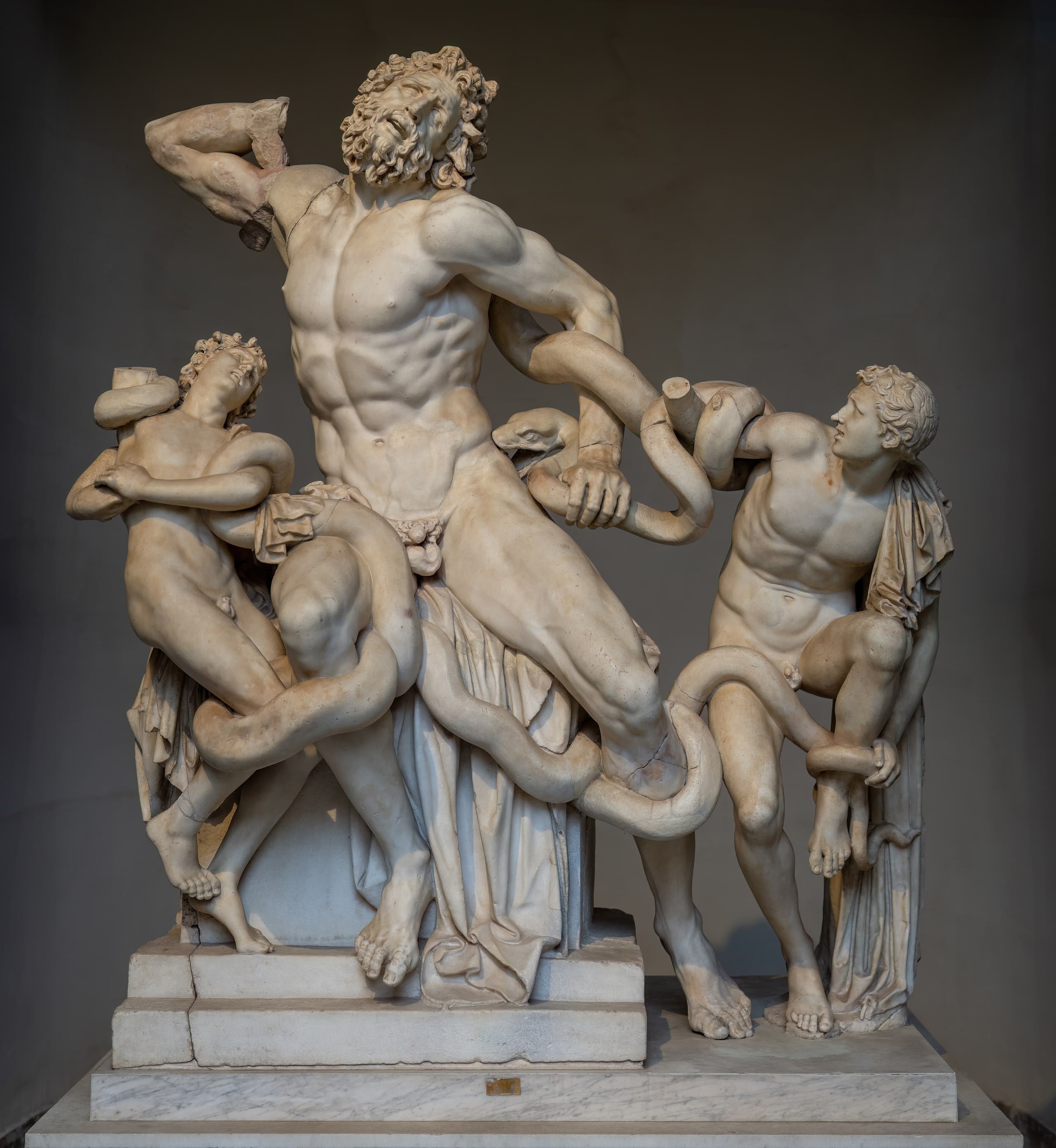
Laocoön's face — the canonical image of physical agony
The central figure's face is pulled into an expression of such extreme strain that a physician studying facial anatomy in the nineteenth century noted the eyebrows as physiologically impossible — the muscles required to produce that configuration cannot contract simultaneously in a living person. The mouth is open, the brow furrowed and lifted, every visible part of the face recruited into the depiction of unbearable effort. This is not the tranquil suffering of later Christian martyrdom art, where pain is tempered by the promise of redemption. It is purely physical agony, with no consolation encoded in the carving.
The bent right arm, restored correctly only in the twentieth century
When the group was excavated in 1506, Laocoön's right arm was missing. The restorers gave him a new one in marble, extended upward in a dramatic gesture. That arm remained in place for four centuries. In 1906 the original arm was identified in a builder's yard in Rome — bent sharply at the elbow, pulled back behind the figure's head, the hand near the shoulder. It was reattached only in modern times. The change is not cosmetic: the bent arm turns the figure's gesture inward, trapping the struggle within the body rather than opening it outward in appeal.
The younger son already going limp
The smaller figure on the right is carved with his body sagging, his head tilted back, his mouth slack. The serpent is still coiled around him, but the tension has gone out of his limbs. He is either unconscious or dead, and the contrast with his father's continuing fight — every muscle still engaged — makes the sequence of the attack legible. One son is past resistance, the other still caught in it, and Laocoön himself is at the centre of the effort, still straining against something he cannot escape.
The story
The group was dug up on the Oppian Hill in Rome in 1506 and recognised almost immediately as an important survival from antiquity. It depicts Laocoön, a Trojan priest, and his two sons Antiphantes and Thymbraeus being attacked by sea serpents. The figures are carved nearly life-sized, and the entire group stands just over two metres tall. The sculptors named on the base — Agesander, Athanadoros and Polydoros, all from the island of Rhodes — worked in the Hellenistic tradition, though exactly when is unresolved. Scholarly estimates for the date of the work range from 150 BC to 42 BC, with some preferring a date in the first century BC. The question of whether this is an original composition or a marble copy of an earlier bronze has not been settled.
The sculpture was incomplete when it was found. Laocoön's right arm was missing, along with parts of the sons' bodies and one of the serpents. Within months of the discovery, restorations were undertaken. The missing arm was replaced with a new one carved in marble, extended upward in a gesture that seemed to match the drama of the scene. That restored arm remained in place for four hundred years.
In 1906 an arm carved in the same marble as the rest of the group was identified in a builder's yard in Rome. It was bent sharply at the elbow, not extended, and when scholars examined it against the break on Laocoön's shoulder, it was clear this was the original. The bent arm was not reattached immediately — the sculpture remained in its restored state for decades longer — but the discovery settled a question that had been argued since the sixteenth century. Some observers, including Michelangelo, had proposed that the arm should be bent, pulled back toward the head rather than raised. The found arm proved them correct.
The difference is not merely a matter of gesture. The extended arm, reaching upward, suggests appeal or defiance, an outward movement that opens the composition. The bent arm, pulled back and trapped behind the figure's own head, turns the struggle inward. It makes the space around Laocoön smaller, the effort more contained, the defeat more inevitable. The serpent has not just attacked him; it has folded him into himself.
The sculpture has been in the Vatican collections since shortly after its excavation and is now displayed in the Pio-Clementino museum. It has undergone multiple restorations, both in antiquity and in modern times, and the evidence for what was original and what was added later is visible in the surface of the marble itself. The group is in mostly excellent condition for an excavated work, but it is a composite object, assembled from its surviving parts and the interventions of restorers across five centuries.
Why it mattered then
The names of the three sculptors — Agesander, Athanadoros and Polydoros — are recorded, which is itself unusual for ancient sculpture. Most works survive without attribution, but this group was noted in writing during antiquity, and the base carried an inscription identifying its makers. That it was considered worth recording suggests it was already regarded as significant in its own period. The subject is a moment from the story of Troy's fall, and the choice to depict Laocoön and his sons at the instant of their destruction, rather than in a moment of heroism or piety, reflects the Hellenistic interest in extreme states — physical strain, psychological collapse, the body at the limit of what it can endure. The style is consistent with other works from the Hellenistic period that emphasised movement, emotion and anatomical precision, often in scenes of violence or suffering. If the sculpture was made in the first century BC, as many scholars now believe, it was created during a period when Greek sculptors were working for Roman patrons, producing works that combined Greek technical mastery with Roman taste for drama and scale. Whether it was commissioned for a private home or a public space is not recorded, but its survival in Rome and its later placement in an imperial collection suggest it was valued by those who controlled it.
Why it matters now
The sculpture has been continuously visible and continuously argued over since 1506, which makes it one of a small number of ancient works that has never dropped out of the conversation. It was studied by Michelangelo within months of its discovery, and the evidence of its influence appears in his own depictions of the human body under strain — the twisting torsos, the bulging musculature, the faces pulled into expressions of effort. The question of the missing arm became a test case for how restorations should be approached: whether the goal is to complete the work as the restorer imagines it, or to mark clearly what is original and what is not. The discovery of the original arm in 1906, and the long delay before it was reattached, reflects a shift in thinking about how ancient objects should be presented. The sculpture is now shown with the bent arm, and the history of its restoration is part of what the object teaches. It is a record not only of Hellenistic sculptural practice but of five centuries of argument about what a fragment should be allowed to become.
The surprising detail
The original right arm was found in 1906 in a builder's yard in Rome, four hundred years after the sculpture was excavated. It had been separated from the group at some point — possibly during the original excavation, possibly earlier — and was not recognised for what it was until a scholar examining it noticed that the marble matched and the break aligned with Laocoön's shoulder. The arm was bent sharply at the elbow, pulled back behind the head, which was the opposite of the extended, upward-reaching arm that had been attached in the sixteenth century. Michelangelo had argued for a bent arm when he saw the sculpture in 1506, but his opinion was not followed by the restorers. The discovery proved him correct, but the bent arm was not reattached to the sculpture immediately. It took decades more before the modern restoration was carried out and the extended arm removed. For four centuries, the sculpture was seen with the wrong arm, and the correction came too late for any of the artists who had drawn it in the intervening period.
What is disputed
The date of the sculpture is genuinely unresolved. Scholarly estimates range from 150 BC to 42 BC, with some preferring a date in the first century BC and others placing it earlier in the Hellenistic period. Whether the work is an original composition or a marble copy of an earlier bronze sculpture is also disputed. The names of the three sculptors are recorded — Agesander, Athanadoros and Polydoros of Rhodes — but no date or patron is documented in ancient sources. The sculpture has undergone multiple restorations, both in antiquity and since its excavation in 1506, and distinguishing original work from later interventions remains a matter of scholarly debate. The height is recorded variously as 2.42 metres and 184 centimetres in different sources, reflecting either measurement method or the inclusion or exclusion of the base.
Remember this
The sculpture was restored with the wrong arm in 1506, and the original was not found until 1906 — four hundred years too late for Michelangelo, who had guessed correctly.
Test yourself
Why does the difference between a bent arm and an extended arm change what the sculpture means, beyond the obvious fact that one is correct and the other is not?
Because the gesture determines whether the figure is appealing outward or trapped inward. An extended arm, reaching up, suggests a plea, a protest, or a defiant gesture toward the gods or the viewer — it opens the composition outward and implies that the struggle might still have an audience or a purpose. A bent arm, pulled back behind the head, closes the space around the figure and makes the effort circular and self-defeating. The serpent has not just attacked Laocoön; it has forced his own body into a position where he cannot extend, cannot reach, cannot do anything but strain against himself. The bent arm makes the defeat structural, not just narrative. It also changes the relationship between the three figures: with the extended arm, Laocoön seems to be reaching past his sons, possibly toward help or the heavens; with the bent arm, he is locked into the same closed struggle they are, with no gesture that escapes the coils. The restorers in 1506 chose drama and extension; the original sculptors chose compression and inevitability.