I · THE OBJECT · BRITISH MUSEUM
The Lewis Chessmen
▶ Listen · narrated
They have expressions — bored, appalled, weary — and the berserkers bite their shields. Ivory chess sets made somewhere in the Norse world, buried on a Hebridean beach.
At a glance
- Date
- 13th century
- Material
- Walrus ivory
- Discovery
- Isle of Lewis, 1833
- Current location
- British Museum (82 pieces); National Museum of Scotland (11 pieces)
Look closer
The berserkers bite their shields
The pieces representing knights show mounted warriors, but a subset of them are carved differently: the riders bite the tops of their shields, and their eyes are wide. These are berserkers — warriors described in Norse sagas as fighting in a trance-like fury. The shield-biting is a detail recorded in written sources, here rendered in ivory. Other knights sit calmly; the berserkers do not.
Warders, not rooks
The piece that moves like a rook in modern chess is not a tower here. It is a standing figure holding a sword and shield, called a warder — a guard. The abstraction of that piece into a castle tower happened later. What we see in these sets is an earlier convention: the piece is a person defending a position, not the fortification itself.
Expressions that vary
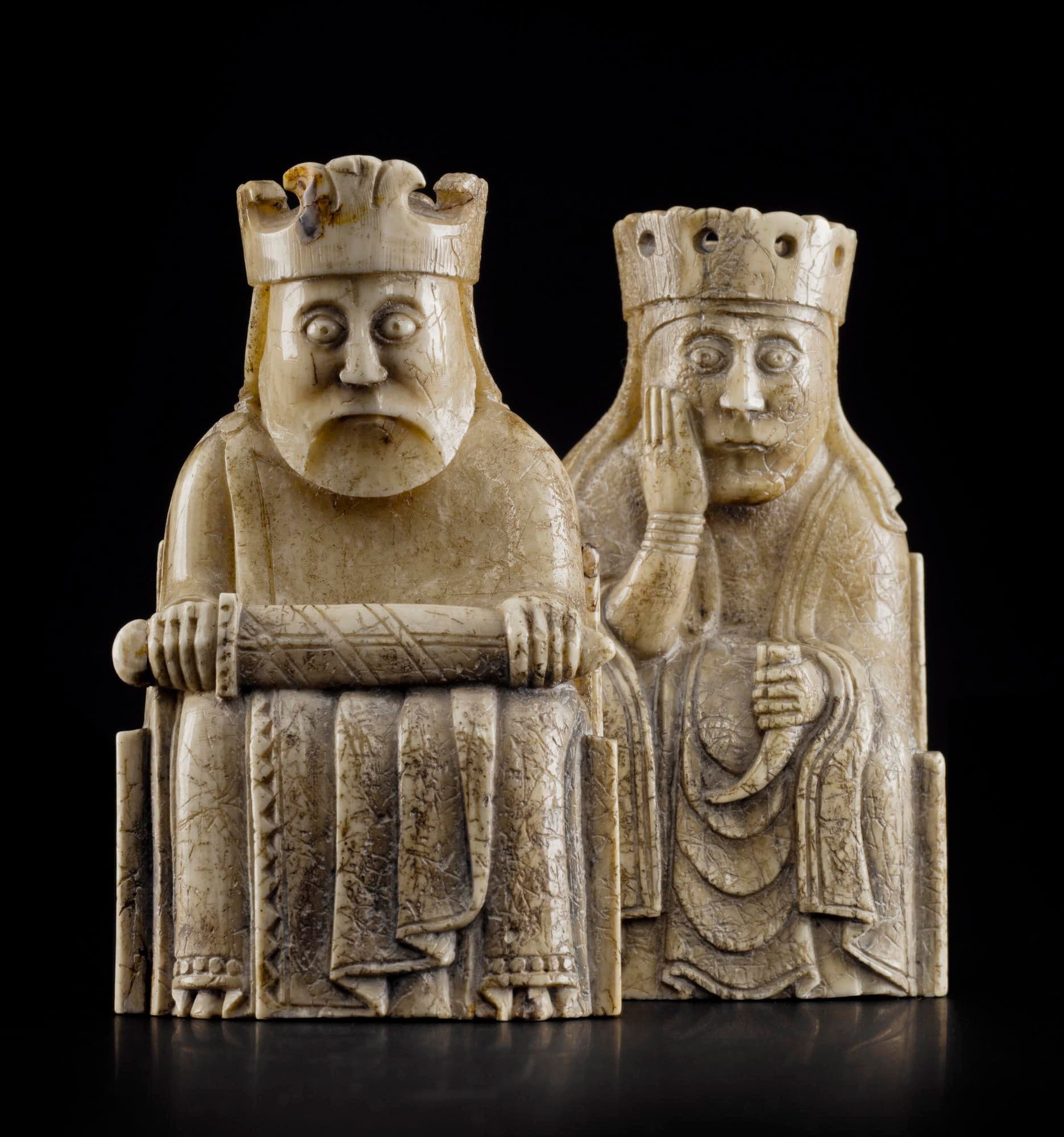
The faces are not uniform. Some kings look bored, chins resting on hands. Some queens rest a cheek on one hand, gazing elsewhere. bishops hold croziers and gesture in blessing, but their expressions range from solemn to weary. The carver or carvers gave individuals individual faces, not a repeated type.
The story
In 1833, ninety-four objects were discovered on the Isle of Lewis in the Outer Hebrides. Seventy-eight were chess pieces. Fourteen were tablemen — flat counters for a game resembling backgammon. One was a belt buckle. Most were carved from walrus ivory; a few from whale tooth.
The chess pieces include kings, queens, bishops, knights, warders (the equivalent of rooks) and pawns. The pawns are small, simple uprights. The other pieces are figures: seated kings and queens, bishops with croziers, mounted knights, standing warders with swords and shields. They range in height, the largest around eight centimetres.
The style is Norse. The carving matches work from other parts of the Norse world in the 12th and 13th centuries, and details — the shape of the thrones, the bishops' mitres, the way the knights' horses are rendered — fit that context. Where the pieces were made is not recorded. Norway and Iceland have both been proposed, but the evidence does not settle it.
What is clear is that they were made as functional gaming pieces, not as display objects. The bases are flat, the pieces stable. They show wear consistent with use. It is not certain whether they constituted complete sets when they were buried, or how many sets they represent. Scholars have tried to group them into sets based on size, style and the colour of the ivory, but the groupings remain provisional. Some pieces are missing: at least four major pieces and a number of pawns are unaccounted for, assuming the hoard originally contained enough for several complete sets.
Why they were buried on Lewis, and by whom, is not known. The island was part of the Norse world in the 13th century, under the Kingdom of the Isles, which was itself contested between Norwegian and Scottish authority. A merchant's stock, a treasure hidden in haste, a deliberate burial — all have been suggested, none proven.
The hoard was divided after discovery. Eighty-two pieces went to the British Museum. Eleven are held by the National Museum of Scotland. At least one is in private hands: a warder sold in 2019 for £735,000, having been misidentified as a decorative object and kept in a family for generations.
Why it mattered then
Chess reached northern Europe from the Islamic world by way of Byzantium and the Mediterranean, arriving in Scandinavia by the 11th or 12th century. The game was played by those with wealth and time: kings, nobles, clergy. Owning a set signalled status. Commissioning one in walrus ivory — a material that had to be obtained from the Arctic, either hunted or traded — signalled it further. The pieces show a Norse visual world. The kings sit on thrones like those described in sagas. The bishops wear mitres and hold croziers in the style of the medieval church. The berserkers biting shields are figures from Norse warrior culture, not from the conventions of chess as it was played further south. Whoever carved these pieces was working within a set of expectations about what a king, a bishop, a warrior should look like, and those expectations were Norse.
Why it matters now
They survive as rare examples of medieval chess sets that were used, not merely kept. Most medieval game pieces that remain are isolated finds or luxury objects preserved because they were never handled. These show wear. They were played with. They also show that abstraction in chess — the move from representational pieces to symbolic ones — was not immediate. The shift from a carved warder holding a sword to a tower representing a fortification, from a mounted knight to a horse's head, happened over centuries. The Lewis pieces sit early in that process. The game is recognisable, but the pieces are still people. The question of where they were made, and why they ended up on Lewis, remains open. The discovery of the privately held warder in 2019, unrecognised for decades, suggests that the hoard may not be complete as catalogued, and that other pieces may still be unaccounted for.
The surprising detail
The pieces were found in a sandbank, but the exact circumstances of the discovery are disputed. Some accounts say they were uncovered by a cow; others that they were found by a man cutting turf. The early reports do not agree. What is certain is that they were found together, and that they had been buried or hidden deliberately — the pieces were not scattered by erosion or accident, but grouped.
What is disputed
Where the pieces were made is not recorded, and the evidence does not settle the question. Norway, Iceland and other parts of the Norse world have been proposed based on stylistic comparison, but no documentary or archaeological evidence ties them to a specific workshop or region. The circumstances of their burial are also unknown: whether they were hidden, lost, or placed deliberately, and by whom, remains a matter of speculation.
How it got here
The pieces were discovered on the Isle of Lewis in 1833 and acquired shortly afterward. Eighty-two pieces were purchased by the British Museum; eleven were acquired by what is now the National Museum of Scotland. The division of the hoard between two institutions occurred in the 19th century, and both museums hold their portions of the find as part of their permanent collections. There is no current repatriation claim on record, though questions about the circumstances of acquisition and export in the 19th century are part of broader discussions about archaeological material removed from Scotland during that period.
Remember this
Walrus ivory chess pieces with faces that vary, carved in the Norse world, buried on a Scottish island for reasons unknown, now divided between two museums.
Test yourself
The Lewis chessmen include berserkers biting their shields as knights, and warders with swords instead of castle towers as rooks. What does the choice to carve people rather than abstract symbols tell us about how the game was understood?
It suggests that chess was still imagined as a representation of a battle or a court, not yet as an abstract system. The pieces correspond to roles — king, bishop, warrior, guard — that had meaning in the social world of the carver and the players. The shift to symbolic pieces, where a tower stands for defensive power and a horse's head for mobility, reflects a later abstraction in which the game is understood as a set of moves rather than a miniature enactment. The Lewis pieces sit at a moment when the game was still figurative, and the figures were expected to look like the people and roles they represented.
Go deeper
Image: National Museums Scotland, CC BY-SA 4.0. Licence: CC BY-SA 4.0. Source.