I · THE OBJECT · BRITISH MUSEUM
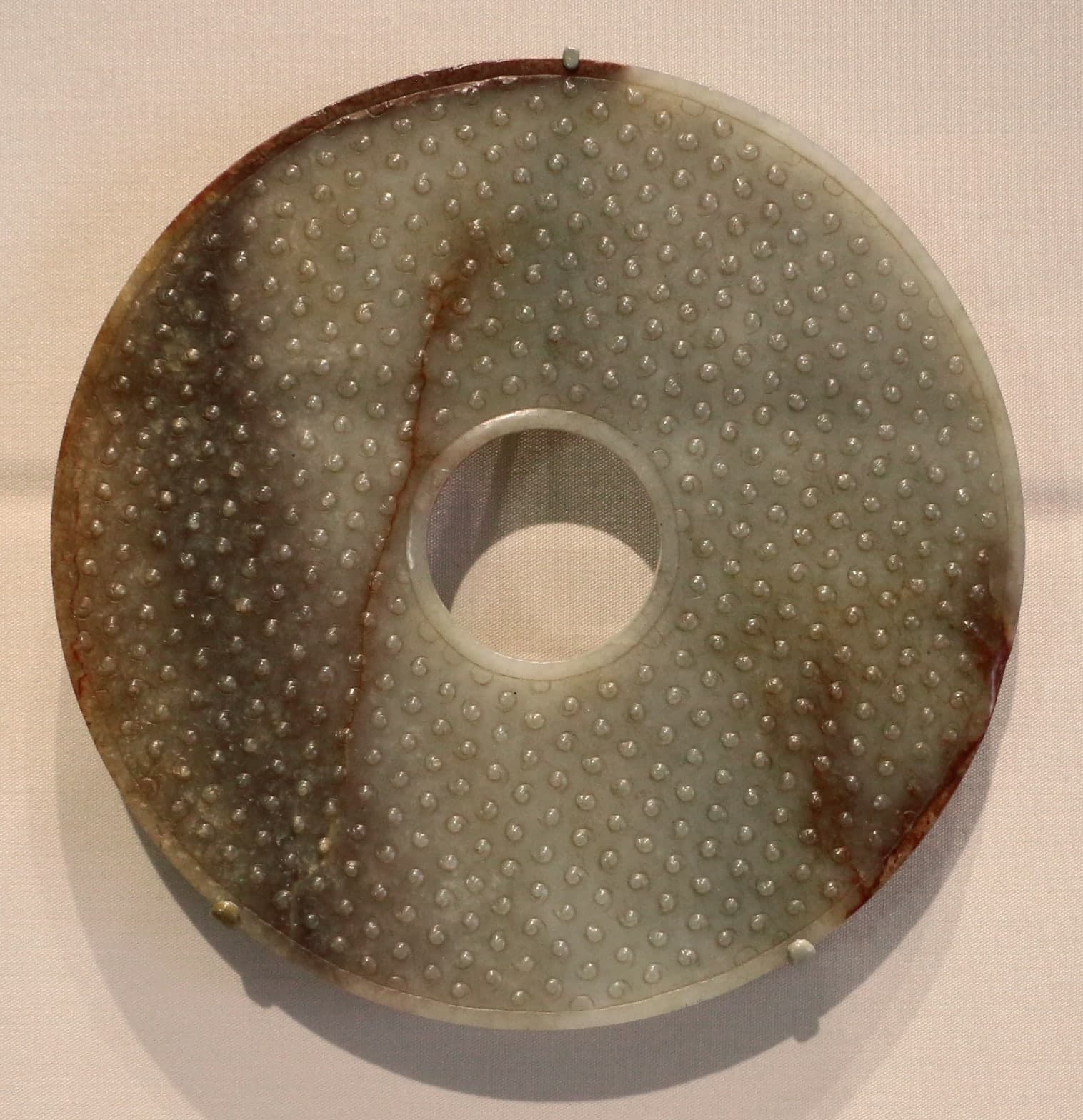
Chinese Jade Bi Disc
▶ Listen · narrated
This took months to make, using techniques that would ruin metal tools. The culture that made it valued jade above all other materials, for reasons still debated.
At a glance
- Material
- Nephrite jade
- Form
- Circular disc with central hole (bi)
- Production period
- Neolithic to Han dynasty
- Cultural origin
- Ancient China
Look closer
The central hole defines the form
A bi is not simply a jade disc — it is specifically a disc with a hole through the centre. The proportions vary: some have wide rims and small holes, others are nearly rings. The hole itself is diagnostic. It distinguishes the bi from other jade forms made in the same periods, and it is the feature that has prompted centuries of speculation about symbolic meaning.
Worked by abrasion, not cutting
Nephrite jade is too hard to carve with the bronze tools available when these were made. Instead, the stone was abraded — worn away slowly using cord, bamboo, and an abrasive slurry of sand and water. The hole was drilled from both sides using a hollow tube, rotating continuously, fed with wet sand. The meeting point of the two drillings is sometimes visible as a ridge inside the perforation. Finishing the surface to a polish required further abrasion with progressively finer materials. A single bi could take months.
Later examples were also made in glass
While jade remained the canonical material, bi forms were also produced in glass during later periods. The glass versions replicate the shape but not the labour. They could be cast or worked much faster than stone, and they lack the surface variation — the subtle shifts in translucency and colour — that jade develops as it is polished. The existence of glass bi suggests the form itself carried meaning, independent of the material's difficulty.
The story
Nephrite jade is a silicate mineral, chemically similar to the rock that forms mountain ranges. It is hard enough to scratch steel, and resistant to fracture in ways that made it useful for objects like axe blades in the Neolithic period. That combination of hardness and toughness also made it extraordinarily difficult to shape.
Metal tools could not cut it. Bronze, the hardest metal available when these discs were made, is softer than nephrite. Attempting to saw or chisel jade with bronze would blunt the tool and leave the stone barely marked. Instead, jade was worked by abrasion: the surface was worn away gradually using cords, wooden or bamboo tools, and a slurry of sand and water. The abrasive did the cutting; the tool simply held it in place and kept it moving.
To drill the central hole, a craftsperson would use a hollow tube — bamboo or bone — rotated against the stone while fed with wet sand. The tube itself did not penetrate; the sand embedded in its edge abraded a circular groove, deepening slowly with each rotation. Drilling proceeded from both sides of the disc, and the two drillings met somewhere in the middle. If they did not align perfectly, a ridge or step remains visible inside the hole. Finishing the outer surface to a smooth polish required further abrasion with finer materials, worked over weeks or months.
The effort involved is difficult to overstate. A single bi represents hundreds of hours of repetitive, precise labour, and the final object has no obvious practical function. It cannot cut, it cannot be worn comfortably, and the hole is usually too small to serve as a fitting for anything structural. Yet bi were produced in large numbers across many centuries, from the Neolithic period through the Han dynasty, and they have been found in elite burials, suggesting they carried significant social or symbolic weight.
What that weight was remains unclear. Later Chinese texts associate the bi with heaven, describing the circle as a celestial symbol, but these texts were written long after the form was developed. Whether Neolithic makers understood the bi in those terms, or whether the symbolism was retrospectively imposed, is not recorded. The objects themselves do not explain their purpose. They are silent on why a culture would invest so much skill and time into making them, and why jade — rather than gold or other rare materials — was the substance that mattered.
Why it mattered then
Jade held a status in early China that has no direct parallel in other ancient cultures. It was valued more highly than gold, which was relatively abundant and easy to work. The difficulty of shaping jade was not an obstacle to its desirability; it may have been part of the reason for it. An object that required months of skilled labour to produce was a demonstration of resources, patience, and access to specialised knowledge. Bi appear in elite burials from the Neolithic period onwards, often in significant numbers. Their presence in graves suggests they were thought to have some role in death or the afterlife, though what role is not specified in the archaeological record. Later textual sources describe jade as having protective or purifying properties, and associate the bi specifically with heaven, but these sources post-date the Neolithic examples by many centuries. Whether those later symbolic meanings were inherited from earlier traditions, or invented to explain objects whose original purpose had been forgotten, is not known. The choice of nephrite itself is notable. Jade is not a single mineral but a term covering two distinct stones: nephrite and jadeite. Nephrite, the material used for these discs, is less vivid in colour than jadeite but can be worked by abrasion. It occurs in riverbeds and mountainsides in certain regions, and its distribution shaped trade networks. Acquiring jade, transporting it, and then investing the labour to shape it into a bi was a sequence of actions that required organisation, wealth, and cultural consensus about what mattered.
Why it matters now
The bi is a reminder that value is not inherent. Jade is hard and durable, but so is granite. It takes a polish, but so do many stones. What made jade precious in early China was not a property of the material itself but a collective decision, sustained over millennia, that this particular stone was worth the effort it demanded. That decision is visible in the object. The months of abrasion, the precision of the hole, the evenness of the polish — these are not incidental. They are the point. The bi is not valued despite the difficulty of making it, but because of it. It is a record of labour, and labour directed towards something that serves no practical need. Modern scholarship still debates what the bi meant to the people who made and used them. The lack of a clear answer is itself instructive. Objects do not always come with explanations, and symbolic meanings are not always stable across time. Later Chinese texts confidently describe the bi as a symbol of heaven, but those texts were written by people who were interpreting objects already ancient in their own day. Whether they were recovering a lost tradition or inventing a new one is a question the objects cannot settle. What the bi does settle is that early Chinese cultures invested immense resources into jade, and that the investment was deliberate. The technical knowledge required to work nephrite by abrasion was hard-won and carefully transmitted. The forms produced — bi, cong, and others — were repeated with enough consistency to suggest shared conventions. The presence of jade in elite burials, across regions and centuries, indicates that its value was widely recognised. The bi is evidence of all of that: a material culture in which difficulty, durability, and symbolic weight were bound together in a stone that could outlast bronze, wood, and memory.
The surprising detail
Later examples of the bi form were made in glass, not jade. Glass could be cast or worked much faster than stone, and it could imitate jade's translucency and colour. The existence of glass bi suggests that the circular form with a central hole had become meaningful in itself, independent of the material's difficulty. A glass bi required far less labour than a jade one, but it still replicated the shape closely enough to be recognisable. Whether glass versions were seen as substitutes, imitations, or simply as a different category of object is not recorded.
What is disputed
The symbolic meaning of the bi is debated. Later Chinese texts associate the circular form with heaven, but these texts were written many centuries after the Neolithic examples were made. Whether that symbolism reflects an unbroken tradition or a later interpretation imposed on objects whose original purpose had been forgotten is not known. The objects themselves carry no inscriptions or images that clarify their use.
Remember this
Jade mattered more than gold in early China, and shaping it into a bi took months of abrasion. The form's meaning is still debated.
Test yourself
If nephrite jade is too hard to cut with bronze tools, why did early Chinese craftspeople not simply use softer, easier stones for symbolic objects?
Because the difficulty was likely part of the value. An object that required months of skilled labour, using techniques that would destroy metal tools, was a visible demonstration of resources, patience, and access to specialised knowledge. Choosing an easier material would have reduced the effort, but it would also have reduced the object's ability to signal those things. The bi is not valuable despite the difficulty of making it, but because of it. Value is not inherent in materials; it is assigned by cultures, and in early China, the assignment was explicit: jade mattered more than gold, and the labour jade demanded was part of what made it matter.