I · THE OBJECT · BRITISH MUSEUM
The Mildenhall Treasure
▶ Listen · narrated
A ploughman hit silver in 1942, and the finder said nothing for years. What came out of the ground was Roman tableware — dishes, bowls, spoons — buried sixteen centuries earlier.
At a glance
- What it is
- Hoard of 34 Roman silver objects
- Date
- Fourth century CE
- Found
- 1942, West Row, near Mildenhall, Suffolk
- Location
- British Museum
Look closer
The Great Dish weighs over eight kilograms
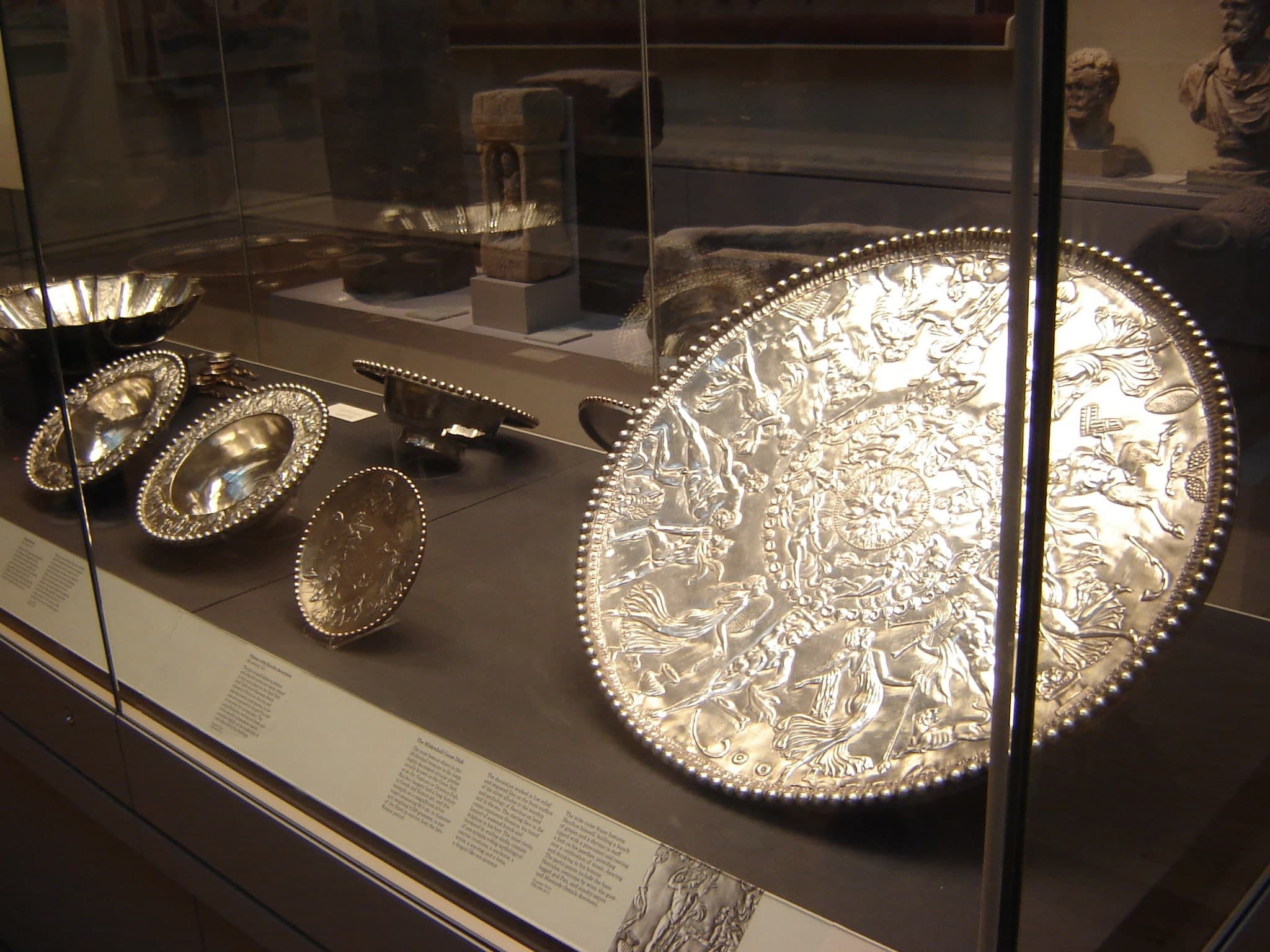
The centrepiece is a circular platter more than sixty centimetres across and weighing over eight kilograms of solid silver. The face at the centre is an Oceanus mask — the god of the encircling sea — with dolphins in his beard and seaweed in his hair. Around him runs a frieze of nymphs and sea creatures. This was display silver, not kitchenware: too heavy to pass comfortably, too elaborate to risk in daily use. It announced wealth and taste to anyone who saw it.
Spoons carry Christian monograms
Several of the spoons in the hoard are inscribed with the chi-rho, the monogram formed from the first two letters of Christ's name in Greek. The combination of pagan imagery on the Great Dish and Christian symbols on the spoons suggests the collection was assembled over time, or that its owner saw no contradiction in using both. Fourth-century Britain was a mixed landscape: Christianity was legal and spreading, but older practices had not vanished.
It was not reported for years
The silver was ploughed up in 1942, but not declared immediately. The finder, a farmer, gave no clear explanation for the delay. Whether he misunderstood the law, hoped to avoid attention during wartime, or had other reasons is not recorded. The gap meant the exact findspot and any archaeological context were lost. What survives is the hoard itself, not the circumstances of its burial.
The story
In 1942, a ploughman working a field at West Row, near Mildenhall in Suffolk, turned up pieces of Roman silver. What came out of the ground was a collection of thirty-four objects: plates, bowls, goblets, ladles and spoons, all made in the fourth century CE. The centrepiece was a circular dish more than sixty centimetres across, weighing over eight kilograms of worked silver, its surface covered with figures from classical mythology.
The find was not reported immediately. The farmer who owned the land gave no clear account of why he waited, and the delay meant that any archaeological record of how the hoard was buried, and what else might have been nearby, was lost. By the time investigators reached the site, the exact location within the field could not be pinpointed, and no controlled excavation was possible. What remains is the silver itself, and the fact that someone, sixteen centuries ago, put it in the ground and never came back for it.
The Great Dish is the most elaborate piece. At its centre is a bearded face with dolphins twisting through the beard and seaweed woven into the hair: an Oceanus mask, representing the god of the encircling sea. Around the mask runs a frieze of dancing figures — nymphs, satyrs, maenads — and beyond them a border of scallop shells. The workmanship is detailed and confident, the figures modelled in relief and chased with fine lines. This was not everyday tableware. It was display silver, made to impress and too heavy to pass easily from hand to hand.
The rest of the hoard includes smaller plates, bowls with fluted sides, two-handled goblets, long-handled ladles and a set of spoons. Several of the spoons carry the chi-rho monogram — the first two letters of Christ's name in Greek, overlaid to form a symbol — scratched or stamped into the silver. The combination of pagan imagery on the Great Dish and Christian symbols on the spoons suggests the collection was not made all at once, or that its owner saw no tension between the two. Fourth-century Britain was legally Christian, but older practices persisted, and a wealthy household might own objects that reflected both.
Why the hoard was buried is not known. Silver hoards from this period are found across the former Roman provinces, and they cluster in the fourth and fifth centuries, when the western empire was under pressure. Some were buried in haste and never recovered because the owner died, fled or could not return safely. Others may have been hidden as a precaution and then forgotten. The Mildenhall hoard was not scattered or damaged, which suggests it was buried carefully, not dumped in panic. But without a record of the burial context, the reason remains a matter of inference.
The collection is now in the British Museum. Replicas are displayed in Mildenhall.
Why it mattered then
Silver was wealth in a portable, divisible form. It could be melted down, weighed and used as currency, or kept as tableware and displayed to guests. A collection like this represented years of accumulated value, and it was not casually abandoned. The fourth century was a period of instability in the Roman province of Britain. The province was raided from the sea and the north, and central authority weakened as the empire's resources were stretched across multiple frontiers. Wealthy households had reason to bury valuables, and many did. The concentration of hoards from this period suggests people expected trouble, and that in many cases they were right: the silver stayed in the ground because the owner never returned. The mix of pagan and Christian imagery in the hoard reflects the religious transition underway. Christianity became legal across the empire in the early fourth century, and by mid-century it was the favoured religion of the imperial court. But older practices did not vanish overnight, especially in private life. A household could own a dish decorated with Bacchic revels and spoons marked with Christian symbols, and use both. The tension modern viewers might see between them was not necessarily felt at the time.
Why it matters now
The Mildenhall hoard is evidence of what the Roman province of Britain looked like in its final century: prosperous enough to own elaborate silver, unstable enough to bury it. The hoard is also a reminder of how much context is lost when an object is removed without record. The exact findspot, the depth, the orientation, any associated structures or other finds — all of that information was gone by the time the silver was declared. What remains is the material itself, which is significant, but incomplete. The delay in reporting also raises questions about the laws requiring finders to declare valuable objects. The law existed to ensure historically important finds reached museums rather than the scrap market, but it depended on people understanding their obligations and acting on them. The Mildenhall case became a test of how those laws worked in practice, and prompted discussion about whether the system was clear enough and whether finders had sufficient incentive to comply. The hoard is now one of the most visited Roman collections in Britain, and replicas allow the local area to display the find as well. It is a rare survival: most Roman silver was melted down long ago, either in antiquity or later. What was buried at Mildenhall stayed buried, which is why it can be seen now.
The surprising detail
The finder kept the discovery quiet for years after 1942, and never gave a clear explanation for the delay. Whether he misunderstood the law, feared bureaucracy during wartime, or had other motives is not recorded. The delay meant the findspot within the field could not be precisely located later, and no controlled excavation was ever carried out. The archaeological context — how deep it was buried, whether it was in a container, what else might have been nearby — was lost. The silver survived sixteen centuries underground, only to lose its context in the twentieth.
What is disputed
The circumstances of the burial are not known. Silver hoards from this period are common across the former Roman provinces, and many date to the fourth and fifth centuries when the western empire was under pressure. The Mildenhall hoard was buried carefully, not scattered, which suggests it was hidden with the intention of recovery. But whether it was buried in haste during a raid, hidden as a precaution during a period of instability, or concealed for some other reason cannot be determined from the objects alone. The delay in reporting the find, and the lack of any controlled excavation, means the archaeological context that might have clarified the circumstances was lost.
How it got here
The hoard was found in 1942 by a ploughman working a field at West Row, near Mildenhall in Suffolk. It was not reported immediately. Under the laws in force at the time, finds of precious metal hidden with the intention of recovery belonged to the Crown, and finders were required to declare them. An inquest was held, and the hoard was declared treasure. The British Museum acquired it, and the finder and landowner received a reward based on its assessed value. Replicas are displayed at the museum in Mildenhall, allowing the local area to present the find alongside the original in London.
Remember this
Thirty-four pieces of fourth-century Roman silver, buried carefully and never reclaimed — and not reported for years after the plough turned them up.
Test yourself
Why does the combination of pagan imagery on the Great Dish and Christian symbols on the spoons not necessarily indicate a contradiction for the original owner?
Because the religious landscape of fourth-century Britain was in transition, and private households did not always mirror the official shift in the same way or at the same speed. Christianity was legal and increasingly favoured, but older practices and imagery persisted, especially in domestic settings. A wealthy owner might commission or inherit pieces at different times, or simply see no conflict in using both. The tension modern viewers read into the pairing may reflect later assumptions about religious exclusivity more than the lived experience of the period. Objects made for different purposes — a display dish for entertaining, spoons for personal use — could carry different symbolic registers without troubling the household that used them.
Go deeper
Image: I, Estel. Licence: CC BY-SA 3.0. Source.