III · THE WORK · ART HISTORY
Bronze Soldier of Tallinn
▶ Listen · narrated
The statue has not changed. The uniform, the bronze, the bowed head are the same. What shifted was the ground beneath it — literally and politically.
At a glance
- Sculptor
- Enn Roos
- Unveiled
- 22 September 1947
- Material
- Bronze figure, dolomite wall
- Current location
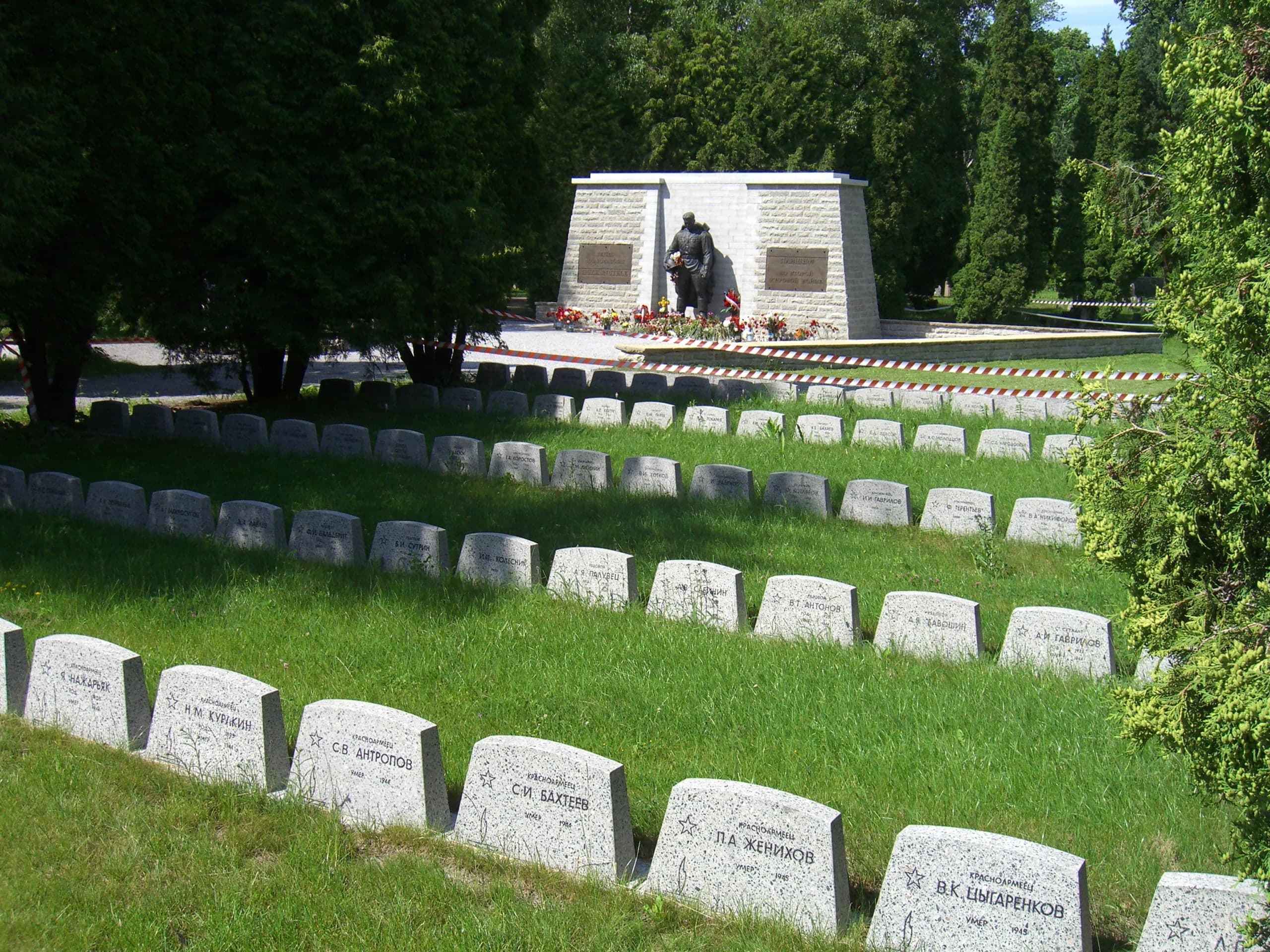
- Defence Forces Cemetery of Tallinn
- Original location
- Tõnismäe, central Tallinn
Look closer
The uniform
The figure wears the field tunic and helmet of a Red Army soldier from the Second World War. The details are legible: the belt, the collar, the way the fabric falls. Roos has not idealised the costume into something timeless. It is a specific uniform from a specific army, and that specificity is what makes the statue's meaning contestable. A generic soldier might honour all the dead; this one honours soldiers who fought under a particular flag, and for some viewers that flag represents liberation, while for others it represents occupation.
The posture
The soldier stands with his head bowed, not in triumph but in what might be grief or exhaustion. His arms hang at his sides. There is no weapon, no raised fist, no forward stride. The pose is passive, commemorative rather than celebratory. Whether this restraint was a choice by Roos or a convention of Soviet war memorials is not recorded, but the result is a figure that does not assert victory so much as mark loss.
The dolomite wall
Behind the bronze figure stands a structure made of dolomite, a sedimentary rock quarried in Estonia. The wall anchors the statue and frames it, providing mass and permanence. Dolomite is a local material, pale and grainy, and its use connects the monument to the ground it stands on. The combination of imported iconography — the Red Army uniform — and local stone creates a tension in the monument's materials that mirrors the tension in its meaning.
The story
The Bronze Soldier was unveiled on 22 September 1947, three years to the day after Soviet forces entered Tallinn. Enn Roos made a two-metre bronze figure of a soldier in Red Army uniform, standing with bowed head, and placed it against a dolomite wall in a small park on Tõnismäe, a low hill in central Tallinn. Beneath the monument lay a burial site: the remains of Soviet soldiers, reburied there in April 1945.
The monument was originally called the Monument to the Liberators of Tallinn. That title encoded a particular interpretation of the war: that the Red Army had freed Estonia from German occupation. For many Estonians, however, the arrival of Soviet forces in 1944 was not liberation but the return of an occupying power. The same event could be read as rescue or as conquest, depending on which side of that divide you stood.
The statue itself does not resolve this. It is a soldier, bowed, unarmed, commemorative. It does not celebrate; it marks. But the uniform it wears and the inscription it bore made it a Soviet monument, and as the decades passed, the Bronze Soldier became a focal point for the political and ethnic divisions within Estonia. For Russian-speaking residents, many of whom had arrived in Estonia during the Soviet period, it was a site of remembrance for those who had died fighting fascism. For many ethnic Estonians, it was a symbol of occupation.
In 2007, the Estonian government decided to move the monument. The statue and the dolomite wall were relocated from Tõnismäe to the Defence Forces Cemetery of Tallinn, on the outskirts of the city. The soldiers' remains were exhumed, identified where possible, and reburied in the cemetery. Some were claimed by relatives and reburied elsewhere in the former Soviet Union.
The relocation was not quiet. It led to two nights of rioting in Tallinn, attacks on the Estonian embassy in Moscow, and a wave of cyberattacks on Estonian government and media websites. The disputes were not about the statue's aesthetic qualities or Roos's skill as a sculptor. They were about what the monument meant, who had the right to decide that meaning, and whether moving it from a central square to a military cemetery was an act of respect or erasure.
The Bronze Soldier now stands in the Defence Forces Cemetery, still above graves, still commemorating the war dead. It has the same posture, the same materials, the same maker. What changed was its location, and with that, its context. A monument in a city square is a public claim about history. A monument in a military cemetery is a site of private mourning. The difference between those two settings is what the riots were about.
Why it mattered then
The monument was commissioned in 1947, during the early years of Soviet control over Estonia. The war had ended two years earlier, and the Soviet Union was consolidating its territorial gains. Monuments like the Bronze Soldier served a dual function: they honoured the dead, and they asserted the legitimacy of Soviet rule. By calling it the Monument to the Liberators of Tallinn, the inscription framed the Soviet military presence as a rescue rather than an occupation. For a population that had lived through German occupation and then Soviet control, the monument was not neutral. It was a statement about who had won and what the official story would be. The choice to place it on Tõnismäe, a visible site in the city centre, reinforced that statement. It was not tucked away; it was planted where people would see it daily.
Why it matters now
The Bronze Soldier remains a test case for how societies handle contested memory. The same object can mean liberation to one group and occupation to another, and neither meaning is erased by moving the statue or changing its name. Estonia's decision to relocate the monument in 2007 was an assertion of sovereignty — the right of an independent state to decide what stands in its public squares — but it also revealed how raw the historical divisions remained, more than fifteen years after the collapse of the Soviet Union. The riots, the cyberattacks, and the diplomatic tensions showed that the monument's meaning was still being fought over, not as history but as present-day politics. For students of public memory, the Bronze Soldier is a case study in what happens when a monument outlives the regime that built it, and when the population looking at it no longer agrees on what it represents.
The surprising detail
The relocation of the Bronze Soldier in 2007 triggered a series of cyberattacks on Estonian government, media, and banking websites. The attacks were among the most sustained and visible examples of politically motivated digital disruption at the time, and they drew international attention to the vulnerability of networked infrastructure. Estonia responded by developing some of the most advanced cyber defence capabilities in Europe, and the incident is now cited in discussions of state-sponsored cyberwarfare. A statue of a soldier, moved from one part of a city to another, became the catalyst for a shift in how governments think about digital security.
What is disputed
The reference material does not record Enn Roos's intentions in designing the statue, nor does it document the decision-making process behind the original placement or the choice of materials. The reasons for the soldier's passive posture and the use of dolomite are not explained in the sources provided. Interpretations of the monument's meaning are multiple and contested, and no scholarly consensus is cited.
Remember this
The Bronze Soldier has not changed. What changed was the ground it stands on, and who decides what that ground means.
Test yourself
The monument was originally called the Monument to the Liberators of Tallinn, and later renamed the Monument to the Fallen in the Second World War. Why does that change in wording matter, even though the statue itself was not altered?
Because the first title asserts a political interpretation — that the Red Army liberated Tallinn — while the second title is neutral about who the fallen fought for or what their arrival meant. 'Liberators' frames the Soviet military presence as rescue, which many Estonians reject because they experienced it as occupation. 'Fallen in the Second World War' removes that claim and turns the monument into a more general commemoration of war dead, without specifying whether their role was liberation or conquest. The statue did not change, but the language around it shifted from a political statement to a less contested acknowledgment of loss. That shift reflects Estonia's move from Soviet control to independence, and its attempt to create a public memory that does not require one group to accept the other's version of history.
Go deeper
Image: gette from Stavanger, Norway, CC BY 2.0. Licence: CC BY 2.0. Source.