III · THE WORK · ART HISTORY
Hermannsdenkmal
▶ Listen · narrated
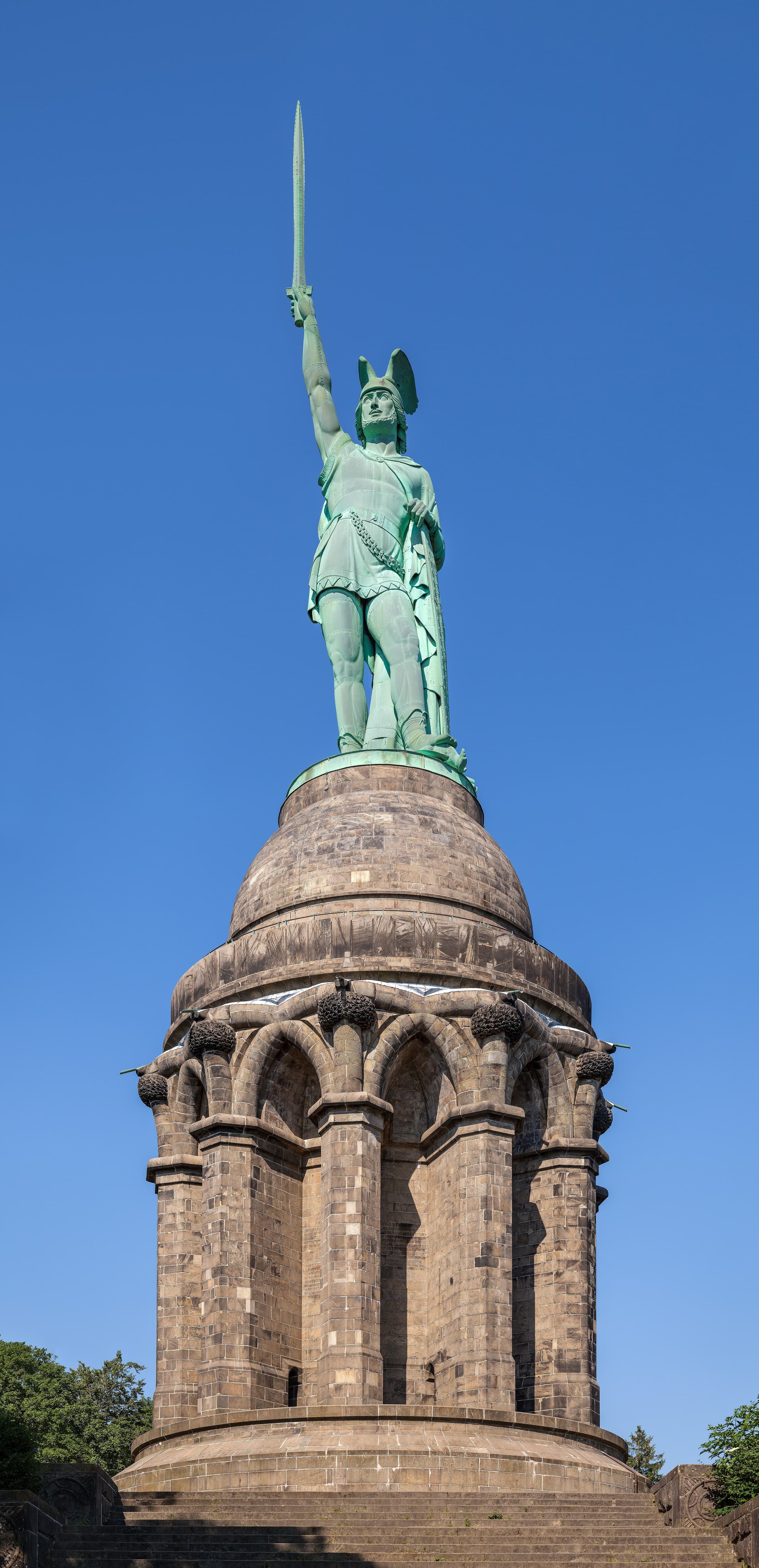
A twenty-five-metre warrior stands in the Teutoburg Forest, sword raised, marking a victory over Rome. The monument took thirty-seven years to build, and its location may be wrong.
At a glance
- Sculptor
- Ernst von Bandel
- Completed
- 1875
- Material
- Iron
- Height
- 24.82 metres
- Location
- Teutoburg Forest, North Rhine-Westphalia
Look closer
The raised sword
The figure holds a sword aloft in his right hand, the blade pointing skyward. This is the gesture the monument was designed around: not a warrior in the act of fighting, but one who has already won, declaring victory. The sword is not drawn back to strike or held at rest. It is raised as a signal, as though the battle is over and the gesture is for those watching from a distance.
The iron construction
The monument is built of iron, not stone. This was a deliberate choice, made at a time when iron construction was associated with modern industry and engineering. The material means the statue is a fabricated object, assembled from cast and wrought components, rather than carved. The iron surface would have read as contemporary, even industrial, against the forested hillside — a monument to an ancient victory built using the materials of the present.
The circular rampart
The monument stands inside the remains of a circular earthwork, a rampart that was already there when construction began. This older fortification — its origin and date not recorded in the available material — provided a ready-made enclosure, a bounded space that separated the monument from the surrounding forest. The statue was placed within something that looked like it might have been defensive, though whether the rampart had any connection to the events being commemorated is not established.
The story
The Hermannsdenkmal stands on a forested hill in the Teutoburg Forest, southwest of Detmold. It is a colossal statue, nearly twenty-five metres tall, built of iron. The figure it represents is Arminius, a war chief of the Cherusci, a leader who defeated Roman forces in the year 9 in what is known as the Battle of the Teutoburg Forest. The monument commemorates that victory. Arminius is referred to in German as Hermann, and the monument takes its name from that.
The statue was the work of Ernst von Bandel, who began construction in 1838 and completed it in 1875. That is thirty-seven years, a span that took Bandel from the planning stages into old age. The monument is a tower as well as a statue: the figure stands on a cylindrical stone pedestal, and inside that pedestal is a structure with internal spaces. The combined height of pedestal and figure is recorded in the material as 24.82 metres for the statue itself, with an additional measurement given as 28.62 centimetres, though what that smaller dimension refers to is not specified.
The location was chosen because it was believed, when the monument was built, to be near the site of the battle it commemorates. The hill, called the Grotenburg — also referred to as the Teutberg or Teut — is densely forested, and the monument stands within the remains of a circular rampart. That earthwork was already present; the statue was placed inside it. The combination of forest, hill and ancient-looking earthwork made the site feel appropriate for a monument to a battle fought in a forest.
But the location is now thought to be wrong. Experts consider it more likely that the battle took place near Kalkriese, roughly one hundred kilometres to the northwest. The material does not say when this reassessment occurred, or how certain the Kalkriese identification is, only that it is now considered more likely. The monument, then, stands in a forest that resembles the battle site, but probably is not it.
The figure holds a sword raised in his right hand. The gesture is one of declaration, not combat. The statue represents a moment after the fighting, a victory announced. The choice of iron as the material, rather than stone or bronze, connects the monument to the industrial capacity of the period in which it was built. Iron construction was modern, associated with engineering and manufacture. A statue built of iron in 1875 carried those associations with it, even when representing an event from antiquity.
Why it mattered then
The monument was built during a period when the question of what it meant to be German was urgent and unresolved. The statue commemorates a victory over Rome, a moment when Germanic tribes defeated an imperial power. That victory was framed, in the nineteenth century, as an early assertion of German identity and resistance to foreign domination. The figure of Arminius — Hermann — became a symbol of unity and defiance, and the monument was intended to make that symbol visible and permanent. The long construction period, from 1838 to 1875, spans decades of political change. The monument's meaning shifted as the political context around it changed. The statue was not built by a government or a state commission; it was a private project, but one that drew on public subscription and was understood to have national significance.
Why it matters now
The Hermannsdenkmal remains a monument to a version of the past that was constructed, not discovered. The battle it commemorates did happen, but the monument does not stand where it happened, and the figure it represents has been made to carry meanings that were assigned to him long after his death. The statue is a reminder that monuments are built in the present, for present purposes, even when they claim to honour the past. The location error is instructive. The site was chosen because it felt right — forested, hilly, enclosed by an old earthwork — and because the belief that the battle had occurred there was widespread at the time. The monument now stands as evidence of how a place can be made to mean something through assertion and construction, even when the historical claim is uncertain. The statue has not been moved. It remains where it was built, marking a site that was believed to be significant, whether or not it was.
The surprising detail
The monument took thirty-seven years to complete, a span that saw Ernst von Bandel grow old with the project. Construction began in 1838 and was not finished until 1875. The result is that the monument belongs both to the period when it was conceived and to the quite different period when it was finally raised. The statue that was planned in the 1830s was completed decades later, and the meaning it carried had changed with the years.
What is disputed
The location of the Battle of the Teutoburg Forest is genuinely disputed. The monument was built in the Teutoburg Forest because that location was believed, in the nineteenth century, to be the battle site. Current expert opinion considers Kalkriese, about one hundred kilometres to the northwest, a more likely location, but the material does not specify when this view became dominant or whether it is universally accepted. The monument remains where it was built, and the discrepancy between commemorative site and probable historical site is itself part of what the monument now means.
Remember this
A monument built to mark a battle that probably happened elsewhere, and completed in a different Germany from the one in which it was begun.
Test yourself
Why does the fact that the monument is built of iron, rather than stone or bronze, matter to how it would have been understood when it was completed?
Because iron, in 1875, was the material of modern engineering and industry, not of traditional sculpture. Stone and bronze were associated with permanence and classical tradition; iron was associated with railways, bridges, and the industrial capacity of the modern state. A colossal statue built of iron carried those associations with it. It presented an ancient subject using a contemporary material, which meant the monument was understood as both a commemoration of the past and a demonstration of present strength. The choice of material connected the victory over Rome to the industrial and military power of the period in which it was built, making the monument a statement about continuity between ancient resistance and modern capability.
Go deeper
Image: Thomas Wolf, www.foto-tw.de. Licence: CC BY-SA 3.0 de. Source.