III · THE WORK · ART HISTORY
The Blind Leading the Blind
▶ Listen · narrated
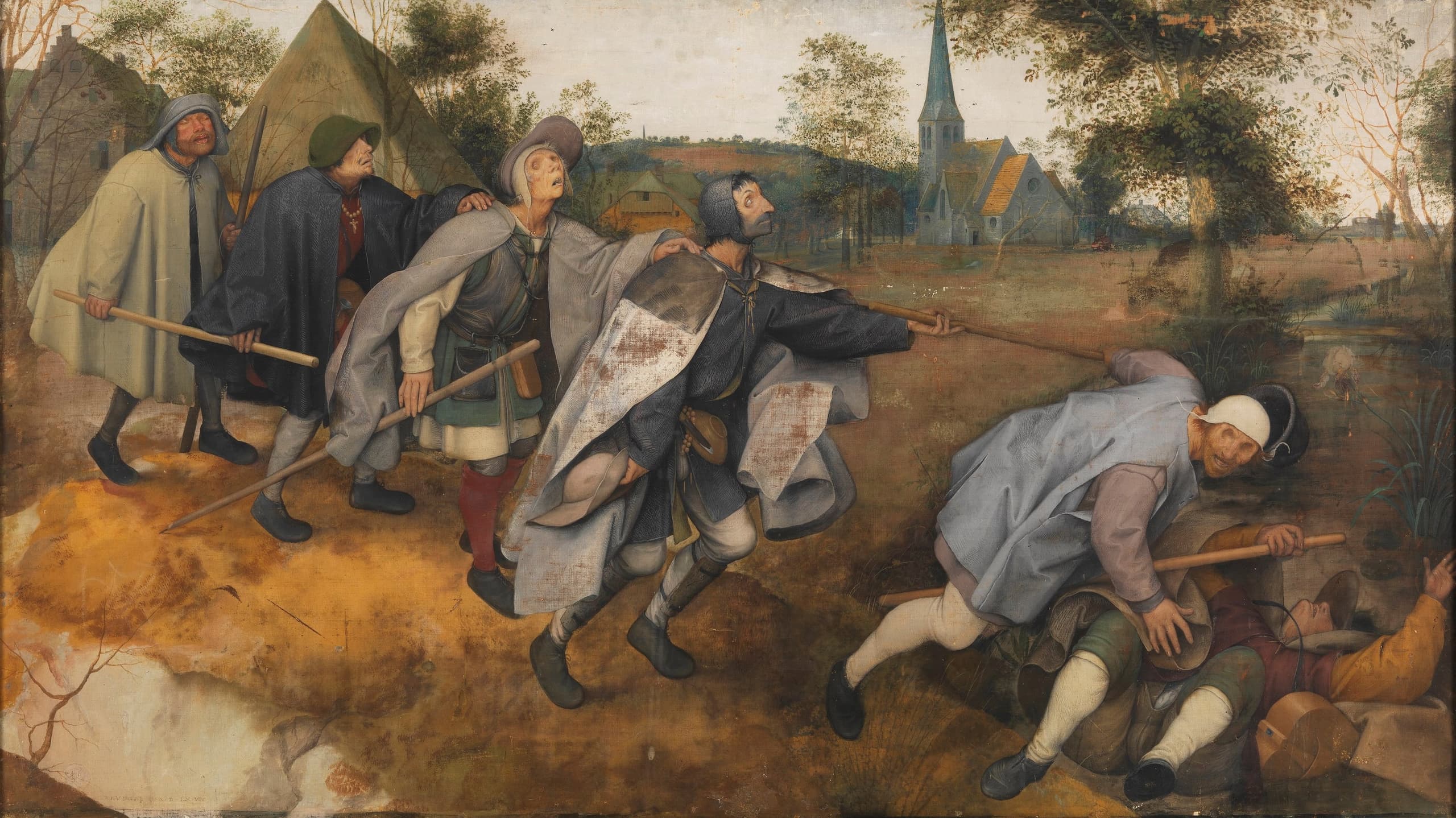
A painting made in 1568 shows six blind men walking in single file, holding on to one another. The leader is in a ditch.
At a glance
- Artist
- Pieter Bruegel the Elder
- Date
- 1568
- Material
- Tempera on canvas
- Dimensions
- 86 × 154 cm
- Collection
- Museo di Capodimonte, Naples
Look closer
Each figure has a different eye condition
Bruegel did not paint generic blindness. The man at the front has eyes that are clouded white — corneal leukoma, an opacity of the cornea. Another has shrunken globes. A third has no eyes at all, only closed lids. The precision suggests Bruegel observed these conditions directly, perhaps in the streets of Brussels or Antwerp, and recorded what he saw. The variety also means that each face reads differently: one tilted back, another forward, each adjusting to a different loss.
The diagonal pulls your eye from right to left
The six men form a descending line that runs from the upper right corner down toward the lower left. The composition is not symmetrical or stable; it tips. The man at the back still stands upright. The second leans slightly. The third more so. By the fifth figure the body is lurching, and the sixth — the leader — is on his back in the water. The diagonal does not just describe the fall; it enacts it. Your eye follows the same downward path the men are taking.
They hold their heads tilted upward
Most of the men lift their chins and tilt their faces toward the sky. This is not a gesture of hope or prayer. It is a practical adjustment: without sight, they rely on hearing and perhaps the sensation of sun or wind on the skin. Raising the head opens the ears to sound from further away and exposes more of the face to environmental cues. Bruegel has painted a compensatory behaviour, something a sighted person might not notice but that makes immediate sense once you consider how the men navigate.
The story
The painting takes its subject from a Biblical parable. In it, Jesus warns against following false teachers, saying that if the blind lead the blind, both will fall into a ditch. Bruegel has turned the metaphor into a literal event, unfolding across a rural landscape.
Six men walk in single file, each resting a hand on the shoulder or staff of the man in front. They wear the plain tunics and soft caps of peasants or beggars. Their staffs are simple wooden poles. The leader is on his back in a shallow stream, his legs in the air, his staff still in his hand. The second man is stumbling forward, his foot catching on the edge of the ditch, his body beginning to tip. The third is losing his balance. The fourth and fifth are still walking but leaning at angles that will not hold. The sixth, at the back, has not yet felt the disruption, but the chain of contact means he will.
The landscape is quiet and specific. Behind the men is a village church with a stepped gable and a small spire. The building has been identified as the church of Sint-Anna-Pede, a village that existed near Brussels. The fields are green, the sky pale. There are trees, a few low buildings, a path. Nothing in the setting is dramatic. The disaster is small-scale, rural, unheroic.
Bruegel painted the work in tempera on canvas. Tempera — pigment mixed with egg yolk or another binder — dries quickly and produces a matte surface. It was less commonly used for large paintings in the sixteenth century than oil, which allowed for slower blending and richer colour. The choice may have been practical, or it may have been deliberate, giving the picture a flatter, more immediate finish.
The painting was made in 1568, the year before Bruegel died. It is now in the Museo di Capodimonte in Naples. At some point it also passed through the Munich Central Collecting Point. How the painting came to be there, and when it was returned to Naples, is not detailed in the surviving records.
Bruegel's son, Pieter Brueghel the Younger, made a larger copy of the composition. Other versions exist, though their attributions and relationships to the original are disputed. The image has been reproduced widely and referenced in poetry and fiction, but those responses are later interpretations, not part of the painting's original context.
Why it mattered then
The painting was made during a period of violent repression in the Spanish Netherlands. In 1567, the Spanish crown established the Council of Troubles, a tribunal tasked with suppressing Protestantism and punishing resistance to Spanish rule. The council ordered mass arrests and executions. Thousands were tried; hundreds were killed. Bruegel lived and worked in this environment. Whether the painting refers to it directly is uncertain. Some interpreters have read the inclusion of the church as a critique of Catholic authority — the blind following the church into disaster. Others have read it as a critique of Protestantism, with the church representing true doctrine and the blind men those who have turned away from it. Both readings assume the painting is a political allegory, but neither can be confirmed from the image alone or from surviving records of Bruegel's intentions. What is clear is that the painting has a bitter tone. The men are not villains or fools; they are vulnerable, dependent on one another, and the system they have built to survive — holding on, following the leader — has failed them. The fall is not sudden or spectacular. It is incremental, almost gentle, and inevitable. That quality — of a disaster that unfolds slowly and cannot be stopped — may have resonated in a moment when the political situation was deteriorating and no resolution was in sight.
Why it matters now
The painting is direct in a way that makes it hard to look away from. The men are not symbolic figures at a distance; they are close, specific, caught in the middle of falling. You see the moment of imbalance before the collapse, and you know what is coming. The composition gives you no place to rest your eye except on the progression of the fall. That directness has made the image durable. It has been borrowed, copied, and referenced across centuries, not because it is reassuring or beautiful, but because it describes a particular kind of failure: the failure that comes from trust, from following, from the assumption that someone ahead of you knows the way. The metaphor is older than Bruegel — it comes from the Biblical parable — but his version is the one that fixed it in visual memory. The painting also matters because of what it records about observation. Bruegel did not generalise. He painted six different men with six different conditions, each adjusting in a different way. That level of attention, applied to people who were often invisible in the art of the period, is rare. The men are not idealised or made pathetic. They are painted as they would have appeared, doing what they would have done. The painting is a metaphor, but it is also a document.
The surprising detail
The painting passed through the Munich Central Collecting Point at some point in its history. The records do not specify when or why, and the painting is now in Naples. The gap means there is a passage in the work's movement between institutions that is not fully accounted for in the surviving documentation.
What is disputed
The interpretation of the church in the background is genuinely disputed. Some scholars read its presence as an anti-Catholic statement, others as a pro-Catholic one, and still others argue the painting was not intended as a political allegory at all. No documentary evidence settles the question. The identification of the church as Sint-Anna-Pede is based on architectural comparison, but that does not clarify what its inclusion was meant to signify.
Remember this
Bruegel painted blindness not as a single condition but as six different ones, each requiring a different adjustment.
Test yourself
The painting shows a Biblical parable being acted out in a specific landscape, with a village church visible in the background. Why might the decision to include that church have made the painting harder to interpret in 1568?
Because 1568 was a year of violent religious conflict in the Spanish Netherlands, and a church in a painting could be read as a symbol of Catholic authority, Protestant dissent, or true doctrine, depending on who was looking. The Council of Troubles, established the previous year, had ordered mass arrests and executions to enforce Spanish rule and suppress Protestantism. In that context, a painting showing blind men and a church could be taken as a critique of Catholic leadership, a critique of those who had abandoned the church, or no political statement at all. The image does not resolve the question, and no record survives of what Bruegel intended. That ambiguity may have been protective, or it may have been deliberate, but it means the painting could be claimed by multiple sides of a conflict that was still unfolding.
Go deeper
Image: Pieter Brueghel the Elder, Public domain. Licence: Public domain. Source.