III · THE WORK · ART HISTORY
Luncheon of the Boating Party
▶ Listen · narrated
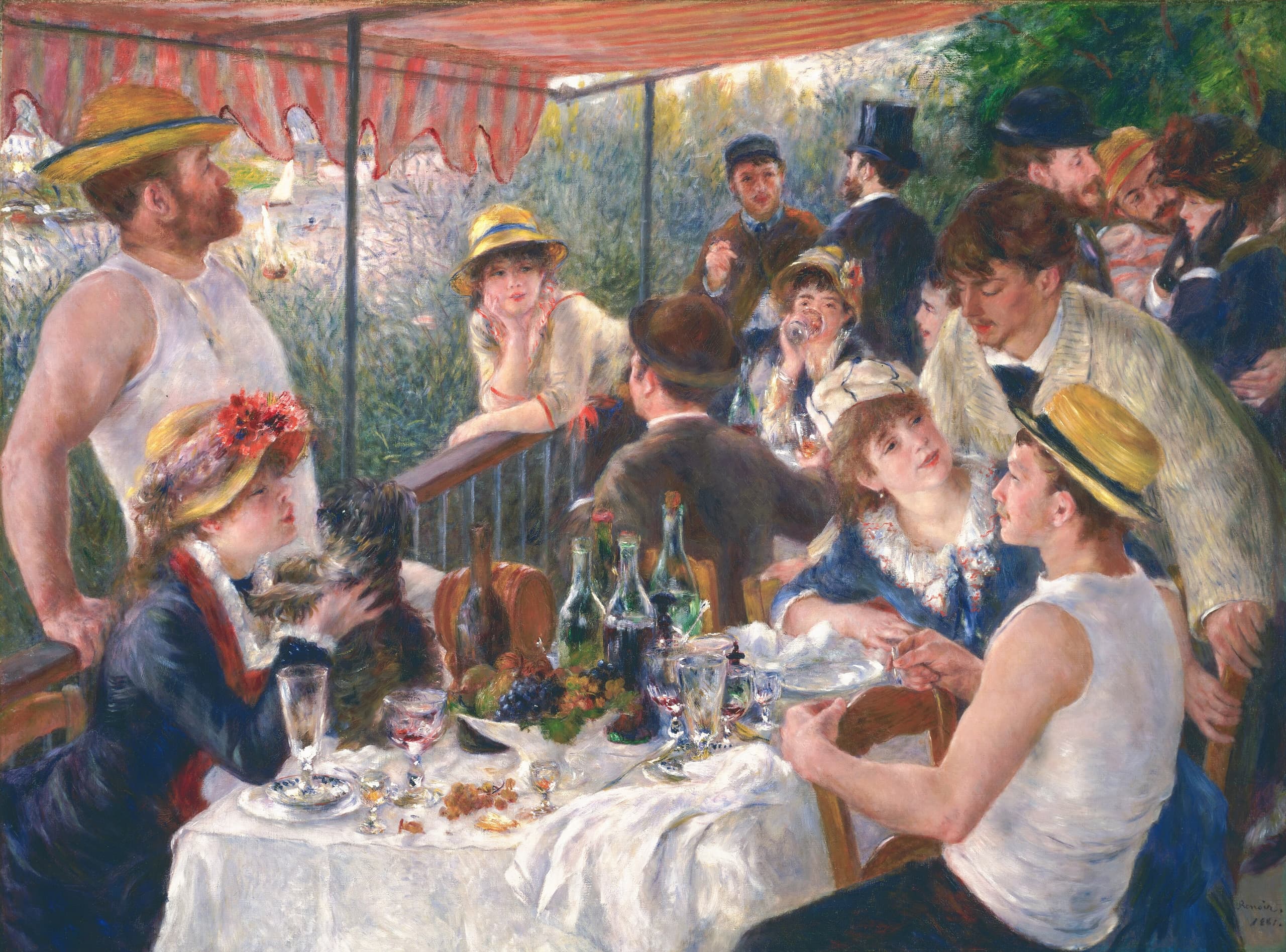
A group lunch painted so that every person is lit differently, the cloth responds to the air, and the crowd feels as though it might stay or leave.
At a glance
- Artist
- Pierre-Auguste Renoir
- Date
- 1880
- Medium
- Oil paint on canvas
- Dimensions
- 130.2 × 175.6 cm
- Collection
- The Phillips Collection, Washington
Look closer
The woman with the dog
A woman in a dark dress and pale straw hat leans on the railing at lower left, holding a small terrier to her face. The dog's fur is rendered with short, separate strokes that let the canvas show through. Her dress is painted wet-on-wet in places, the pigment blurred where sleeve meets bodice. She is the most contained figure in the composition: upright, self-enclosed, looking only at the animal. Everyone else is turning, leaning, talking across the table.
The awning overhead
The striped fabric runs across the top third of the canvas, filtering the light that falls on the figures below. Renoir has painted it with loose, directional strokes that suggest folds and tension without describing them precisely. The awning establishes that this is a covered terrace, and it accounts for the particular quality of the light: diffused, warm, but still strong enough to cast shadows on faces and glassware. It also introduces a horizontal structure that anchors the otherwise informal scatter of figures.
The still life at lower right
The corner of the table holds a cluster of bottles, glasses, a basket of fruit. The glass surfaces catch light as small bright marks; the fruit is suggested with quick touches of colour. This is the most traditional element in the painting — a still life within a figure composition — but it is painted with the same fluidity as the people. The bottles are not outlined. The grapes are not individually rendered. Everything is described by the behaviour of light on its surface, not by drawing.
The story
Renoir painted fourteen people on the balcony of a restaurant, seated and standing around a table still set with the remains of a meal. The setting is outdoors but covered, under a striped awning that diffuses the daylight. Figures occupy the foreground in conversation, leaning on the rail, holding glasses. Others are grouped at the rear, some standing, some seated, all engaged with one another or looking outward. The composition is dense but not crowded: each figure is given enough space to be distinct, and the eye can move through the scene without losing track of who is where.
The painting is structured by light. The awning filters the sun, and Renoir has used that filtered light to model faces, clothing, and objects with a warmth that is consistent across the canvas but not uniform. Figures in the foreground receive more direct illumination; those at the back are cooler, slightly more shadowed. The light is not static. It flickers — a term used to describe the way Renoir's brushwork suggests movement in the air, the slight shifts in brightness that occur when sunlight passes through fabric or reflects off a moving surface. This is not an effect of blurring or softening edges. It is achieved through the placement of individual strokes, each one a distinct touch of pigment that registers a specific moment of colour and light.
The brushwork varies across the canvas. In some areas — the woman's dress at lower left, the man's jacket at lower right — the paint is applied wet-on-wet, colours blending where they meet. In others — the awning, the background foliage — the strokes are separate, laid down so that the weave of the canvas remains visible between them. This variation is not decorative. It is how Renoir conveys the different textures and surfaces in the scene: the weight of fabric, the transparency of glass, the softness of skin, the density of foliage. The technique is consistent with the approach associated with Impressionism, where the goal is to record the appearance of things as they are seen under particular conditions of light, rather than to describe their form through outline or modelling.
The figures are not posed in the formal sense. They are arranged, but the arrangement suggests a moment that could dissolve: a conversation that might end, a figure who might stand and leave. This sense of informality is reinforced by the way people are distributed across the depth of the scene. There is no single focal point. The composition invites the eye to move, to notice the woman with the dog, then the man in the straw hat leaning back, then the pair at the rear engaged in conversation. It is a painting of a group, but it does not present the group as a unified subject. It presents them as individuals who happen to be in the same place at the same time.
The painting was exhibited in 1882. It was acquired by a dealer and later purchased for The Phillips Collection, where it has remained. The work is oil on canvas, 130.2 by 175.6 centimetres. It is an example of genre art — a scene of everyday life — executed with the techniques and concerns of Impressionism.
Why it mattered then
The painting was shown in 1882, at a moment when the approach it represents — painting everyday subjects with attention to the effects of light rather than to narrative or allegory — was still being argued over. The exhibition in which it appeared was one in a series organised by artists working outside the official system, and the work was noticed. Three critics singled it out in their reviews, though the criteria they used are not recorded in detail. What the painting offered was a demonstration that a scene with no historical or literary subject, no dramatic event, no moral lesson, could sustain a large canvas and a complex composition. The subject is a lunch. The figures are not doing anything that requires explanation. They are eating, drinking, talking, resting. The painting treats this as sufficient. It does not elevate the scene by making it symbolic or picturesque. It records it as a specific instance of light, colour, and human presence, and it does so with a technical confidence that makes the lack of a grander subject seem deliberate rather than evasive. The work also demonstrated the flexibility of the approach associated with Impressionism. The varied brushwork, the attention to how light behaves on different surfaces, the willingness to leave some areas suggested with quick touches while working others wet-on-wet — these were methods that had been developed in landscape painting and were here applied to a crowded interior with multiple figures. The result was a painting that felt immediate, as though the moment it depicted was still unfolding, without sacrificing the structure or coherence expected of a large composition.
Why it matters now
The painting remains a clear example of how a work can be both carefully constructed and apparently spontaneous. The arrangement of figures, the distribution of light, the variation in brushwork — all of these are the result of deliberate choices, made over the course of the painting's execution. Yet the effect is one of ease, of a scene captured rather than assembled. This balance between control and informality is part of what makes the work continue to hold attention. It also offers a record of a particular way of seeing. The decision to treat light as the primary subject, to let the description of surfaces emerge from the behaviour of colour rather than from outline or modelling, represents a shift in what painting was understood to be for. The work does not tell a story. It does not instruct. It does not memorialise. It presents a moment, and it does so in a way that insists the moment is worth sustained looking. That insistence — that ordinary experience, rendered with attention to how it appears, is a sufficient subject for art — has become so widely accepted that it is easy to forget it was once a position that required defending. The painting is also a reminder that Impressionism was not a single set of techniques applied uniformly. Renoir's handling here is distinct from that of his contemporaries. The fluidity of the brushwork, the warmth of the palette, the density of the composition — these are choices specific to this work and this artist. The movement was not a style in the sense of a fixed set of rules. It was a shared interest in certain problems, and each artist solved those problems differently.
The surprising detail
The painting was purchased in 1923 for $125,000, a sum that represented a significant outlay at the time. The buyer had pursued the work for a decade before acquiring it. The purchase was not made by a museum or a public institution but by a private collector, who later established the collection that now holds the painting. The sum paid, and the length of the pursuit, indicate that the work was already understood to be of considerable importance within two decades of the artist's death, and that its value was recognised not only by scholars or critics but by collectors willing to commit substantial resources to acquiring it.
Remember this
Renoir painted a lunch as though the light falling on it were the subject, not the people or the occasion.
Test yourself
The painting is often described as informal or spontaneous, yet it is a large canvas with a complex arrangement of figures. What technical evidence suggests that the apparent spontaneity was the result of deliberate construction rather than rapid execution?
The variation in brushwork across the canvas. Some areas are painted wet-on-wet, with colours blending where they meet; others are built up with separate, distinct strokes that leave the canvas visible between them. This variation is not random. It corresponds to the different textures and surfaces being depicted: fabric, glass, skin, foliage. Achieving this requires working at different speeds and with different levels of resolution in different parts of the painting, which is not consistent with a single rapid session. The fluidity of the final effect is the product of controlled choices about where to resolve detail and where to leave it suggested, not the result of working quickly throughout. The painting looks spontaneous because Renoir chose to preserve the marks of the process, not because the process itself was unplanned.
Go deeper
Image: Pierre-Auguste Renoir, Public domain. Licence: Public domain. Source.