I · THE OBJECT · BRITISH MUSEUM
Codex Waecker-Gotter
▶ Listen · narrated
Some objects carry their history in their title. This Mexican codex has been called three different names, each marking a hand it passed through on its way to a museum vitrine.
At a glance
- Type
- Manuscript
- Origin
- Mexico
- Current location
- British Museum
- Reference number
- Am1962,03.8
Look closer
Pre-Conquest style, but when was it made?
The manuscript is described as Pre-Conquest-style, meaning it uses the pictorial conventions, layout and materials that were standard in central Mexico before Spanish arrival. But that does not tell us when it was actually made. Codices in traditional style continued to be produced after contact, sometimes for decades. The style is a clue to method and training, not a date stamp.
Three names, three former keepers
Waecker-Gotter, Sanchez-Solís, Egerton: the manuscript carries all three surnames in its various names. Each marks a stage in the object's movement through private hands before it reached the museum. The British Museum itself uses the Waecker-Gotter name, but the other two remain in circulation, a reminder that an object's identity can multiply as it travels.
A reference number that postdates arrival
The manuscript entered the British Museum in 1911, but its reference number — Am1962,03.8 — dates from 1962. Museum numbering systems are not always applied at acquisition. Objects can sit for years, or decades, before they are formally accessioned and assigned a permanent identifier. The gap between arrival and numbering is itself a record of how institutions process what they hold.
The story
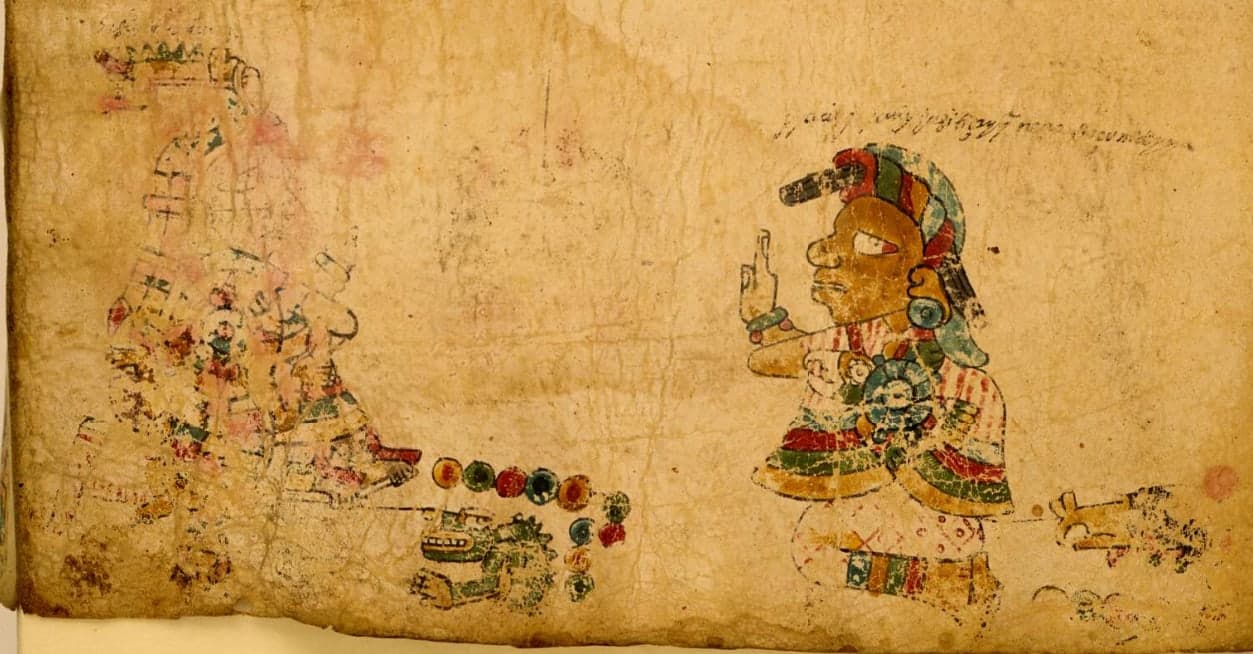
The Codex Waecker-Gotter is a manuscript made in Mexico, and it is written and illustrated in the style that was standard in central Mexican communities before Spanish forces arrived in the early sixteenth century. That style — figures in profile, year signs marked by particular glyphs, a layout that reads in directions determined by the content rather than a fixed left-to-right order — is distinctive, and it continued in use well after contact. So while the manuscript is described as Pre-Conquest-style, that phrase names a method, not necessarily a date. Codices in traditional form were still being produced decades after Spanish administration was established, sometimes on commission, sometimes as records of older material copied into new books.
The manuscript has been known by three different names, each recording a person who once owned it. Waecker-Gotter, Sanchez-Solís and Egerton are all surnames of former holders, and all three appear in the literature. The British Museum, which has held it since 1911, calls it the Codex Waecker-Gotter, but the other names persist. This multiplication of titles is common for objects that moved through private collections before entering institutional hands. Each name is a marker in the chain of ownership, and each has stuck in different scholarly contexts.
The reference number assigned by the museum — Am1962,03.8 — postdates the manuscript's arrival by half a century. It entered the collection in 1911 but was not formally accessioned under that number until 1962. The lag is not unusual. Museums acquire objects faster than they process them, and numbering systems are sometimes revised or applied retrospectively. The gap between arrival and accessioning is itself a piece of the object's institutional history, a reminder that being in a museum and being catalogued by one are not the same event.
What the manuscript contains is not detailed in the material available, and that silence is worth noting. Many codices from this period record histories, genealogies, tribute obligations or ritual calendars. Without knowing what is written or painted inside, we cannot say what function this manuscript served or what kind of knowledge it was made to preserve. That absence of detail is a limit on what can responsibly be said about it.
Why it mattered then
Manuscripts in this style were working documents. They recorded information that communities needed to keep: land boundaries, lineages, tribute owed or received, ritual dates. Some were official records, others were made for private use. The fact that this manuscript was made in Pre-Conquest style suggests it was produced within a tradition of knowledge-keeping that survived contact, whether as continuity or as deliberate revival. Communities that kept writing in traditional forms after Spanish arrival were asserting a claim to their own systems of record, even as new administrative languages and scripts were being imposed around them. The manuscript's existence, regardless of when exactly it was made, is evidence that those systems persisted.
Why it matters now
The Codex Waecker-Gotter is part of a body of material that documents how knowledge was recorded and transmitted in central Mexico, and how those practices changed or endured through colonial imposition. Manuscripts like this are studied for what they reveal about indigenous writing systems, about the continuity of traditional knowledge production, and about the ways objects moved from their places of origin into European and American collections. The fact that it has three names is itself instructive: it maps a route through private hands, and it raises questions about how and why manuscripts left Mexico and under what circumstances they were acquired by the institutions that now hold them. Those questions are live ones, and they bear on how museums describe and contextualise what they have.
The surprising detail
The manuscript has been in the British Museum since 1911, but it was not given a formal reference number until 1962. That fifty-one-year gap between arrival and accessioning is a reminder that museum cataloguing is not automatic or immediate. Objects can sit in storage, known but not yet fully processed, for decades. The delay does not mean the manuscript was ignored, but it does mean that its formal place in the collection's records came much later than its physical arrival. The reference number is not a date of acquisition; it is a date of administrative completion.
What is disputed
The date of the manuscript's creation is not recorded in the available material. It is described as Pre-Conquest-style, but that does not confirm it was made before Spanish contact. Codices in traditional style were produced both before and after conquest, and without further evidence the date remains uncertain.
How it got here
The manuscript entered the British Museum in 1911. It had previously been held by private owners, whose surnames — Waecker-Gotter, Sanchez-Solís and Egerton — are preserved in the various names by which the manuscript is known. How it left Mexico and under what circumstances it was acquired by those private collectors is not detailed in the available sources. Questions of provenance and the movement of Mexican manuscripts into European and American collections are matters of ongoing scholarly and institutional attention.
Remember this
A manuscript in Pre-Conquest style, with three names marking three former owners, now in London with a reference number applied half a century after it arrived.
Test yourself
Why does the phrase 'Pre-Conquest-style' not tell us when the manuscript was made?
Because style and date are not the same thing. Pre-Conquest-style means the manuscript uses the pictorial conventions, layout and materials that were standard in central Mexico before Spanish arrival, but codices in that style continued to be produced after contact, sometimes for decades. A manuscript can be made in traditional form long after the tradition's original context has changed. Style names a method and a set of visual choices, not a moment. To know when this manuscript was made, we would need evidence beyond the style itself — and that evidence is not recorded in the available material.
Go deeper
Image: An author from the Mixtec region c.1500, CC BY-SA 4.0. Licence: CC BY-SA 4.0. Source.