I · THE OBJECT · BRITISH MUSEUM
Obelisks of Nectanebo II
▶ Listen · narrated
These shattered monuments were made for a ruler facing the end of independent Egypt, confiscated after a military surrender, and have stood in Britain for two centuries while their ownership is debated.
At a glance
- Date
- 5th century BC
- Discovery
- 1737, Cairo
- Material
- Granite
- Current location
- British Museum, Great Court
Look closer
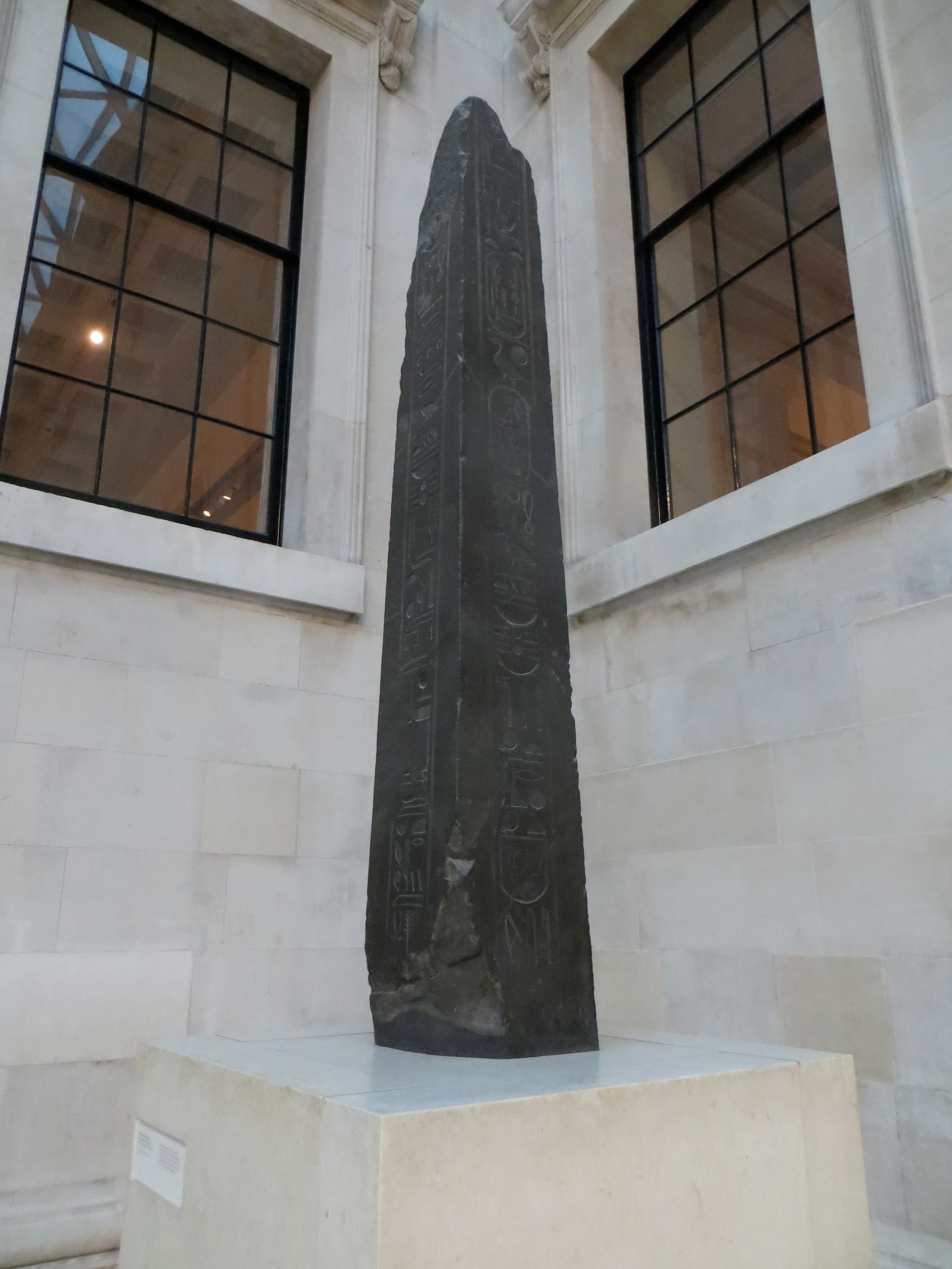
Fragmentary condition
Both obelisks are broken. They stand today as monumental fragments rather than complete needles. The damage happened before they were recovered — they were found already in pieces, reused or abandoned in Cairo, far from where they were originally erected.
Hieroglyphic inscriptions
The surfaces carry hieroglyphic texts naming Nectanebo II. These inscriptions identify the ruler who commissioned them and connect the monuments to the tradition of obelisk-carving that stretches back through Egyptian history. The hieroglyphs are carved in relief, cut into the hard granite surface.
Relocated twice
The obelisks were made for Hermopolis, a city in central Egypt. They were later moved to Cairo, where they were found in 1737. After recovery by French scholars during Napoleon's 1798 expedition to Egypt, they were confiscated by British forces and transported to England. They have been in the British Museum ever since, currently displayed in the Great Court.
The story
Nectanebo II ruled Egypt in the 5th century BC, during the final years of native Egyptian control before Persian conquest. He commissioned these obelisks for Hermopolis, a city in central Egypt known in Egyptian as Khmun and associated with the god Thoth. The monuments were carved from granite and inscribed with hieroglyphs naming the pharaoh.
Obelisks were a traditional Egyptian monument form: tall, four-sided pillars tapering to a pyramidal point, usually erected in pairs at temple entrances. They were carved from single blocks of stone and their surfaces carried inscriptions honouring gods and rulers. Nectanebo II's obelisks followed this established pattern, though they would not remain at Hermopolis.
At some point after they were erected, the obelisks were moved to Cairo. The circumstances of this relocation are not recorded. They were found there in 1737, already broken into fragments. The monuments had been separated from their original setting for an unknown length of time.
French forces under Napoleon invaded Egypt in 1798. The expedition included scholars and artists tasked with documenting Egyptian antiquities. The French recovered the obelisk fragments from Cairo and prepared to transport them to France. However, French forces were defeated by the British. Under the terms of capitulation, the British confiscated a number of antiquities that the French had collected, including these obelisks and the Rosetta Stone.
The fragments were shipped to England and entered the British Museum's collection. They have been displayed there since their arrival, currently standing in the Great Court where visitors can walk around them. The obelisks remain in fragmentary condition — they are shown as broken monuments, not restored to their original height or form.
Why it mattered then
Nectanebo II was the last native Egyptian pharaoh before Persian conquest ended independent rule. His reign represented the final decades of a tradition that stretched back thousands of years. Commissioning obelisks for Hermopolis was an act of continuity — maintaining the practices of temple-building and monument-carving that had defined Egyptian kingship. Hermopolis was a significant religious centre, associated with Thoth, the god of writing, knowledge and the moon. Erecting obelisks there reinforced the pharaoh's role as a temple patron and his connection to the divine order. The inscriptions on the monuments would have proclaimed his names and titles, making his authority visible in stone at a major cult site. The context was precarious. Egypt had already experienced periods of Persian domination, and Nectanebo II's reign would end with another invasion. The obelisks were commissioned during a time when the institutions they represented — native kingship, temple ritual, the hieroglyphic tradition — were under external threat. Whether the monuments were completed before the final Persian conquest is not recorded in the available material.
Why it matters now
The obelisks are evidence of how antiquities moved through colonial encounters. They were recovered by French scholars during Napoleon's 1798 expedition to Egypt, confiscated by British forces after a military defeat, and transported to London as spoils of war. Their presence in the British Museum is part of a larger pattern of how European institutions acquired Egyptian monuments during the 18th and 19th centuries. Egypt has requested the return of antiquities removed during this period. The obelisks, like the Rosetta Stone and other objects taken under similar circumstances, are part of ongoing discussions about museum collections and colonial history. The British Museum's position is that the objects are held in trust for the world and are accessible to an international audience in London. The Egyptian government's position is that monuments removed during foreign occupation should be returned to Egypt. The fragments also stand as reminders of Nectanebo II's reign and the end of pharaonic independence. They connect visitors to a specific historical moment — the final years of native Egyptian rule — and to the long tradition of obelisk-carving that Nectanebo II was continuing. They are broken, relocated twice, and far from where they were made, which is itself part of what they now communicate.
The surprising detail
The obelisks were confiscated as spoils of war, not excavated by the institution that now holds them. The British Museum acquired them by seizing them from French forces after a military defeat. The French had recovered the fragments in Cairo and intended to transport them to France, but the British confiscation transferred them to London instead. This means the obelisks entered the collection through a military surrender agreement, not through archaeological expedition or purchase.
What is disputed
The circumstances of the obelisks' move from Hermopolis to Cairo are not recorded. It is not known when this relocation happened, why the monuments were moved, or whether they were deliberately transported or salvaged as fragments. The original context at Hermopolis — which temple they stood before, and whether they were erected as a pair or part of a larger complex — is also unknown.
How it got here
The obelisks were recovered by French scholars during Napoleon's 1798 expedition to Egypt. After the defeat of French forces, the British confiscated them along with other antiquities, including the Rosetta Stone, under the terms of the capitulation agreement. They were transported to England and have been in the British Museum since that time. Egypt has requested the return of antiquities removed during this period. The British Museum's position is that the objects are held in trust for a global audience and are accessible to international visitors in London. The Egyptian government's position is that monuments taken during foreign occupation should be returned to Egypt.
Remember this
Two broken obelisks, made for the last native pharaoh, moved twice, and seized as spoils of war — their history of displacement is now part of what they mean.
Test yourself
Why does it matter that the obelisks were found already broken and relocated to Cairo, rather than discovered intact at Hermopolis?
Because it shows that the monuments had already been displaced and damaged within Egypt itself, long before European forces arrived. The obelisks were not removed from their original setting by the French or British — they were found in Cairo, separated from Hermopolis by an unknown chain of events. This means their history includes at least two relocations: an earlier move within Egypt, and the later confiscation and transport to London. The fragmentary condition also tells us they were broken before 1737, not damaged during recovery or transport. Understanding this sequence matters for understanding what the objects have been through, and for recognising that their story of displacement began before the colonial encounter that brought them to Britain.
Go deeper
Image: Jononmac46, CC BY-SA 4.0. Licence: CC BY-SA 4.0. Source.