I · THE OBJECT · BRITISH MUSEUM
The Swimming Reindeer
▶ Listen · narrated
Someone thirteen thousand years ago knew exactly how a reindeer holds its head when it swims, and carved that knowledge into mammoth tusk in enough detail that we can still see it.
At a glance
- Date
- 111th century BC
- Material
- Mammoth ivory
- Dimensions
- 3 × 2.7 cm
- Discovery
- Bruniquel rock shelters, 1866
- Collection
- British Museum
Look closer
Swimming posture, anatomically exact
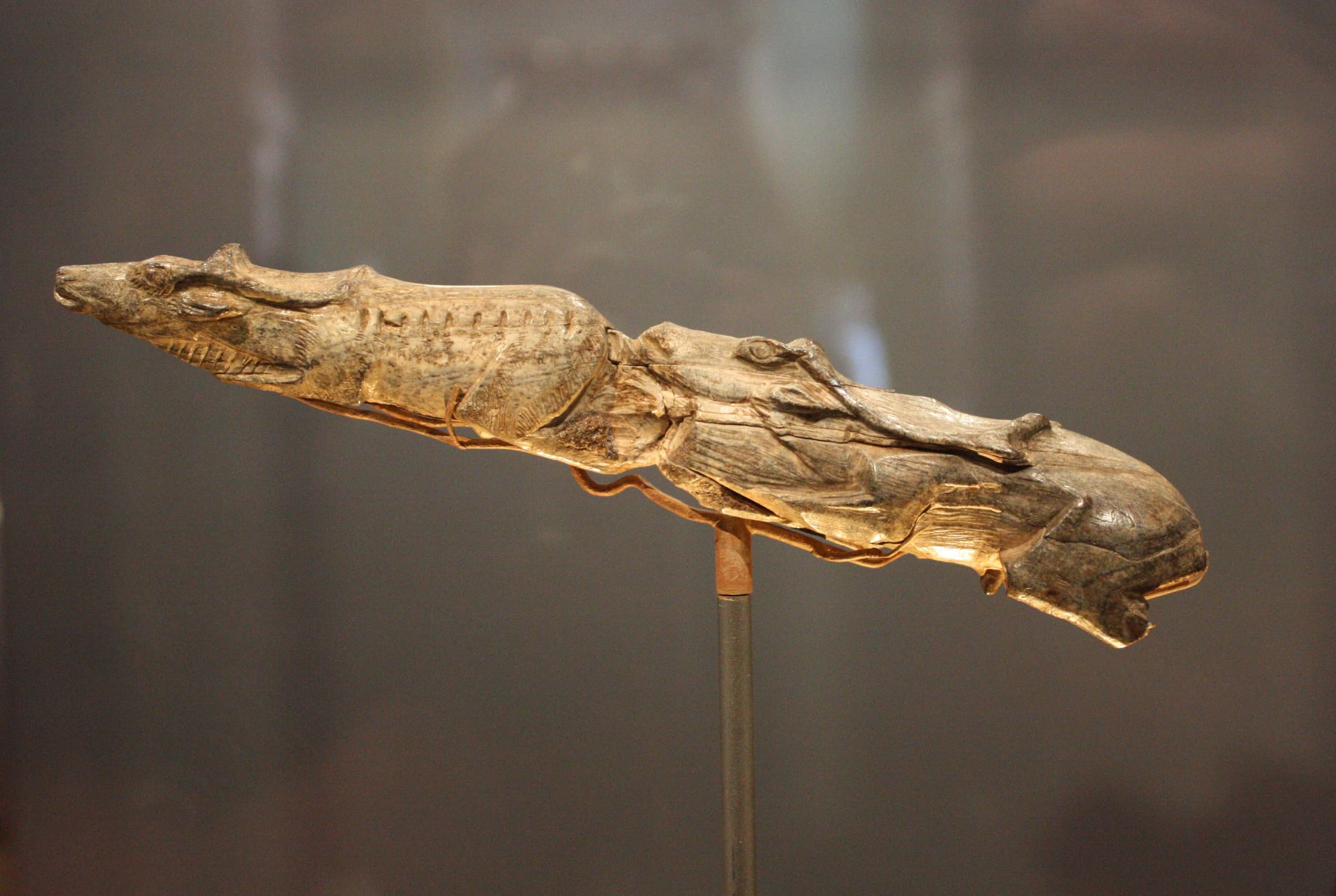
Both animals have their heads raised clear of the water, necks stretched forward, antlers laid flat along their backs — the exact posture a swimming reindeer adopts to keep its nose above the surface while its body is submerged. The legs are not visible because they would be underwater, paddling. The sculptor did not guess at this: reindeer swim rivers during seasonal migration, and someone spent enough time watching to carve the posture from memory.
Carved from the tip of a tusk
The sculpture was made from the solid tip of a mammoth tusk, not a flat section cut from the side. That gave the sculptor a naturally tapering, slightly curved form to work with — the curve echoes the animals' swimming line. Mammoth ivory is dense and fine-grained, and it takes fine detail when worked with stone tools. The tusk itself came from an animal that had been extinct in this region for thousands of years by the time the sculpture was made; the ivory was either very old when it was carved, or came from a population that survived longer elsewhere.
Found in two pieces, rejoined decades later
The sculpture was discovered in two separate pieces in 1866 at the Bruniquel rock shelters. The pieces were kept apart until 1904, when Abbé Henri Breuil — a priest and archaeologist — realised they fit together to form a single object. The break runs through the body of the rear reindeer. Once rejoined, the composition became clear: two animals swimming in line, the second following behind, as reindeer do when crossing water in a group.
The story
The sculpture is smaller than a human hand: three centimetres high, less than three wide. It was carved from the tip of a mammoth tusk sometime in the 111th century BC, during the period archaeologists call the Magdalenian, in what is now southwestern France. The artist worked with stone tools on ivory dense enough to hold fine detail, and the result is two reindeer swimming nose to tail, their heads raised, their antlers flat along their backs.
That posture is specific. A swimming reindeer keeps its nose clear of the water while its body is submerged, and it lays its antlers back to reduce drag. The legs are underwater, paddling, so the sculptor did not carve them — what you see is what would be visible from the bank. The observation is exact enough that it must have come from sustained watching, not imagination. Reindeer swim during seasonal migration, crossing rivers as they move between feeding grounds, and someone in the Magdalenian spent enough time near water to know how they hold themselves when they do it.
The sculpture was found in two pieces in 1866, during excavations at the Bruniquel rock shelters. The pieces were separated, and it was not until 1904 that Abbé Henri Breuil, working through collections, realised they belonged together. The break runs through the body of the rear animal. Once rejoined, the composition became legible: not two unrelated carvings, but a single scene of two reindeer in line, one following behind the other as they cross water together.
The ivory itself is mammoth tusk, not reindeer antler or bone. Mammoths had been absent from this part of Europe for some time by the 111th century BC, so the tusk was either very old when it was carved — a piece of ivory passed down or scavenged from much earlier remains — or it came from a population that survived longer in another region and was traded or carried to Bruniquel. Either way, the material was not local or recent, which suggests it was valued.
The scale is small enough that the object could be held in one hand, and the curve of the tusk has been left in the finished piece — it echoes the line of the swimming animals. The carving is three-dimensional, worked in the round, and the detail is fine: the antlers are individually delineated, the musculature of the neck is modelled, the posture is consistent across both figures. Whoever made this had both the skill to work ivory with stone tools and the patience to render something they had watched closely.
Why it mattered then
The sculpture records sustained observation of animal behaviour, which implies sustained proximity. Reindeer migrate seasonally, and their movements structure the year for people who follow them: when they cross water, where they feed, when they calve. Carving two reindeer swimming suggests that the moment mattered — not as a single event, but as a recurring one, predictable and significant enough to be worth recording in a material that was difficult to obtain and difficult to work. The choice of mammoth ivory, rather than reindeer antler or bone, is also meaningful. Antler was abundant and renewable; mammoths were not. Using ivory that was either very old or traded from elsewhere signals that the object was made to last, or to be kept, or to carry weight beyond its size. The detail and the scale together suggest something portable and deliberate, possibly made to be carried or exchanged, possibly tied to knowledge about migration routes or seasonal movements. The fact that two animals are shown together, in line, also matters. Reindeer swim in groups, not singly, and the composition captures that social behaviour. It is not a generalised image of a reindeer; it is a specific observation of how they move through water together. That kind of specificity suggests the sculptor's knowledge was practical, not decorative.
Why it matters now
The sculpture is evidence of sustained, detailed observation of the natural world thirteen thousand years ago. It shows that people in the Magdalenian were not simply hunting animals or using them; they were watching them closely enough to understand their behaviour, to remember it, and to render it accurately in three dimensions on a piece of ivory smaller than a palm. That challenges any assumption that early art is symbolic or abstract by default. This is not a stylised reindeer or a ritual image; it is an anatomically exact record of a swimming posture, carved by someone who knew what they were looking at. It suggests that observation, memory and skill were all present, and that the boundary between practical knowledge and art — if there was one — was not the boundary we assume. The sculpture also survives as a reminder that objects we now see as art may have had other purposes in their own time. It is small enough to carry, specific enough to teach, detailed enough to be a record. Whether it was made to be kept, exchanged, or used in some way we no longer understand, it was made by someone who had spent time watching reindeer swim, and who thought that knowledge was worth preserving.
The surprising detail
The sculpture was found in two separate pieces in 1866, and the pieces were kept apart for thirty-eight years before anyone realised they belonged together. It was Abbé Henri Breuil, working through collections in 1904, who saw that the break surfaces matched and that the two fragments formed a single composition. Until that moment, they were catalogued as two unrelated carvings. The break runs through the body of the rear reindeer, and once the pieces were rejoined, the scene became clear: two animals swimming nose to tail, exactly as reindeer do when crossing water in a group. The sculpture had been incomplete in museum storage for nearly four decades before anyone understood what it was.
What is disputed
The ivory is mammoth tusk, but mammoths were no longer present in southwestern France by the 111th century BC. The tusk was therefore either very old when it was carved — scavenged from remains that had lain in the ground for thousands of years — or it was obtained through trade or travel from a region where mammoths survived longer. The evidence does not settle which, though the care taken in the carving suggests the material was valued.
How it got here
The sculpture was excavated from the Bruniquel rock shelters in 1866 and entered museum collections in France. It is now held by the British Museum. The circumstances of its transfer from France to Britain are not detailed in the available records.
Remember this
Someone thirteen thousand years ago watched reindeer swim often enough to carve their exact posture from memory, in ivory, on an object smaller than a hand.
Test yourself
The sculptor carved two reindeer swimming nose to tail, with their antlers laid flat along their backs. Why is that posture significant?
Because it is the exact posture a swimming reindeer adopts to keep its head above water while minimising drag. The antlers are laid back, the neck is stretched forward, and the legs — which would be underwater, paddling — are not shown because they would not be visible from the bank. The sculptor did not invent or stylise this; they observed it. That level of anatomical accuracy means the artist had watched reindeer swim repeatedly, understood the behaviour, and remembered it well enough to carve it in three dimensions on a piece of ivory. It is evidence of sustained, practical knowledge of animal behaviour, rendered as art.
Go deeper
Image: CC BY-SA 2.0. Licence: CC BY-SA 2.0. Source.