I · THE OBJECT · BRITISH MUSEUM
The Ain Sakhri Lovers
▶ Listen · narrated
Someone in the tenth millennium BC sat down with a calcite pebble and a stone tool and carved two people holding one another. It still fits in your hand.
At a glance
- Date
- 9th millennium BC
- Material
- Calcite
- Found
- Ain Sakhri caves
- Collection
- British Museum
Look closer
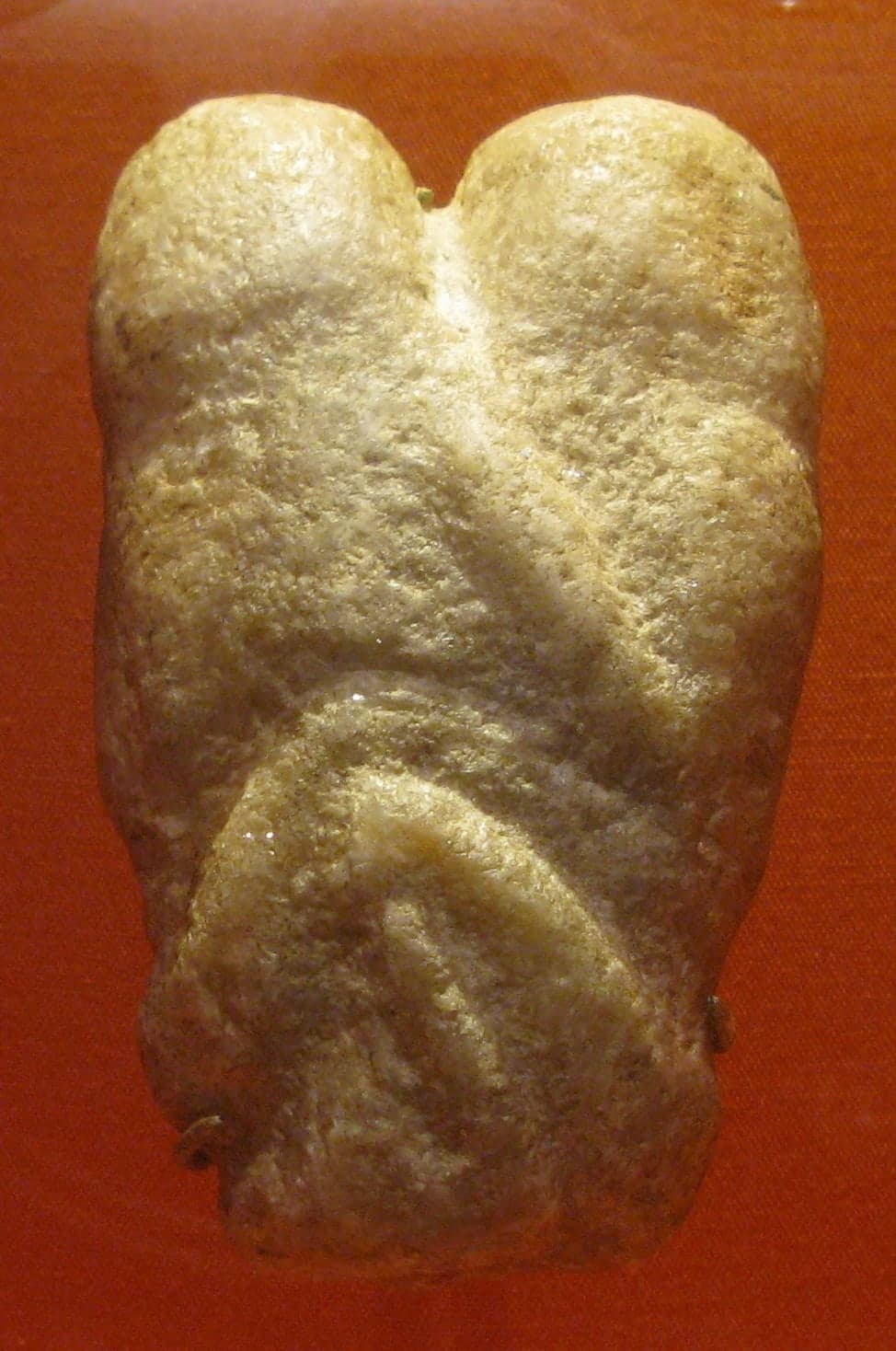
The figures share a single body below the shoulders
The carving does not show two separate bodies pressed together. Below the heads and shoulders, the stone reads as a single mass. The legs are not distinguished from one another — there are no gaps, no individual limbs. What you see instead is a continuous form that suggests two figures merging. The effect depends on how you hold it: rotate the piece and different parts resolve into faces, arms, the curve of a back.
It was made to be turned
The sculpture has no front. Every angle offers a different reading of the embrace. From one side you see what might be a face; turn it and that face becomes a shoulder, or the back of a head. The carver worked the stone so that the relationship between the two figures stays legible no matter how you orient it. That takes planning — you cannot add that quality after the fact by smoothing the surface. The form had to be conceived as something that would be handled and rotated.
The calcite is a warm brown, and polished
Calcite can be translucent, white, or — as here — a pale brown. The surface has been worked smooth. Whether that polish came from the maker's final passes with an abrasive or from millennia of handling is not recorded. The stone is small enough to close your fingers around, and the form invites it: there are no projections to snap off, no delicate detail that would suffer from touch.
The story
The Ain Sakhri figurine was found in one of the caves near Bethlehem that give it its name. It is a sculpture in calcite, carved in the ninth millennium BC by someone in the Natufian culture — a group of people living in the eastern Mediterranean region in the period just before farming.
The Natufians are named after a site, not a language or a nation. What links them is a way of life that shows up in the archaeological record across the Levant between roughly twelve thousand and ten thousand years ago. They did not farm, but they were not fully nomadic either. They built stone structures, some of them substantial. They harvested wild grains intensively enough to develop tools — sickle blades, grinding stones — that only make sense if you are processing cereals in quantity. They buried their dead with care, sometimes with ornaments. The settlement pattern suggests people who returned to the same places season after season, even if they moved between them.
That way of life — settled enough to accumulate objects, to invest labour in a home site, to bury people in a place you expect to come back to — is part of the context for this carving. A figurine this size is portable, but it is not something you make if your possessions are limited to what you can carry every day. It represents labour: hours of pecking, grinding, and polishing stone with stone. The calcite would have been chosen deliberately — it is soft enough to work without metal tools, but it still takes time.
The subject is two figures in an embrace. The heads are visible, tilted toward one another. Arms curve around shoulders. Below that, the bodies are not separated. The carving does not distinguish legs or torsos in the way a later sculptor might. What it does instead is create a form that reads as two people joined, and it does this from every angle. Turn it in your hand and the embrace holds. A curve that looked like a back becomes a face; what seemed like an arm resolves into a shoulder. The piece has no fixed front or back.
That quality — the fact that it was designed to be rotated and handled — is not incidental. It tells you something about how the maker thought about the object. This was not a carving meant to sit on a surface or stand in a niche. It was made for the hand.
What the carving meant to the person who made it, or to the people who kept it, is not recorded. The embrace is explicit enough that many descriptions call it a depiction of sexual intercourse, though the abstraction of the lower body leaves room for interpretation. What is clear is that someone chose to spend time making a sculpture of two people holding one another, and chose to make it in a way that required you to turn it, to handle it, to see it from multiple sides.
The Natufian period ended when farming began. Within a few centuries of this carving, people in the same region were planting crops, building permanent villages, and living in ways that would lead to cities, to writing, to the long historical record. This figurine comes from the edge of that shift, from a moment when people were settled enough to make things like this but still living on wild resources.
Why it mattered then
The Natufian way of life was not stable over the long term — it gave way to farming within a relatively short time — but while it lasted, it was a way of living that allowed for things beyond immediate subsistence. The figurine is evidence of that margin. Someone had time to carve it. Someone valued it enough to keep it, or it would not have survived to be found thousands of years later. The subject itself — two people embracing — suggests that relationships between people were considered worth depicting. That is not a given in the archaeological record of this period. Most Natufian art, where it survives, is geometric or abstract. Figurative carving of any kind is uncommon. A sculpture of two people together, carved in a way that emphasises their connection rather than their individuality, is rarer still. The care taken in making the piece readable from every angle also tells you something. This was not a quick sketch or a casual object. The maker thought about how it would be experienced — not just looked at, but held and turned. That implies an audience, or at least an expectation that the object would be handled by others. Whether it had a ritual function, or was a personal possession, or meant something else entirely, is not known. What is clear is that it mattered enough to make well.
Why it matters now
The figurine is held by the British Museum. How it arrived there is not fully documented in the available material. It was found in the Ain Sakhri caves, but the circumstances of the find, the year, and the route by which it entered the collection are not detailed in the records at hand. What makes it significant now is not its age alone, though the date places it in a period from which very little figurative art survives. It is the subject and the execution together. The carving is a depiction of intimacy, made in a way that requires you to engage with it physically. You cannot see what it is from a single glance. You have to turn it. That quality — the need to handle it to understand it — is preserved in the object itself, even though it now sits behind glass. It also sits at a point in human history that is hard to reconstruct. The Natufians left no writing. What we know about them comes from stone tools, from the layout of their sites, from the bones of the animals they ate and the seeds they gathered. A figurine like this is rare evidence of how people thought about one another, or at least what they chose to depict. It is one of very few surviving images of human connection from a time before farming, before cities, before any of the structures we associate with civilization. That it was made to be held matters. It is a reminder that art is not always about display. Some objects are made for the hand, for private experience, for a kind of attention that requires touch. The figurine still asks for that, even if museum visitors can no longer give it.
The surprising detail
The sculpture is small enough to hold in one hand — the exact dimensions are not given in the material, but it is described as fitting comfortably in the palm. That scale is part of its function. It was not made to be seen from a distance, or to impress through size. It was made to be picked up, turned, examined closely. The intimacy of the subject matches the intimacy of the object itself.
What is disputed
The exact circumstances of the find are not detailed in the available records. The figurine is described as having been found in the Ain Sakhri caves, but the date of discovery, the excavation context, and how it came to the British Museum are not specified in the material at hand.
How it got here
The figurine was found in the Ain Sakhri caves near Bethlehem and is now held by the British Museum. The details of how and when it entered the collection are not provided in the available documentation.
Remember this
A carving made to be held and turned, from a time when people were settled enough to make art but still lived by gathering wild grain.
Test yourself
The Natufians were not farmers, but the figurine comes from a period often called the threshold of agriculture. What about their way of life made that threshold possible?
They harvested wild cereals intensively and returned to the same sites season after season, which meant they were familiar with the plants and had reason to stay near them. That combination — knowing the growth cycle of wild grains and being settled enough to observe it year after year — is what lets you notice which seeds grow best, which plants yield more, and eventually to start planting deliberately. Nomadic groups move too often to see those patterns through. Fully settled farmers have already made the leap. The Natufians were in between: settled enough to watch, mobile enough that they had not yet committed. The figurine comes from that in-between moment, when people had the stability to make objects that required time and care, but had not yet reorganised their lives around planted fields.
Go deeper
Image: Geni, CC BY-SA 4.0. Licence: CC BY-SA 4.0. Source.